-
Glass Fused To Steel Tanks (896)
-
Stainless Steel Tanks (434)
-
Fusion Bonded Epoxy Tanks (660)
-
Galvanized Steel Tanks (321)
-
Aluminum Dome Roofs (1336)
-
Wastewater Storage Tanks (280)
-
Welded Steel Tanks (457)
-
Pressure Vessels (451)
-
Anaerobic Digester (202)
-
Industrial Water Tanks (364)
-
Glass Lined Steel Tanks (180)
-
Bolted Steel Tanks (389)
-
Sludge Storage Tank (115)
-
Biogas Storage Tank (173)
-
Leachate Storage Tanks (133)
-
Agricultural Water Storage Tanks (179)
-
Fire Water Tank (166)
-
Grain Storage Silos (146)
-
Biogas Projects (424)
-
Wastewater Treatment Projects (1752)
-
Double Membrane Roof (223)

|
TES Tank Guide: What to Specify From Thermocline to Diffuser
| Place of Origin: | CHINA |
| Brand Name: | CEC TANKS |
| Certification: | ISO 9001:2008, AWWA D103 , OSHA , BSCI |
| Model Number: | W20180508003 |
| Minimum Order Quantity: | 1 SET |
| Price: | $5000~$20000 one set |
| Packaging Details: | PE poly-foam between each two steel plates;wooden pallets and wooden box |
| Delivery Time: | 10-30 days after deposit received |
| Payment Terms: | L/C,T/T |
| Supply Ability: | 60 sets per month |
|
Detail Information |
|||
| Place of Origin | CHINA | Brand Name | CEC TANKS |
|---|---|---|---|
| Certification | ISO 9001:2008, AWWA D103 , OSHA , BSCI | Model Number | W20180508003 |
| Coating Color: | Dark Green, Or Customizing Colors | Coating Thickness: | 0.25~0.40mm, Double Coating |
| Acid And Alkalinity Proof: | Standard Coating Suits For PH3 - PH11, Special Coating Suits For PH1 - PH14 | Adhesion: | 3,450N/cm |
| Hardness: | 6.0 Mohs | Holiday Test: | >1500V |
| Installation: | By Jacking Machine Or Steel Pole, Fast In Installation | Permeability: | Gas / Liquid Impermeable |
| Foundation: | Concrete Or Glass Fused Steel | Steel Grade: | ART 310 |
| Applications: | Water , Waste Water, Digester , Reactor , Grain , Sludge , Chemicals | Highlight: | industrial water tanks thermocline,TES tank diffuser specification,thermal energy storage tanks |
Product Description
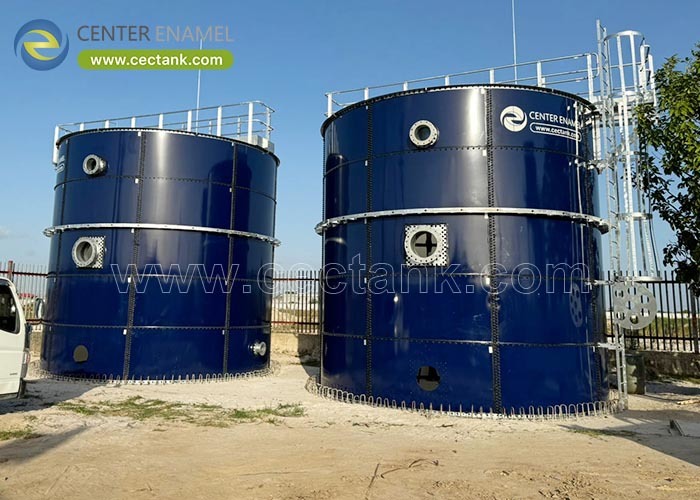
This TES tank guide lists what to specify: storage volume from the peak deficit and reserve hours, the supply-to-return temperature difference, diffuser design targeting an inlet Froude at or below about 0.5, insulation with a vapour barrier, the shell class (AWWA D103 bolted or ASME VIII pressurized) and material (GFS/FBE/stainless), plus BMS integration. Center Enamel has no published TES delivery; its large-bolted-vessel builds are cited as shell-capability evidence only. The guide complements, not duplicates, the company's existing technical pages.
This guide lists what to specify on a TES tank, from thermocline to diffuser. Start with the duty: storage volume, temperature swing, charge and discharge flow, and loop pressure, which set the shell class and diffuser performance. Specify the thermocline sharpness target and the multi-depth sensor layout that proves it. Choose the shell - bolted GFS, FBE, stainless or welded - by water chemistry and pressure, with insulation and vapour barrier matched to the climate and trace heating where freeze risk exists. Confirm the applicable standard: AWWA D103 and ISO 28765 for bolted tanks, ASME Section VIII for pressurized shells, and NSF/ANSI 61 or WRAS where contact water applies. Center Enamel has no published TES delivery; its large-bolted-vessel record is cited as capability evidence only.
Start from the cooling deficit: the peak load the tank must cover, and the hours of reserve (ride-through plus load shift). Convert that to a water volume using the temperature difference. Specifying total daily load rather than peak deficit is the classic oversizing error and should be avoided.
- Peak deficit times reserve hours = stored cooling.
- Convert to volume via the temperature difference.
- Do not size to total daily load.
- Reserve = ride-through plus load shift.
The supply-to-return delta T is the lever that sets volume: a wider delta T stores more per cubic metre but may stress the loop. A common chilled-water band is roughly 4 to 6 deg C. State the required delta T in the spec so vendors size honestly rather than assuming a favourable number.
- Typical chilled-water delta T: ~4-6 deg C.
- Wider delta T = more storage per volume.
- State delta T to force honest sizing.
- Balance against loop and coil constraints.
The diffuser is the component that decides realized efficiency. Specify an inlet Froude at or below about 0.5 and require the vendor to design it from your actual flow rate, not a catalogue value. Ask for the expected thermocline thickness and the guaranteed usable-volume fraction.
- Inlet Froude at or below ~0.5.
- Design from actual flow, not a catalogue.
- Require stated thermocline thickness.
- Require guaranteed usable-volume fraction.
For chilled duty, specify polyurethane or mineral wool with a climate-matched vapour barrier, and freeze protection (trace heating or glycol) where any loop section can approach freezing. Name the acceptable heat-gain rate so the tank performs, not just stands.
- PU or mineral wool with vapour barrier.
- Climate-matched specification.
- Trace heating or glycol for freeze risk.
- Name an acceptable heat-gain rate.
State the shell class (atmospheric bolted per AWWA D103 / ISO 28765, or ASME VIII pressurized) and the material (GFS, FBE, stainless, or welded carbon steel) from the water chemistry and pressure class. Require contact-water certifications (NSF/ANSI 61, WRAS) where applicable.
- Atmospheric bolted AWWA D103 / ISO 28765.
- Pressurized ASME Section VIII.
- Material from chemistry: GFS/FBE/stainless/CS.
- NSF/ANSI 61, WRAS where contact applies.
Honest boundary: Center Enamel has no published thermal-energy-storage or data-center TES delivery in its verified project record. The references above (Namibia 44,900 m3 GFS drinking water, 2022; Cilincing 21,088 m3; Sardinia 30,549 m3) are cited strictly as large-diameter bolted-vessel manufacturing-capability evidence, not as TES or data-center projects. No TES project result, dimension or client is claimed.
| Parameter | Value | Note |
| Company | Shijiazhuang Zhengzhong Technology (Center Enamel) | GFS tank manufacturer since 2008 |
| Manufacturing system | Bolted GFS / FBE / stainless / galvanized + ASME Sec VIII vessels | Same plant builds all families |
| Capability reference | Namibia drinking-water 44,900 m3 (2022); diameter/height Not Provided | GFS bolted; cited as large-vessel capability, NOT a TES project |
| Other verified large builds | Cilincing Indonesia 21,088 m3 (2024); Sardinia 30,549 m3 (2025) | Water / process duty; not TES |
| Standards | AWWA D103, ISO 28765, EN 1090, ASME VIII, NSF/ANSI 61, WRAS | Where potable or indirect-potable contact applies |
| Scale | >30,000 installed projects; 100+ countries; up to 60,000 m3 single tank | Public company facts |
Storage volume from the peak deficit and reserve hours, the supply-to-return temperature difference, diffuser Froude at or below about 0.5, insulation with a vapour barrier, shell class and material, and BMS integration.
Size to the peak cooling deficit and the reserve hours, not to total daily load. Oversizing to daily load adds cost and footprint with little proportional benefit.
An inlet Froude at or below about 0.5, designed from your actual flow rate, with a stated thermocline thickness and guaranteed usable-volume fraction.
Polyurethane or mineral wool with a climate-matched vapour barrier, plus freeze protection (trace heating or glycol) where any loop section can approach freezing.
Atmospheric bolted per AWWA D103 / ISO 28765 or ASME VIII pressurized, in GFS, FBE, stainless or welded carbon steel, chosen from chemistry and pressure class.
Honest boundary: Center Enamel has no published thermal-energy-storage or data-center TES delivery in its verified project record. The references above (Namibia 44,900 m3 GFS drinking water, 2022; Cilincing 21,088 m3; Sardinia 30,549 m3) are cited strictly as large-diameter bolted-vessel manufacturing-capability evidence, not as TES or data-center projects. No TES project result, dimension or client is claimed.
NSF/ANSI 61 and WRAS where the water is potable or indirectly potable; AWWA D103 and ISO 28765 for the bolted tank structure.
Charge and discharge while multi-depth sensors confirm the thermocline forms and holds; hydrotest per AWWA or ASME before handover.
The diffuser design basis, guaranteed usable volume, thermocline thickness, heat-gain rate, and the commissioning proof - not just the shell price.
A TES tank specification should state storage volume from the peak deficit and reserve hours, the temperature difference, diffuser Froude at or below about 0.5, insulation with a vapour barrier, shell class (AWWA D103 bolted or ASME VIII pressurized) and material, plus BMS integration. Buyers should demand the diffuser design basis and commissioning proof, not just a shell price. Center Enamel supplies the bolted GFS, FBE, stainless and ASME vessel families behind the shell, with its large-water builds cited as capability evidence, not as TES deliveries.