-
Glass Fused To Steel Tanks (896)
-
Stainless Steel Tanks (434)
-
Fusion Bonded Epoxy Tanks (660)
-
Galvanized Steel Tanks (321)
-
Aluminum Dome Roofs (1336)
-
Wastewater Storage Tanks (280)
-
Welded Steel Tanks (457)
-
Pressure Vessels (451)
-
Anaerobic Digester (202)
-
Industrial Water Tanks (364)
-
Glass Lined Steel Tanks (180)
-
Bolted Steel Tanks (389)
-
Sludge Storage Tank (115)
-
Biogas Storage Tank (173)
-
Leachate Storage Tanks (133)
-
Agricultural Water Storage Tanks (179)
-
Fire Water Tank (166)
-
Grain Storage Silos (146)
-
Biogas Projects (424)
-
Wastewater Treatment Projects (1752)
-
Double Membrane Roof (223)
|
How to Install a TES Tank: Foundation Erection and Commissioning
| Place of Origin: | CHINA |
| Brand Name: | CEC TANKS |
| Certification: | ISO 9001:2008, AWWA D103 , OSHA , BSCI |
| Model Number: | W20180508003 |
| Minimum Order Quantity: | 1 SET |
| Price: | $5000~$20000 one set |
| Packaging Details: | PE poly-foam between each two steel plates;wooden pallets and wooden box |
| Delivery Time: | 10-30 days after deposit received |
| Payment Terms: | L/C,T/T |
| Supply Ability: | 60 sets per month |
|
Detail Information |
|||
Product Description
Installing a TES tank runs: survey and foundation (ring-wall or slab from geotech), shell erection (bolted panels or welded shell), diffuser/nozzle fit, insulation with vapour barrier, hydrotest, then charge-discharge commissioning that proves the thermocline. Bolted erection is faster on site than welded. Center Enamel has no published TES delivery; its large-bolted-vessel builds show erection capability, cited as evidence only. This article adds a detailed checklist to the existing guide.
Installing a TES tank runs from a geotech-based foundation through shell erection, diffuser and nozzle fit, insulation with a vapour barrier, hydrotest, and finally stratified commissioning that proves the thermocline. Bolted panel kits erect faster on site than welded shells and suit large diameters; either way coating and plate quality are verified before the shell closes. The commissioning step, charge and discharge with multi-depth sensors, is where design intent is proven, and skipping it hides mixing losses that quietly shrink usable volume. The repeated failures are a rushed foundation, uncoated or damaged panels, a generic diffuser that ignores site flow, abbreviated commissioning, and missing documentation. A written checklist with independent inspection at every stage turns a good design into a performing asset. Center Enamel has no published TES delivery; its large-bolted-vessel builds show erection capability cited as evidence only.
Begin with a survey tied to the geotech report: a ring-wall or slab foundation, checked for level, sized to carry the full water weight (a 10,000-gallon tank exceeds 80,000 pounds full). Poor foundations cause settlement and joint stress, so this step is not skippable.
- Geotech-based ring-wall or slab.
- Survey and level check.
- Sized for full water weight.
- Settlement here ruins joints later.
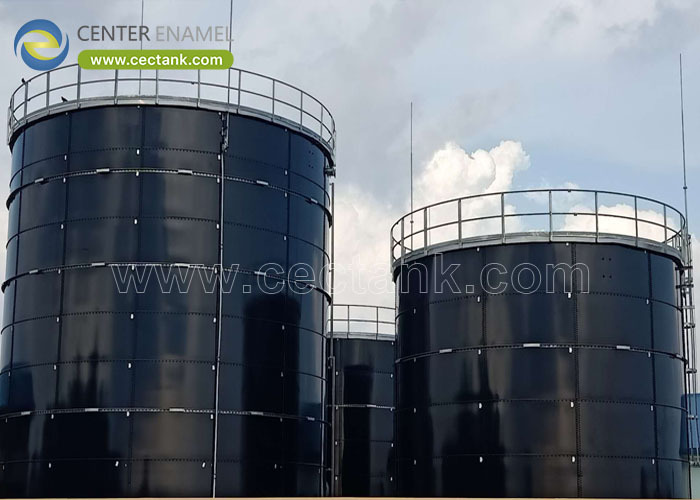
A bolted shell erects from containerised panels with torque-controlled fastening and gasketed joints; a welded shell ships as plates or a field-welded unit. Bolted construction shortens the critical path and suits large diameters. Either way, panel/plate quality and coating are verified before the shell closes.
- Bolted: panels, torque control, gaskets.
- Welded: plates or field-welded shell.
- Bolted is faster on site for large diameters.
- Verify coating/plate before closing.
The diffuser manifold and nozzles are set to the hydraulic design, then insulation (PU or mineral wool) with a vapour barrier is applied for chilled duty, with trace heating or glycol where any exposed loop can approach freezing. All water-contact surfaces are verified clean before fill to protect stratification and hygiene.
- Diffuser/nozzles to hydraulic design.
- Insulation + vapour barrier for chilled duty.
- Trace heating/glycol for freeze risk.
- Clean water-contact surfaces before fill.
The tank is filled and hydrotested per the applicable AWWA or ASME standard, then charged and discharged while multi-depth sensors confirm the thermocline forms and holds. Only after stratification is verified is the tank handed to operations - this is the step where design intent is proven, and skipping it hides mixing losses.
- Hydrotest per AWWA or ASME.
- Charge/discharge with multi-depth sensors.
- Confirm thermocline forms and holds.
- Hand over only after stratification proof.
The repeated failures are a rushed foundation, uncoated or damaged panels, a generic diffuser that ignores site flow, and skipped commissioning. Each quietly erodes usable volume or shortens life; the checklist exists to stop them before handover.
- Rushed or unlevel foundation.
- Uncoated or damaged panels accepted.
- Generic diffuser ignoring site flow.
- Commissioning skipped or abbreviated.
- No documented torque or gasket batch records at each lift.
- Shell closed without independent inspection sign-off.
- Thermal imaging of joints skipped after first fill.
- Commissioning run too short to confirm a stable sharp thermocline.
- Freeze-protection and trace-heating checks omitted on exposed loops.
Honest boundary: Center Enamel has no published thermal-energy-storage or data-center TES delivery in its verified project record. The references above (Namibia 44,900 m3 GFS drinking water, 2022; Cilincing 21,088 m3; Sardinia 30,549 m3) are cited strictly as large-diameter bolted-vessel manufacturing-capability evidence, not as TES or data-center projects. No TES project result, dimension or client is claimed.
Parameter |
Value |
Note |
Company |
Shijiazhuang Zhengzhong Technology (Center Enamel) |
GFS tank manufacturer since 2008 |
Manufacturing system |
Bolted GFS / FBE / stainless / galvanized + ASME Sec VIII vessels |
Same plant builds all families |
Capability reference |
Namibia drinking-water 44,900 m3 (2022); diameter/height Not Provided |
GFS bolted; cited as large-vessel capability, NOT a TES project |
Other verified large builds |
Cilincing Indonesia 21,088 m3 (2024); Sardinia 30,549 m3 (2025) |
Water / process duty; not TES |
Standards |
AWWA D103, ISO 28765, EN 1090, ASME VIII, NSF/ANSI 61, WRAS |
Where potable or indirect-potable contact applies |
Scale |
>30,000 installed projects; 100+ countries; up to 60,000 m3 single tank |
Public company facts |
Survey and foundation, shell erection (bolted or welded), diffuser/nozzle fit, insulation with vapour barrier, hydrotest, then charge-discharge commissioning that proves the thermocline.
It is driven by foundation and shell size; bolted panel kits are fastest on site because they avoid field welding, but the foundation and commissioning set the real schedule.
Commissioning proves the thermocline forms and holds; without it, mixing losses that quietly shrink usable volume are never caught before handover.
Fill and pressure-test per the applicable AWWA or ASME standard before the tank enters service.
Rushed foundations, accepting uncoated or damaged panels, a generic diffuser that ignores site flow, and skipping or abbreviating commissioning.
Honest boundary: Center Enamel has no published thermal-energy-storage or data-center TES delivery in its verified project record. The references above (Namibia 44,900 m3 GFS drinking water, 2022; Cilincing 21,088 m3; Sardinia 30,549 m3) are cited strictly as large-diameter bolted-vessel manufacturing-capability evidence, not as TES or data-center projects. No TES project result, dimension or client is claimed.
Polyurethane or mineral wool with a climate-matched vapour barrier, plus trace heating or glycol where any loop section can approach freezing.
Bolted shells suit atmospheric duty and fast erection; welded suits pressurized or seamless needs. The shell class follows the loop pressure and duty.
Hydrotest and structure follow AWWA D103 / ISO 28765 for bolted tanks and ASME Section VIII for pressurized shells; commissioning follows the project specification.
Installing a TES tank runs from a geotech-based foundation through shell erection, diffuser and nozzle fit, insulation with a vapour barrier, hydrotest, and finally stratified commissioning that proves the thermocline. Bolted erection is faster than welded for large diameters, and commissioning is the step that turns design intent into a performing asset. Center Enamel supplies the bolted GFS, FBE, stainless and ASME vessel families behind the shell and has no published TES delivery; its large-water builds are cited as capability evidence only.
Suggested CTA: Request Center Enamel's installation and commissioning checklist matched to your foundation and shell class.