-
Glass Fused To Steel Tanks (896)
-
Stainless Steel Tanks (434)
-
Fusion Bonded Epoxy Tanks (639)
-
Galvanized Steel Tanks (321)
-
Aluminum Dome Roofs (1336)
-
Wastewater Storage Tanks (280)
-
Welded Steel Tanks (457)
-
Pressure Vessels (310)
-
Anaerobic Digester (202)
-
Industrial Water Tanks (349)
-
Glass Lined Steel Tanks (180)
-
Bolted Steel Tanks (389)
-
Sludge Storage Tank (115)
-
Biogas Storage Tank (173)
-
Leachate Storage Tanks (133)
-
Agricultural Water Storage Tanks (179)
-
Fire Water Tank (166)
-
Grain Storage Silos (146)
-
Biogas Projects (424)
-
Wastewater Treatment Projects (1670)
-
Double Membrane Roof (223)

|
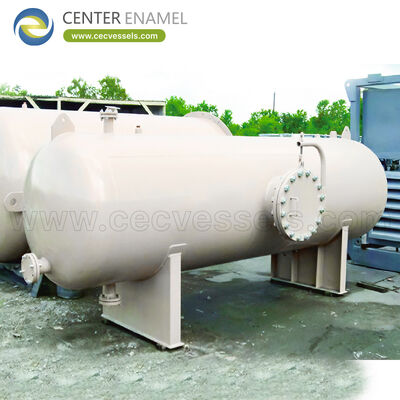
China Wastewater Treatment Pressure Vessel Manufacturer Delivering Advanced Containment Solutions And Process Stability For Industrial Water Management
| Place of Origin: | China |
| Brand Name: | Center Enamel |
| Certification: | ISO 9001,CE, NSF/ANSI 61, WRAS, ISO 28765, LFGB, BSCI, ISO 45001 |
| Minimum Order Quantity: | 1 Sets |
| Price: | 2000 |
| Delivery Time: | 2 months |
| Payment Terms: | L/C,T/T |
| Supply Ability: | 200 sets / days |
|
Detail Information |
|||
Product Description
China Wastewater Treatment Pressure Vessel Manufacturer Delivering Advanced Containment Solutions And Process Stability For Industrial Water Management
Wastewater treatment pressure vessels are the pressurized process components inside water-management trains: dissolved-air flotation (DAF) units, anaerobic digestion gas holders and pressurized buffer or reaction vessels. They contain process streams safely while stabilizing flow and treatment.
A China wastewater treatment pressure vessel manufacturer must deliver containment that resists corrosive, often biological media and supports the process stability that downstream discharge or reuse limits require.
This article defines the equipment, explains how it supports process stability, reviews design and material choices, covers applications, and sets out buyer acceptance criteria.
What A Wastewater Pressure Vessel Is
Unlike atmospheric treatment tanks, these are code-rated pressure vessels inside the water line: DAF contact and separation vessels operating at a few bar, anaerobic digester gas storage at low pressure, and pressurized reaction or buffer drums.
They are judged both as pressure boundaries and as process equipment - the internal hydraulics and gas handling matter as much as the shell rating.
How It Supports Process Stability
DAF vessels use pressurized saturator water to release micro-bubbles that lift suspended solids; stable saturator pressure is what makes floatation consistent. Buffer and reaction vessels decouple variable influent from steady treatment.
Digester gas holders accommodate biogas volume swings so combustion or flaring stays stable. In each case the vessel smooths a variable process into a controllable one.
- Pressure control: saturator and gas-holder pressure setpoints are central to performance.
- Containment: the pressure boundary prevents release of odorous or hazardous process gas.
Key Design And Material Considerations
Wastewater is corrosive and biologically active; stainless steel or lined carbon steel is common, with material chosen against the specific stream (pH, chlorides, H2S). Internal coatings and cathodic protection may be specified.
Gas-side components need flash-arrest and ventilation consideration; nozzles and access must suit both process and inspection. The code basis is usually ASME, EN 13445 or GB depending on destination.
- Corrosion strategy: material plus coating plus allowance, set per stream chemistry.
- Access: manways and clean-out openings enable maintenance without dismantling.
Application Scenarios
Industrial effluent clarification (DAF), anaerobic digestion for sludge and high-strength wastewater, and pressurized equalization or reaction steps are typical. They serve food, beverage, chemical and municipal-industrial water management.
The common need is reliable containment of a variable, sometimes hazardous stream while the process stays stable enough to meet limits.
- DAF: removes suspended solids and fats ahead of biological treatment.
- Digester gas: stores biogas safely against load swings.
Selection Criteria For Buyers
Define the process duty (flow, pressure, temperature, stream chemistry) and the applicable code before inquiry. The vessel is then sized and material-selected against that duty.
Ask for the inspection and test plan, material certificates and any gas-side safety provisions. Containment reliability in corrosive service is proven by these documents, not by claims.
Operational, Lifecycle And Maintenance Considerations
Thermal equipment lives or dies on the details that are invisible at commissioning. For condensers and pressure vessels, the highest-impact lifecycle decisions are material selection at the interface, access for tube or bundle inspection, and a corrosion-allowance philosophy matched to the duty.
A practical preventive program pairs a documented baseline hydraulic and thermal test at acceptance with periodic non-destructive examination of nozzles, shell seams and support saddles. Where the medium is corrosive or the environment is coastal, the external coating system and cathodic-protection details should be specified up front rather than retrofitted.
- Access for inspection: provide sufficient manways, channel covers or bundle pull clearance so internal surfaces can be examined without destructive disassembly.
- Spares strategy: agree on critical spares (gaskets, nozzles, instrument stubs) at the contract stage to avoid long unplanned outages.
- Coating continuity: verify coating specification (for example C5M for semi-marine duty) covers internals, externals and touch-up after hydrotest.
Project Execution, Lead Time And Documentation
A pressure vessel or condenser is a engineered-to-order product, so the commercial discussion should be followed quickly by a technical data sheet, a confirmed code (ASME, EN 13445, GB or client specification) and an inspection and test plan. Early agreement on these inputs protects both schedule and price.
Typical lead time from approved drawing to ex-works shipment is around two months for standard configurations, with MOQ of one unit; complex alloy or large-diameter items are scheduled case by case. Payment is conventionally structured on L/C or T/T terms agreed at contract.
- Documentation pack: includes design calculation, material certificates (EN 10204 3.1 where required), welding procedure qualification, NDE reports, hydrotest record and painting inspection report.
- Third-party inspection: client or nominated inspector attendance at key hold points is arranged in advance to avoid rework loops.
- Logistics: export packing, lift plans and port coordination are confirmed against vessel dimensions and weight before shipment.
Wastewater Vessel Duty Comparison
| Duty | Pressure range | Key concern | Material direction |
| DAF vessel | Low (bar range) | Saturator stability | SS or lined CS |
| Digester gas holder | Very low | Gas safety | SS or coated CS |
| Process buffer | Per duty | Flow smoothing | CS or SS |
Indicative Specification Checklist
| Parameter | Why it matters | Buyer action |
| Stream chemistry | Sets material | Provide pH, chlorides, H2S |
| Operating pressure | Sets rating | Confirm with process P&ID |
| Code | Market acceptance | Match destination |
| Gas-side safety | Hazard control | Specify ventilation / arrest |
Conclusion
Wastewater treatment pressure vessels sit at the intersection of process performance and pressure containment. Their contribution to industrial water management is steady, safe operation of streams that are anything but steady.
Source from a China wastewater treatment pressure vessel manufacturer that proves material selection, code fabrication and inspection for corrosive service - containment and process stability depend on it.
About The Manufacturer
Center Enamel (Shijiazhuang Zhengzhong Technology Co., Ltd.) designs and fabricates pressure vessels, condensers, heat exchangers and separation equipment for chemical, petrochemical, food, beverage, brewing, metallurgy, oil refining and pharmaceutical service. The manufacturing system operates under ASME, ISO 9001, CE, NSF/ANSI 61, WRAS, ISO 28765, LFGB, BSCI and ISO 45001 certifications.
Documented capabilities cover design pressures from 0.1 to 10 MPa, stainless-steel and carbon-steel construction, and MOQ of one unit with typical lead times around two months under L/C and T/T terms. Every order is released against an approved design drawing, material certificate and inspection plan before fabrication begins.
Frequently Asked Questions (FAQ)
What pressure vessels are used in wastewater treatment?
Dissolved-air flotation vessels, anaerobic digester gas holders and pressurized buffer or reaction vessels - all code-rated pressure boundaries inside the water line.
Why is material selection critical here?
Wastewater is corrosive and biologically active; pH, chlorides and H2S dictate stainless, lined carbon steel or protective systems.
What does a DAF vessel do?
It uses pressurized saturator water to release micro-bubbles that lift suspended solids for removal; stable saturator pressure is key to consistent performance.
Which code applies?
ASME, EN 13445 or GB depending on destination and client specification, agreed before design.
How is gas-side safety handled?
Through ventilation, flame-arrest and pressure-relief provisions appropriate to biogas or process-gas duty, defined in the design.
What is the typical lead time?
Around two months from approved drawing for standard items; MOQ is one unit, with alloy or large vessels scheduled after data sheet confirmation.
What documentation is delivered?
Design calculation, material certificates, welding qualification, NDE, hydrotest record and coating inspection where applicable.
Can these vessels handle variable influent?
Yes - buffer and reaction vessels are specifically used to decouple variable influent from steady treatment.
What maintenance access is needed?
Manways and clean-out openings should be specified at design so internal surfaces can be inspected and cleaned.
Suggested CTA: Share your wastewater process duty and stream chemistry, and we will propose a code-compliant vessel with material and inspection plan.