-
Glass Fused To Steel Tanks (896)
-
Stainless Steel Tanks (434)
-
Fusion Bonded Epoxy Tanks (652)
-
Galvanized Steel Tanks (321)
-
Aluminum Dome Roofs (1336)
-
Wastewater Storage Tanks (280)
-
Welded Steel Tanks (457)
-
Pressure Vessels (326)
-
Anaerobic Digester (202)
-
Industrial Water Tanks (349)
-
Glass Lined Steel Tanks (180)
-
Bolted Steel Tanks (389)
-
Sludge Storage Tank (115)
-
Biogas Storage Tank (173)
-
Leachate Storage Tanks (133)
-
Agricultural Water Storage Tanks (179)
-
Fire Water Tank (166)
-
Grain Storage Silos (146)
-
Biogas Projects (424)
-
Wastewater Treatment Projects (1682)
-
Double Membrane Roof (223)

|
What Is an Industrial Reactor System? Components, Types & Applications
| Place of Origin: | China |
| Brand Name: | Center Enamel |
| Certification: | ISO 9001,CE, NSF/ANSI 61, WRAS, ISO 28765, LFGB, BSCI, ISO 45001 |
| Minimum Order Quantity: | 1 Sets |
| Price: | 2000 |
| Delivery Time: | 2 months |
| Payment Terms: | L/C,T/T |
| Supply Ability: | 200 sets / days |
|
Detail Information |
|||
Product Description
What Is an Industrial Reactor System? Components, Types & Applications
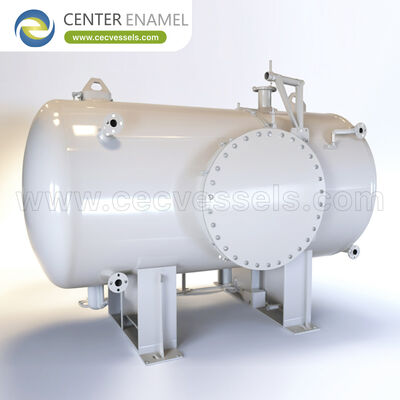
Answering the core question: What is an industrial reactor system, and how does it differ from a standalone reaction vessel? An industrial reactor system is the complete, integrated assembly built around a reactor vessel: the code-stamped pressure vessel itself, plus the agitation train, heating and cooling circuit, feeding metering, instrumentation, control software, and overpressure protection engineered to work as one unit. While a bare vessel only contains chemistry, a reactor system executes it—holding temperature within ±1°C, dosing reactants on recipe, and interlocking safety devices throughout the production cycle.
1. Core Components and Operating Principles of a Reactor System
A reactor system integrates mechanical, thermal, and control subsystems around the vessel:
- Reaction Vessel and Agitation Train: The ASME or CE-stamped vessel—jacketed, with internal coils where needed—hosts the chemistry, while a gearbox-driven agitator with selected impellers delivers the mixing intensity the reaction kinetics demand, from gentle blending to high-shear gas dispersion.
- Heat Transfer and Thermal Control: Circulation through the vessel jacket, dimple jackets, or internal coils—supplied by hot oil, steam, or refrigerated units—removes or injects reaction heat. Cascade control loops cascade from the reactor temperature to the jacket circuit to prevent thermal overshoot.
- Instrumentation, Control and Safety Layers: Pressure and temperature transmitters, level and flow instruments feed a PLC or DCS executing recipe control, while independent safety layers—rupture discs, relief valves, and hard-wired interlocks—protect against overpressure and runaway scenarios.
2. Major Types of Industrial Reactor Systems
Facilities deploy reactor system configurations matched to their production mode:
- Batch Reactor Systems: The most flexible configuration: a jacketed stirred vessel with charge and discharge sequences controlled by recipe. Ideal for multi-product plants producing pharmaceuticals, specialty chemicals, and resins in campaign mode.
- Continuous Reactor Systems: Continuous stirred-tank (CSTR) or tubular (PFR) systems running at steady state around the clock, maximizing throughput and consistency for bulk chemicals, polymerization, and high-volume intermediates.
- Modular and Skid-Mounted Systems: Complete reactor systems pre-assembled, wired, and factory-tested on a structural skid. They arrive as plug-and-produce units, compressing on-site construction schedules from months to weeks.
Industrial Reactor System Types Comparison Matrix
System Type |
Operating Mode |
Primary Industrial Application |
Core Operational Advantage |
Batch Reactor System |
Cyclic charge–react–discharge with recipe control |
Pharmaceuticals, specialty chemicals, resins |
Ultimate recipe flexibility for multi-product plants |
Continuous Reactor System |
Steady-state CSTR or tubular flow |
Bulk chemicals, polymerization, intermediates |
Highest throughput with uniform product quality |
Skid-Mounted Modular System |
Pre-engineered, factory-tested package |
Pilot plants, fast-track capacity additions |
Compressed delivery and commissioning timelines |
Frequently Asked Questions (FAQ)
Q: What components make up a complete industrial reactor system?
A: A reactor system comprises the pressure vessel, agitator and drive, jacket or coil heating/cooling circuit, reactant feeding and metering devices, process instrumentation, the PLC/DCS control layer, and overpressure protection such as rupture discs and relief valves.
Q: What is the difference between a reactor and a reactor system?
A: A reactor is the containment vessel alone. A reactor system is the integrated package—vessel plus agitation, thermal control, feeding, instrumentation, and safety systems—delivered as a functional production unit.
Q: Why choose a skid-mounted reactor system?
A: Skid-mounted systems are assembled and tested in the factory, so on-site work reduces to utility connections. This cuts installation time, weld inspection, and commissioning risk—critical for fast-track projects and pilot facilities.
Q: How does a reactor system control exothermic reactions?
A: The control system cascades reactor temperature onto the jacket coolant loop while dosing feeds on a recipe; if temperature deviates, feed rates cut back automatically, and independent safety actions (emergency cooling, dump, or relief) protect the vessel.