-
Glass Fused To Steel Tanks (896)
-
Stainless Steel Tanks (434)
-
Fusion Bonded Epoxy Tanks (652)
-
Galvanized Steel Tanks (321)
-
Aluminum Dome Roofs (1336)
-
Wastewater Storage Tanks (280)
-
Welded Steel Tanks (457)
-
Pressure Vessels (326)
-
Anaerobic Digester (202)
-
Industrial Water Tanks (349)
-
Glass Lined Steel Tanks (180)
-
Bolted Steel Tanks (389)
-
Sludge Storage Tank (115)
-
Biogas Storage Tank (173)
-
Leachate Storage Tanks (133)
-
Agricultural Water Storage Tanks (179)
-
Fire Water Tank (166)
-
Grain Storage Silos (146)
-
Biogas Projects (424)
-
Wastewater Treatment Projects (1682)
-
Double Membrane Roof (223)

|
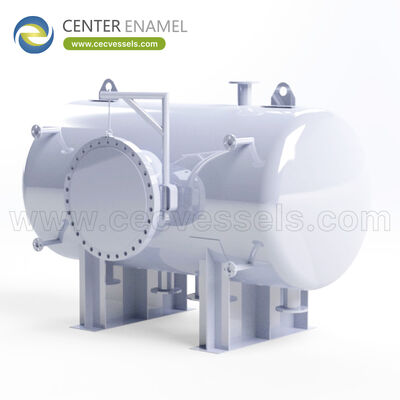
What Is a Pressure Vessel? Design Principles, Types & Applications
| Place of Origin: | China |
| Brand Name: | Center Enamel |
| Certification: | ISO 9001,CE, NSF/ANSI 61, WRAS, ISO 28765, LFGB, BSCI, ISO 45001 |
| Minimum Order Quantity: | 1 Sets |
| Price: | 2000 |
| Delivery Time: | 2 months |
| Payment Terms: | L/C,T/T |
| Supply Ability: | 200 sets / days |
|
Detail Information |
|||
Product Description
What Is a Pressure Vessel? Design Principles, Types & Applications
Answering the core question: What is a pressure vessel, and why is its design governed by strict engineering codes? A pressure vessel is a closed containment vessel engineered to hold gases or liquids at pressures substantially above atmospheric pressure—typically above 15 psi (1.03 bar), the jurisdictional threshold of the ASME Boiler and Pressure Vessel Code. Because stored pressure energy can release violently on failure, vessels are designed under ASME Section VIII or the European PED, fabricated from certified plate materials, and verified by hydrostatic testing at 1.3* design pressure before entering service.
1. Core Design Principles of Pressure Vessels
Pressure vessel engineering revolves around stress analysis, code compliance, and material integrity:
- Stress Analysis and Wall Thickness: Internal pressure generates hoop (circumferential) stress—the dominant load in cylindrical shells—plus longitudinal stress and discontinuity stresses at nozzles and heads. Code formulas calculate minimum wall thickness with allowable stress values and joint efficiency factors.
- Design Code Compliance: ASME BPVC Section VIII (Division 1 for conventional design, Division 2 for higher-stress analysis, Division 3 for ultra-high pressure) and the European PED 2014/68/EU define design rules, material qualification, welding procedures, and mandatory third-party inspection.
- Material Selection and Corrosion Allowance: Vessels are fabricated from carbon steel (SA-516), stainless steels (304/316L), or clad and nickel-alloy plates for aggressive media. Designers add a corrosion allowance—typically 1.5–3 mm—so the vessel retains code thickness over its 20–30+ year design life.
2. Major Types of Pressure Vessels
Industrial operations deploy distinct vessel categories based on function and geometry:
- Storage and Buffer Vessels: Horizontal or vertical drums and spheres that store compressed air, process gases, liquefied product, or surge liquids, decoupling upstream supply from downstream demand.
- Heat Transfer Vessels: Shell and tube exchangers, reboilers, condensers, and jacketed reactor vessels where pressure containment doubles as a heat exchange envelope with internal coils or external jackets.
- Reaction Vessels: Chemical reactors and autoclaves that contain reactions under elevated pressure and temperature, integrating agitation, instrumentation, and relief protection while maintaining code-stamped pressure boundaries.
Pressure Vessel Types Comparison Matrix
| Vessel Category | Typical Geometry & Feature | Primary Industrial Application | Core Operational Advantage |
|---|---|---|---|
| Storage / Buffer Vessel | Vertical or horizontal drums; spheres for large gas volumes | Compressed air, LPG storage, process surge control | Simple construction and large capacity at moderate cost |
| Heat Transfer Vessel | Shell and tube, reboiler, condenser, jacketed body | Refineries, chemical plants, utilities | Combines containment with heating or cooling duty |
| Reaction Vessel (Reactor) | Agitated vessel with jacket, coils and internals | Chemical, petrochemical, pharmaceutical synthesis | Contains reacting media under controlled pressure and temperature |
Frequently Asked Questions (FAQ)
Q: At what pressure does a vessel become a code-regulated pressure vessel?
A: In ASME jurisdiction, vessels with design pressure above 15 psi (approximately 1 bar) generally fall under the Boiler and Pressure Vessel Code; in the EU, the PED applies based on pressure and volume categories. Local regulations vary by country and service.
Q: What does an ASME stamp actually certify?
A: The ASME U stamp certifies that the vessel design, materials, welding, and testing all comply with Section VIII of the ASME Code, with documentation reviewed by an Authorized Inspector—accepted worldwide as proof of safe construction.
Q: Which materials are standard for pressure vessel construction?
A: Carbon steel SA-516 is the workhorse for general service, 304/316L stainless steel serves corrosive and hygienic duties, while duplex stainless and nickel alloys such as Hastelloy handle chloride-rich and highly acidic media.
Q: How are pressure vessels tested before entering service?
A: Every code vessel undergoes hydrostatic testing—typically at 1.3* design pressure—plus full non-destructive examination of welds (radiography or ultrasonic testing) and documented thickness verification of shell and heads.