-
Glass Fused To Steel Tanks (896)
-
Stainless Steel Tanks (434)
-
Fusion Bonded Epoxy Tanks (652)
-
Galvanized Steel Tanks (321)
-
Aluminum Dome Roofs (1336)
-
Wastewater Storage Tanks (280)
-
Welded Steel Tanks (457)
-
Pressure Vessels (326)
-
Anaerobic Digester (202)
-
Industrial Water Tanks (349)
-
Glass Lined Steel Tanks (180)
-
Bolted Steel Tanks (389)
-
Sludge Storage Tank (115)
-
Biogas Storage Tank (173)
-
Leachate Storage Tanks (133)
-
Agricultural Water Storage Tanks (179)
-
Fire Water Tank (166)
-
Grain Storage Silos (146)
-
Biogas Projects (424)
-
Wastewater Treatment Projects (1682)
-
Double Membrane Roof (223)
|
What Is a Scale-Up Reactor? Principles, Challenges & Applications
| Place of Origin: | China |
| Brand Name: | Center Enamel |
| Certification: | ISO 9001,CE, NSF/ANSI 61, WRAS, ISO 28765, LFGB, BSCI, ISO 45001 |
| Minimum Order Quantity: | 1 Sets |
| Price: | 2000 |
| Delivery Time: | 2 months |
| Payment Terms: | L/C,T/T |
| Supply Ability: | 200 sets / days |
|
Detail Information |
|||
Product Description
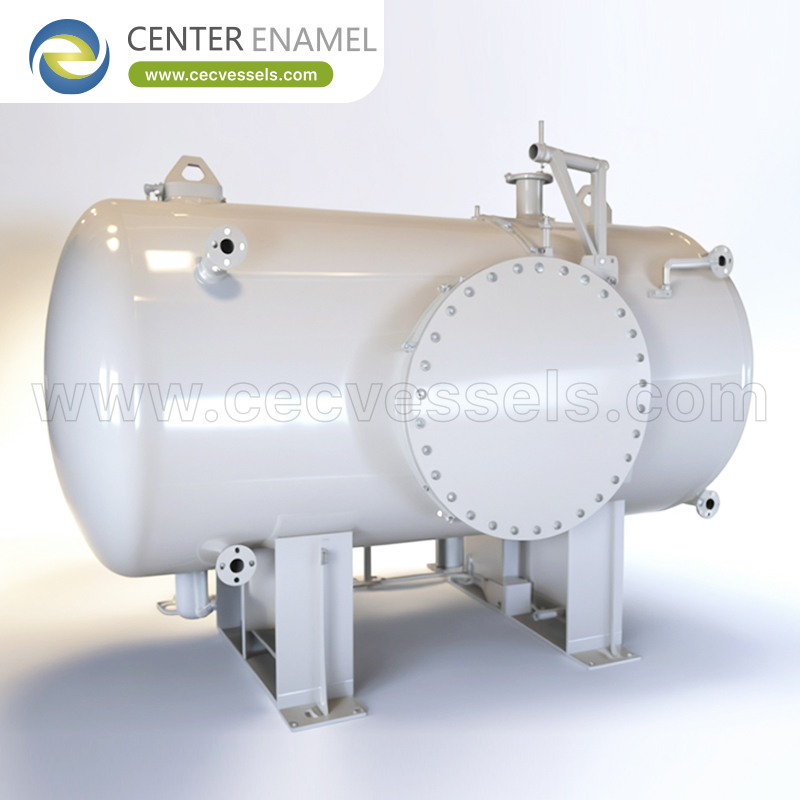
What Is a Scale-Up Reactor? Principles, Challenges & Applications
Answering the core question: What is a scale-up reactor, and why does successful chemistry at 1 liter so often fail at 10,000? A scale-up reactor is the intermediate-scale pressure vessel—typically one-tenth to one-hundredth of production volume—used to translate laboratory chemistry into a reliable manufacturing process. Its central challenge is that key parameters do not scale linearly: when vessel volume grows tenfold, the heat-transfer surface-to-volume ratio drops by roughly a factor of ten while mixing time lengthens, so a reaction that was effortless to cool in a flask can run away in a plant reactor. Scale-up reactors exist to discover and solve these non-linearities before capital is committed.
1. Core Scale-Up Principles and Similarity Rules
Engineers scale reactors by preserving dimensionless similarity rather than raw dimensions:
- Geometric, Kinematic and Dynamic Similarity: Scale-up theory matches ratios: identical vessel aspect (geometric), comparable flow patterns (kinematic), and equal Reynolds or power numbers (dynamic). Preserving the power-per-volume or tip-speed criterion keeps the mixing environment chemically equivalent across scales.
- The Heat Transfer Bottleneck: Jacket area grows with volume^(2/3), so a 10* volume increase cuts the surface-to-volume ratio—and removable heat per liter—by about 10*. Internal coils, external recirculation loops, or semi-batch feed strategies must compensate for what the jacket alone can no longer remove.
- Dimensionless Reaction Numbers: The Damköhler number (reaction rate versus mixing rate) exposes whether a reaction is kinetics-limited or mixing-limited. When mixing limits, simply enlarging the vessel changes selectivity—a classic cause of scale-up yield loss.
2. Major Scale-Up Strategies and Reactor Approaches
Three engineering routes bridge laboratory results and full production:
- Geometric Scale-Up in Stirred Tanks: The traditional route: progressively larger agitated vessels (lab → pilot → production) keeping geometry, impeller tip speed, or power-per-volume constant. Widely applied for batch specialty and pharmaceutical processes.
- Numbering-Up of Flow Reactors: Instead of enlarging one vessel, multiple identical small channels run in parallel. Because each channel retains validated mixing and heat-transfer behavior, performance transfers with essentially no risk—favored for continuous flow chemistry.
- Hybrid and Model-Based Scale-Up: Combining CFD mixing simulation, reaction calorimetry, and kinetic modeling to predict plant behavior before pilot construction—shortening development timelines and revealing hot spots and dead zones computationally.
Reactor Scale-Up Strategies Comparison Matrix
Scale-Up Strategy |
Scaling Rule Applied |
Best-Suited Process Type |
Core Risk Mitigated |
Geometric Scale-Up (Stirred Tank) |
Constant power/volume or tip speed across volumes |
Batch pharma, specialty chemicals, polymers |
Mixing-driven selectivity loss between scales |
Numbering-Up (Flow Channels) |
Identical parallel channels at validated conditions |
Fast exothermic or hazardous continuous chemistry |
Heat removal limits and unproven large equipment |
Model-Based (CFD + Calorimetry) |
Simulation extrapolates validated lab kinetics |
Complex multiphase and high-hazard reactions |
Hot spots, dead zones and runaway scenarios |
Frequently Asked Questions (FAQ)
Q: What is the primary purpose of a scale-up reactor?
A: A scale-up reactor de-risks the transfer of chemistry from laboratory to production, exposing non-linear changes in mixing, heat removal, and residence time before a full-scale plant is built.
Q: Why does heat removal become harder as reactors get bigger?
A: Vessel volume grows with the cube of linear dimension while jacket area grows only with the square—so a 10* volume jump leaves roughly 10* less heat-transfer surface per liter, demanding internal coils, external loops, or slower feed strategies.
Q: What mixing parameters are usually kept constant during scale-up?
A: Engineers most often hold power input per unit volume, impeller tip speed, or blending time constant, choosing the criterion whose failure mode (shear damage, gas flooding, or slow blending) is least tolerable for the specific chemistry.
Q: How does numbering-up differ from traditional scale-up?
A: Numbering-up multiplies identical small reactors in parallel instead of building one large one, so every channel keeps exactly the heat transfer and mixing performance already proven—eliminating most scale-up uncertainty.