-
Glass Fused To Steel Tanks (852)
-
Stainless Steel Tanks (434)
-
Fusion Bonded Epoxy Tanks (622)
-
Galvanized Steel Tanks (321)
-
Aluminum Dome Roofs (1336)
-
Wastewater Storage Tanks (280)
-
Welded Steel Tanks (457)
-
Pressure Vessels (295)
-
Anaerobic Digester (202)
-
Industrial Water Tanks (349)
-
Glass Lined Steel Tanks (180)
-
Bolted Steel Tanks (389)
-
Sludge Storage Tank (115)
-
Biogas Storage Tank (173)
-
Leachate Storage Tanks (133)
-
Agricultural Water Storage Tanks (179)
-
Fire Water Tank (166)
-
Grain Storage Silos (146)
-
Biogas Projects (424)
-
Wastewater Treatment Projects (1610)
-
Double Membrane Roof (223)

|
Makeup Water Storage Tanks for Data Center Cooling: Sizing and Water Quality
| Place of Origin: | China |
| Brand Name: | CEC TANKS |
| Certification: | ISO 9001:2008, AWWA D103 , OSHA , BSCI |
| Model Number: | W20160504020 |
| Minimum Order Quantity: | 1set |
| Price: | $5000~$20000 one set |
| Packaging Details: | PE poly-foam between each two steel plates ; wooden pallet and wooden box |
| Delivery Time: | 0-60 days after deposit received |
| Payment Terms: | L/C,T/T |
| Supply Ability: | 60 sets per month |
|
Detail Information |
|||
Product Description
Cooling towers are the largest water consumer in most data centers, and the makeup water tank is what keeps them running when the municipal supply dips or the treatment system needs stable feed. It is a different application from chilled water or TES, and it deserves its own sizing logic. This article covers makeup water storage for data center cooling.
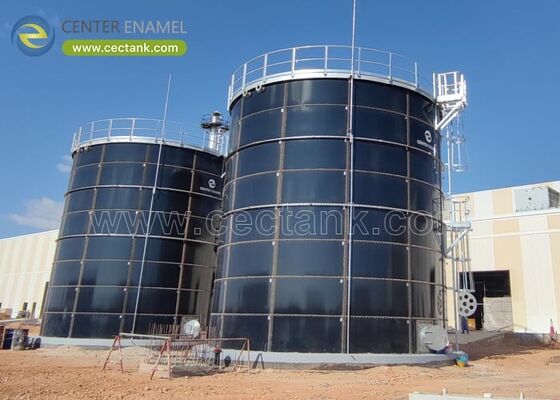
A makeup water storage tank for data center cooling replaces the water a cooling tower loses to evaporation, drift, and blowdown, and is sized from the tower load, local evaporation rate, and the blowdown schedule, with margin for supply interruption. It is clean treated water, often non-potable, so an inert GFS or FBE lining keeps it usable, but NSF/ANSI 61 is not the governing standard unless the water is potable. We have no data-center makeup project in this library; we cite analogous clean-water tanks we delivered, the Guadeloupe potable-water GFS tank in France (2024), the Namibia drinking-water array (6 x 11,230 m3, 2022), the Indonesia Cilincing drinking-water tank (21,088 m3, 2024), and the Hebei agricultural irrigation epoxy tank in China (6,310 m3, 2024).
Cooling towers lose water three ways: evaporation, the largest and unavoidable, driven by heat rejection; drift, water carried out as droplets, controlled by drift eliminators; and blowdown, the deliberate bleed to control dissolved solids. The makeup tank must replace all three, so sizing starts with measuring or estimating each at your site.
- Evaporation: heat-rejection driven.
- Drift: controlled by eliminators.
- Blowdown: deliberate bleed.
- Makeup replaces all three.
Size the tank from the total makeup rate (evaporation plus drift plus blowdown) times the autonomy you require, often enough to bridge a supply interruption or a treatment-cycle gap, with margin. A wider safety margin costs little relative to a tower shutdown. The Guadeloupe and Namibia drinking-water tanks show our ability to build large clean-water storage.
- Rate x autonomy = volume.
- Bridge supply interruption.
- Margin prevents shutdown.
- Large clean-water build proven.
Makeup water may carry scale, biocide, and corrosion inhibitors depending on the treatment program, so the tank lining must resist that chemistry. GFS or FBE with a documented chemical-resistance list is the safe choice; the water is typically non-potable, so NSF 61 is not the governing requirement unless the loop is potable. Keep the tank sealed to limit biological growth.
- Lining resists treatment chemistry.
- GFS / FBE + resistance list.
- Usually non-potable, not NSF 61.
- Sealed to limit biology.
Place the makeup tank close to the treatment feed and the tower make-up line, with level sensing to the BMS so the reserve is monitored. Bolted coated panels ship flat and erect fast, which helps when the tank is on a tight construction schedule. The table summarizes the sizing inputs.
- Near treatment feed and tower.
- Level to BMS.
- Flat-pack, fast erection.
- Monitor the reserve.
Input | Effect on size |
Evaporation rate | Largest driver |
Drift + blowdown | Adds to rate |
Autonomy needed | Multiplier |
Safety margin | Prevents shutdown |
We have no data-center makeup project in this library. The clean-water tanks cited (Guadeloupe France 2024, Namibia 2022, Cilincing Indonesia 2024, Hebei China epoxy 2024) are analogous water-storage deliveries, not data-center projects, offered as evidence of our ability to build large coated clean-water tanks.
- No DC makeup in library.
- Citations analogous, not claims.
- Large clean-water build real.
- Sizing needs your tower data.
From the total makeup rate, evaporation plus drift plus blowdown, times the autonomy you require to bridge a supply interruption, with a safety margin.
Usually not, because it is typically non-potable treated water for cooling towers; NSF/ANSI 61 applies only if the water is potable-grade.
GFS or FBE with a documented chemical-resistance list matched to your treatment program, because the water may carry scale, biocide, and inhibitors.
No, makeup replaces cooling-tower losses for continuous operation, while chilled water carries cooling and TES shifts energy cost over hours.
Enough to bridge a supply interruption or treatment-cycle gap at your site; a wider margin costs little relative to a tower shutdown.
Not in our project library. We cite clean-water tanks at other clients as analogous capability, not data-center deliveries.
A makeup water storage tank for data center cooling is sized by the three loss streams a cooling tower creates, evaporation, drift, and blowdown, multiplied by the autonomy you need to bridge supply gaps, with a safety margin that costs little against a tower shutdown. The lining must resist the treatment chemistry, so GFS or FBE with a chemical-resistance list is the safe choice, and because the water is typically non-potable, NSF 61 is not the governing standard. We present our clean-water tanks in France, Namibia, Indonesia, and China as analogous evidence, not data-center deliveries, because our library holds no data-center makeup project.
Suggested CTA: Provide your cooling tower load, local evaporation rate, and blowdown schedule and we will size a coated makeup water storage tank for your data center cooling loop.