-
Glass Fused To Steel Tanks (807)
-
Stainless Steel Tanks (434)
-
Fusion Bonded Epoxy Tanks (622)
-
Galvanized Steel Tanks (321)
-
Aluminum Dome Roofs (1336)
-
Wastewater Storage Tanks (280)
-
Welded Steel Tanks (457)
-
Pressure Vessels (295)
-
Anaerobic Digester (202)
-
Industrial Water Tanks (349)
-
Glass Lined Steel Tanks (180)
-
Bolted Steel Tanks (389)
-
Sludge Storage Tank (115)
-
Biogas Storage Tank (173)
-
Leachate Storage Tanks (133)
-
Agricultural Water Storage Tanks (179)
-
Fire Water Tank (166)
-
Grain Storage Silos (146)
-
Biogas Projects (424)
-
Wastewater Treatment Projects (1570)
-
Double Membrane Roof (223)

|
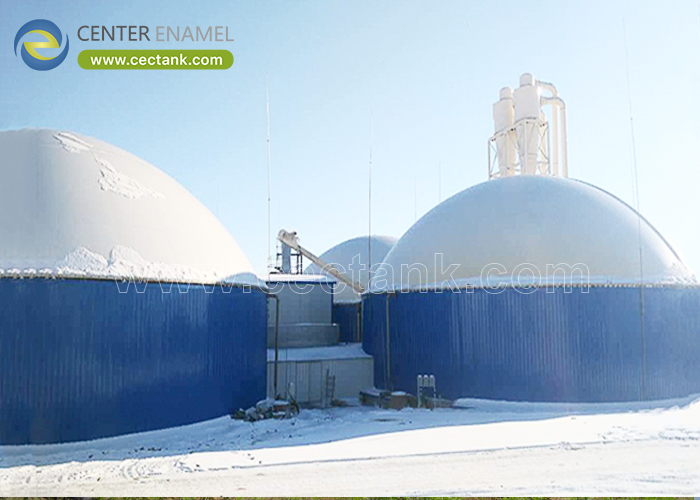
GFS Biogas Digestion Tanks: Why Glass-Fused-to-Steel Fits Anaerobic Digestion
| Place of Origin: | China |
| Brand Name: | CEC TANKS |
| Certification: | ISO 9001:2008, AWWA D103 , OSHA , BSCI |
| Model Number: | W201691123005 |
| Minimum Order Quantity: | 1set |
| Price: | $5000~$20000 one set |
| Packaging Details: | PE poly-foam between each two steel plates ; wooden pallet and wooden box |
| Delivery Time: | 0-60 days after deposit received |
| Payment Terms: | L/C,T/T |
| Supply Ability: | 60 sets per month |
|
Detail Information |
|||
| Place of Origin | China | Brand Name | CEC TANKS |
|---|---|---|---|
| Certification | ISO 9001:2008, AWWA D103 , OSHA , BSCI | Model Number | W201691123005 |
| Steel Plates Thickness: | 3mm To 12mm , Depends On The Tank Structure | Corrosion Integrity: | Excellent |
| Chemical Resistance: | Excellent | Capacity: | 20 M3 To 18,000 M3 |
| Service Life: | ≥30 Years | Permeability: | Gas / Liquid Impermeable |
| Highlight: | glass-fused-to-steel biogas tanks,anaerobic digestion storage tanks,fusion bonded epoxy biogas tanks |
||
Product Description
GFS Biogas Digestion Tanks: Why Glass-Fused-to-Steel Fits Anaerobic Digestion
Anaerobic digestion is a hostile environment for a tank. The liquid is acidic, the gas space is saturated with hydrogen sulfide, and the process runs warm. Among the materials available, Glass-Fused-to-Steel (GFS) has become the default for many digesters because its fused glass face is inert to exactly the chemistry that eats painted and even some stainless tanks. This article explains the material logic and what a GFS digester provider must actually deliver.
Key Takeaway
GFS fits anaerobic digestion because the vitreous enamel face fused to steel at 820-930C is inert to the acidic, H2S-rich digester environment and survives the 35-38C mesophilic duty without organic-coating breakdown. A credible GFS biogas provider designs to ISO 28765, proves the lining with a 100% 1500 V holiday test and 3450 N/cm2 adhesion, and supplies a sealed bolted shell matched to 20-40 day retention and 55-65% methane yield.
The Chemistry GFS Survives
A digester's worst zone is the gas space above the liquid, where H2S and moisture attack the tank wall. GFS presents an inert glass face to both the liquid and the gas, so it does not rely on a thick organic film that can blister. The enamel (0.25-0.45 mm per face) is fused, not painted, so it does not peel under thermal cycling.
- Inert glass face resists acidic liquor and H2S gas.
- Fused at 820-930C - no organic film to blister.
- Performs through 35-38C mesophilic cycles.
Design for the Process
A GFS digester is engineered to the retention time and gas load: typical HRT of 20-40 days, mesophilic 35-38C, and a methane content of 55-65% that sets the gas-holder size. ISO 28765 governs the GFS design and AWWA D103-09 the bolted structure; the bolts (8.8-grade) and sealant carry the sealed shell.
- HRT 20-40 d; methane 55-65%.
- Design to ISO 28765 + AWWA D103-09.
- Sealed shell for gas management.
What a Provider Must Prove
Beyond the panel, the provider must show the lining controls: 100% 1500 V holiday test, adhesion near 3450 N/cm2, hardness near 6.0 Mohs, and panel traceability. These are the documents that separate a controlled GFS process from a hopeful one.
| Proof | Good value | Why it matters |
|---|---|---|
| Holiday test | 1500 V, 100% surface | No pinholes / leaks. |
| Adhesion | ~3450 N/cm2 | Bond survives cycles. |
| Hardness | ~6.0 Mohs | Abrasion resistance. |
| Traceability | Panel-to-batch numbering | Defect maps to furnace run. |
Project Reference
Delivered GFS digesters show the family in service: the China PAQUES biogas project (2022, GFS and stainless digesters), the France CSTR digester (2021, 2,215 m3), the Sweden biogas project (2024, multiple GFS digesters), and the Japan cow-manure wastewater tanks (2024, 2 x 9,305 m3, total 18,610 m3).
- China PAQUES 2022: GFS + SS biogas digesters.
- France CSTR 2021: 2,215 m3 GFS digester.
- Japan 2024: 2 x 9,305 m3 cow-manure digesters, 18,610 m3 total.
Company Expertise
Center Enamel operates its own enameling with furnace-temperature control and 100% 1500 V holiday testing, designs GFS digesters to ISO 28765, and has exported digesters for agricultural, municipal and industrial biogas across multiple climates.
Frequently Asked Questions
Why choose GFS over painted steel for a digester?
The fused glass face is inert to the acidic, H2S-rich digester environment and will not blister or peel like an organic coating under thermal cycling.
What temperature can a GFS digester handle?
Mesophilic digestion at 35-38C is the common duty; the fused enamel handles the thermal cycling without coating breakdown.
How long is the retention time?
Typically 20-40 days for mesophilic digestion; the tank volume is sized to that retention and the feedstock.
Is GFS suitable for the gas space?
Yes - the inert glass face resists the H2S-laden gas space above the liquid, which is usually the most corrosive zone.
What standards apply?
ISO 28765 for the GFS design and AWWA D103-09 for the bolted structure, with a 100% 1500 V holiday test on the lining.
Can a GFS digester be paired with a membrane roof?
Yes; the bolted GFS shell is commonly paired with a double-membrane gas holder for 5-30 mbar biogas storage.
GFS earns its place on digesters because its inert, fused glass face shrugs off the acid and H2S that destroy other linings, and a disciplined provider proves that with holiday testing, adhesion data and ISO 28765 design rather than adjectives.