-
Glass Fused To Steel Tanks (807)
-
Stainless Steel Tanks (434)
-
Fusion Bonded Epoxy Tanks (622)
-
Galvanized Steel Tanks (321)
-
Aluminum Dome Roofs (1336)
-
Wastewater Storage Tanks (280)
-
Welded Steel Tanks (457)
-
Pressure Vessels (295)
-
Anaerobic Digester (202)
-
Industrial Water Tanks (349)
-
Glass Lined Steel Tanks (180)
-
Bolted Steel Tanks (389)
-
Sludge Storage Tank (115)
-
Biogas Storage Tank (173)
-
Leachate Storage Tanks (133)
-
Agricultural Water Storage Tanks (179)
-
Fire Water Tank (166)
-
Grain Storage Silos (146)
-
Biogas Projects (424)
-
Wastewater Treatment Projects (1570)
-
Double Membrane Roof (223)

|
Farm Water Tanks: Sourcing Reliable Agricultural Water Storage
| Place of Origin: | China |
| Brand Name: | CEC TANKS |
| Certification: | ISO 9001:2008, AWWA D103 , OSHA , BSCI |
| Model Number: | W201691123005 |
| Minimum Order Quantity: | 1set |
| Price: | $5000~$20000 one set |
| Packaging Details: | PE poly-foam between each two steel plates ; wooden pallet and wooden box |
| Delivery Time: | 0-60 days after deposit received |
| Payment Terms: | L/C,T/T |
| Supply Ability: | 60 sets per month |
|
Detail Information |
|||
| Place of Origin | China | Brand Name | CEC TANKS |
|---|---|---|---|
| Certification | ISO 9001:2008, AWWA D103 , OSHA , BSCI | Model Number | W201691123005 |
| Steel Plates Thickness: | 3mm To 12mm , Depends On The Tank Structure | Corrosion Integrity: | Excellent |
| Chemical Resistance: | Excellent | Capacity: | 20 M3 To 18,000 M3 |
| Service Life: | ≥30 Years | Permeability: | Gas / Liquid Impermeable |
| Highlight: | farm water storage tanks,agricultural epoxy water tanks,fusion bonded epoxy storage |
||
Product Description
Farm Water Tanks: Sourcing Reliable Agricultural Water Storage
On a farm, water storage is infrastructure, not an afterthought - it buffers an unreliable supply against irrigation demand, livestock drinking, and the fire reserve a remote property needs. The tank has to survive sun, dust, thermal cycling and sometimes livestock, with minimal upkeep. This article covers material choices and what to check when sourcing a farm water tank.
A farm water tank is selected by duty: irrigation and livestock drinking favor a corrosion-resistant, low-upkeep liner (GFS enamel or FBE epoxy, or hot-dip galvanized for raw water), while a fire reserve adds dedicated suction and freeze protection. For rural sites, bolted construction ships flat and erects fast, and a sealed or domed roof limits algae and evaporation. Size to the demand you actually have, not a round number.
Duties on a Farm
Farm water serves three loads: irrigation (seasonal, high peak), livestock drinking (steady, smaller), and fire reserve (dedicated, code-driven where required). They can share a tank only if the fire authority permits; otherwise the fire reserve needs its own suction. The liner choice follows the water quality - potable for livestock, raw for irrigation.
- Irrigation: high seasonal peak.
- Livestock: steady potable demand.
- Fire: dedicated reserve where required.
Material Choices
GFS enamel gives an inert, low-upkeep face suited to both potable and raw water; FBE epoxy is the alternative organic lining; hot-dip galvanized is a cost-effective raw-water option. All are bolted, so they ship flat and erect without heavy welding - a real advantage at a remote site.
- GFS: inert, low upkeep, potable + raw.
- FBE: thick organic lining.
- Galvanized: economical raw water.
Siting and Upkeep
Place the tank on a ring foundation with a starter ring, plan for thermal expansion, and choose a roof that limits debris and algae. A bolted, factory-lined tank reduces field coating and the repaint cycle that plagues welded farm tanks.
|
Factor |
Recommendation |
|
Liner |
GFS / FBE / galvanized by water quality. |
|
Foundation |
Ring foundation + starter ring. |
|
Roof |
Dome or sealed to limit algae. |
|
Erection |
Bolted, flat-pack for remote sites. |
|
Fire duty |
Dedicated suction if required. |
Project Reference
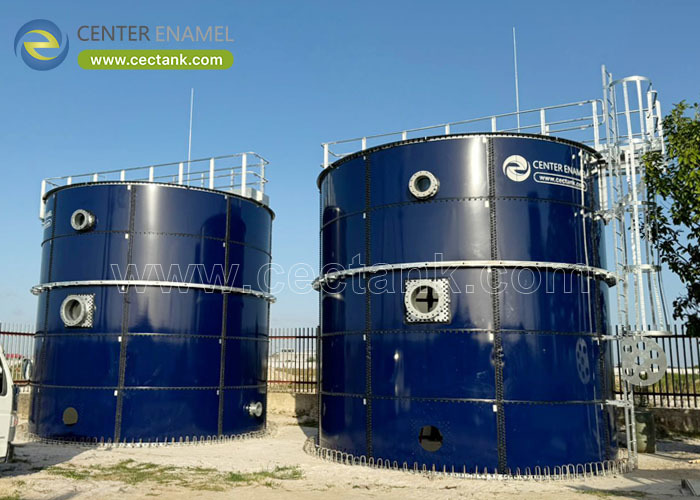
Agricultural and rural water storage is delivered at scale: the China Agricultural Irrigation Water Project (Epoxy Tank, 2024, Hebei) used 2 x 3,155 m3 FBE tanks (6,310 m3 total), and the Namibia freshwater program (2022) and Maldives drinking-water programs (2023/2024) show the same bolted GFS technology serving rural and island communities.
- China Hebei 2024: 2 x 3,155 m3 FBE irrigation tanks.
- Namibia 2022: six 11,230 m3 freshwater tanks.
- Maldives 2023/2024: island drinking water.
Company Expertise
Center Enamel supplies GFS and FBE bolted farm and rural water tanks with ISO 28765 / AWWA D103-09 design and factory-applied linings that avoid the repaint cycle. The flat-pack bolted format suits remote agricultural sites.
Frequently Asked Questions
What material is best for a farm water tank?
GFS enamel or FBE for low upkeep and potable use; hot-dip galvanized for economical raw-water irrigation.
Can one tank serve irrigation and livestock?
Yes for the water itself, but a fire reserve usually needs a dedicated suction - check with the local authority.
Why bolted for a remote farm?
Bolted tanks ship flat and erect without heavy welding, which matters where skilled labor and equipment are scarce.
Do I need a roof?
A dome or sealed roof limits algae, debris and evaporation - worthwhile on an open farm site.
How is an irrigation tank sized?
From peak irrigation demand and the supply buffer you need between fills, not a round number.
Is galvanized safe for drinking water?
For livestock potable duty, confirm the coating is potable-rated; otherwise choose GFS/FBE with the appropriate listing.
Conclusion
A farm water tank is infrastructure that has to survive sun, dust and thermal cycling with little upkeep. Pick the liner by water quality, bolt it for remote erection, roof it against algae, and size it to real demand - and it will outlast the welded alternative that needs repainting.
Suggested CTA: Tell us your farm's irrigation, livestock and fire demands and we will size and specify a bolted GFS or FBE tank for the site.