-
Glass Fused To Steel Tanks (807)
-
Stainless Steel Tanks (434)
-
Fusion Bonded Epoxy Tanks (592)
-
Galvanized Steel Tanks (321)
-
Aluminum Dome Roofs (1336)
-
Wastewater Storage Tanks (237)
-
Welded Steel Tanks (457)
-
Pressure Vessels (295)
-
Anaerobic Digester (202)
-
Industrial Water Tanks (349)
-
Glass Lined Steel Tanks (180)
-
Bolted Steel Tanks (389)
-
Sludge Storage Tank (115)
-
Biogas Storage Tank (173)
-
Leachate Storage Tanks (133)
-
Agricultural Water Storage Tanks (179)
-
Fire Water Tank (166)
-
Grain Storage Silos (146)
-
Biogas Projects (424)
-
Wastewater Treatment Projects (1520)
-
Double Membrane Roof (223)
|
Anaerobic Digester Tank: Design and Operation for Stable Biogas
| Place of Origin: | China |
| Brand Name: | CEC TANKS |
| Certification: | ISO 9001:2008, AWWA D103 , OSHA , BSCI |
| Model Number: | J2016012106 |
| Minimum Order Quantity: | 1set |
| Price: | $5000~$20000 one set |
| Packaging Details: | PE poly-foam between each two steel plates ; wooden pallet and wooden box |
| Delivery Time: | 0-60 days after deposit received |
| Payment Terms: | L/C,T/T |
| Supply Ability: | 60 sets per month |
|
Detail Information |
|||
Product Description
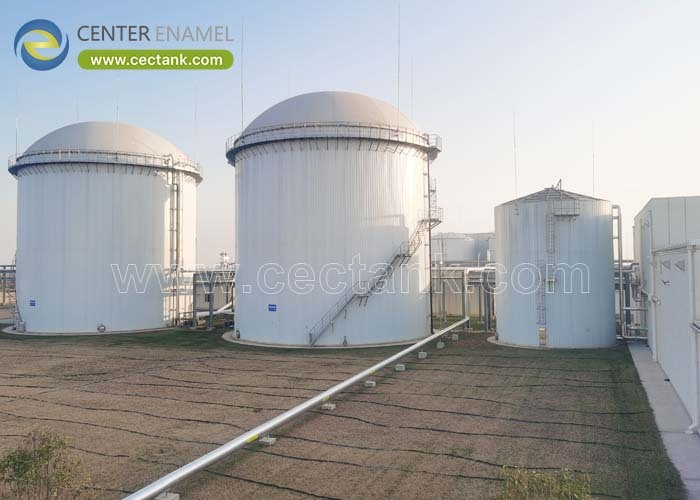
An anaerobic digester tank is a sealed vessel where microbes break down organic waste into biogas at 35-38°C mesophilic temperature over a 20-40 day retention. The acidic, methane-rich slurry demands an inert lining rated for 30-50 years. Engineered by Shijiazhuang Zhengzhong Technology Co., Ltd. (Center Enamel) to AWWA D103-09 and ISO 28765, capacities span 500-50,000 m3.
An anaerobic digester tank is a sealed reactor where anaerobic microbes convert manure, sludge, or organic waste into biogas with 55-65% methane over a 20-40 day hydraulic retention. In Glass-Fused-to-Steel (GFS) form the interior carries enamel fused at 820-930°C to 0.25-0.40 mm, resisting the acidic slurry for 30-50 years of continuous duty.
- Retention: 20-40 days HRT.
- Gas: 55-65% methane.
- Surface: 0.25-0.40 mm enamel.
- Range: 500-50,000 m3.
Digester tanks are built as CSTR with mixers, as upflow (UASB) reactors, or as covered lagoons. The shell carries a holiday-tested enamel or epoxy coat, and roofs range from fixed cones to aluminum geodesic domes with a double-membrane holder. Mixing uses 5-15 W/m3 to keep solids suspended and gas yield stable.
- CSTR: mixed digester.
- UASB: upflow reactor.
- Coat: enamel or epoxy.
- Mix: 5-15 W/m3.
They serve farms converting manure, food processors handling organic waste, and municipalities treating sludge. Operating at 35-38°C mesophilic temperature, the tank resists pH 3-11 and 1-14 in special grades. The inert lining is the reason the same tank family covers wet digestion and gas storage on one site.
- Farms: manure and residue.
- Municipal: sludge digestion.
- Temperature: 35-38°C.
- pH: 3-11, 1-14 special.
Sizing sets hydraulic retention at 20-40 days and temperature at 35-38°C, with biogas at 55-65% methane and 5-30 mbar. The shell is calculated to AWWA D103-09 and ISO 28765, plates blasted to Sa 2.5 and holiday-tested at 1500 V. The holder and seal are designed for the 5-30 mbar gas pressure without leakage.
- Retention: 20-40 days.
- Temperature: 35-38°C.
- Pressure: 5-30 mbar.
- Test: 1500 V per m2.
The inert enamel interior outlasts painted steel for 30-50 years and speeds erection through bolting. A genuine limitation is that the digester is not suited to feedstock below pH 5.5 unless a correction step is added; this boundary must be confirmed during process design, or the coating warranty is at risk in acidic feed.
- Advantage: inert, 30-50 years.
- Advantage: fast bolted build.
- Limitation: not for pH<5.5 as-is.
- Boundary: confirm pH in design.
The figures below are the load-bearing values a provider should quote per digester tank; capacities reach 50,000 m3 and design life runs 30-50 years. They let an engineer confirm the shell, coating, and gas system before steel is ordered for an anaerobic duty.
| Design parameter | Typical value or range | Why it matters |
|---|---|---|
| Capacity range | 500-50,000 m3 | Single-tank throughput |
| Hydraulic retention | 20-40 days | Digestion stability |
| Operating temperature | 35-38 °C | Mesophilic default |
| Biogas methane | 55-65 % | Calorific value |
| Gas pressure | 5-30 mbar | Holder and seal design |
| Mixing energy | 5-15 W/m3 | Solids suspension |
| Enamel DFT | 0.25-0.40 mm | Acid resistance |
| Holiday test | 1500 V | Every panel checked |
| Code basis | AWWA D103-09 / ISO 28765 | Design authority |
| Limitation to check | Feed pH below 5.5 | Add correction step |
Against welded steel and concrete, a Glass-Fused-to-Steel (GFS) anaerobic digester tank wins on corrosion resistance and build speed for the 500-50,000 m3 range. Use the table to match the material to feed corrosivity, site logistics, and required life.
| Criterion | GFS bolted tank | Welded steel tank | Concrete tank | FRP tank |
|---|---|---|---|---|
| Corrosion defense | Vitreous enamel, inert | Coating-dependent | Good but porous | Liner-dependent |
| Construction | Bolted, fast on site | Welded, slower | Cast in place | Molded / shop |
| Capacity ceiling | Up to 60,000 m3 | Up to 150,000 m3 | Very large | Limited (<5,000 m3) |
| Design life | 30-50 years | 30-50 years | 40-60 years | 20-30 years |
| Best fit | Corrosive, modular | Very large, generic | Heavy civil works | Small, neat chemical |
Specify the enamel DFT of 0.25-0.40 mm, the 1500 V holiday test, and the ISO 28765 calculation; require references from digester duties of similar volume. Shijiazhuang Zhengzhong Technology Co., Ltd. (Center Enamel) issues drawings, NDE records, and inspection packages per tank.
- Ask for: ISO 28765 calculation.
- Verify: 1500 V test, 0.25-0.40 mm.
- Confirm: digester reference.
- Package: drawings plus NDE.
An anaerobic digester tank is a coating system, a code calculation, and an inspection record built to last 30-50 years under acidic, gas-rich duty. Choose a provider who shows the enamel proof and the ISO 28765 math.
A sealed reactor where microbes turn organic waste into biogas (55-65% methane) over a 20-40 day retention, typically 500-50,000 m3.
Glass-Fused-to-Steel enamel resists the acidic slurry for 30-50 years; concrete and welded steel are alternatives for specific duties.
The bolted shell is designed to AWWA D103-09 and ISO 28765, with plant control under ISO 9001 and ISO 45001.
Mesophilic digestion runs at 35-38°C with a 20-40 day hydraulic retention for stable gas yield.
Plates are blasted to Sa 2.5, coated to 0.25-0.40 mm DFT, and holiday-tested at 1500 V per square meter.
Yes. Capacity, mixer, roof, holder, and coating grade are engineered per feedstock, with drawings issued per tank.
- AD tanks run 35-38°C, 20-40 day retention, 55-65% methane.
- GFS enamel resists acidic slurry for 30-50 years.
- Require ISO 28765 plus a 1500 V holiday test.
- Confirm feed pH during design, not after build.