-
Glass Fused To Steel Tanks (807)
-
Stainless Steel Tanks (434)
-
Fusion Bonded Epoxy Tanks (592)
-
Galvanized Steel Tanks (321)
-
Aluminum Dome Roofs (1336)
-
Wastewater Storage Tanks (237)
-
Welded Steel Tanks (457)
-
Pressure Vessels (295)
-
Anaerobic Digester (202)
-
Industrial Water Tanks (349)
-
Glass Lined Steel Tanks (180)
-
Bolted Steel Tanks (389)
-
Sludge Storage Tank (115)
-
Biogas Storage Tank (173)
-
Leachate Storage Tanks (133)
-
Agricultural Water Storage Tanks (179)
-
Fire Water Tank (166)
-
Grain Storage Silos (146)
-
Biogas Projects (424)
-
Wastewater Treatment Projects (1520)
-
Double Membrane Roof (223)
|
Oil Storage Tanks: API 650 Design and Floating-Roof Basics
| Place of Origin: | China |
| Brand Name: | CEC TANKS |
| Certification: | ISO 9001:2008, AWWA D103 , OSHA , BSCI |
| Model Number: | W20161227006 |
| Minimum Order Quantity: | 1set |
| Price: | $5000~$20000 one set |
| Packaging Details: | PE poly-foam between each two steel plates ; wooden pallet and wooden box |
| Delivery Time: | 0-60 days after deposit received |
| Payment Terms: | L/C,T/T |
| Supply Ability: | 60 sets per month |
|
Detail Information |
|||
Product Description
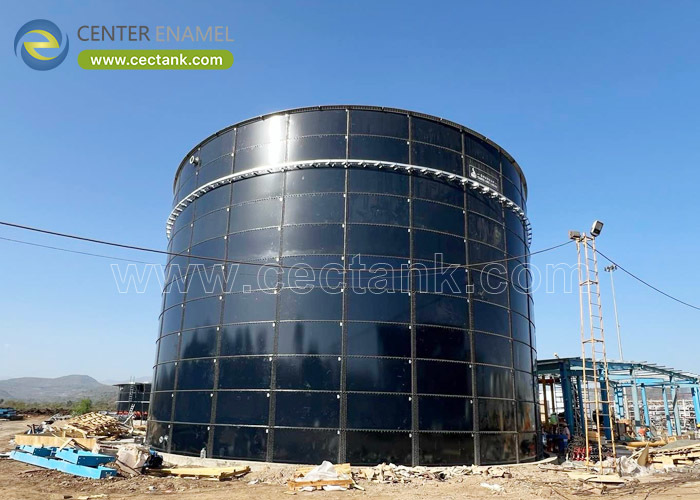
An oil storage tank is a welded steel vessel built to API 650 for bulk hydrocarbon storage from 100 to 150,000 m3, with floating or fixed roofs controlling vapor. External and internal coatings of epoxy or urethane defend against corrosion, backed by cathodic protection for a 30-50 year life. Engineered by Shijiazhuang Zhengzhong Technology Co., Ltd. (Center Enamel) for refinery, terminal, and depot duty.
An oil storage tank is a welded, field-erected vessel built to API 650 for crude, fuel, or product oil, typically 100-150,000 m3. Floating roofs ride the liquid surface to cut evaporation and fire risk, while fixed roofs suit smaller or pressurized duty. The shell uses 6-40 mm plate for the hydrostatic head, and the tank is designed for a 30-50 year life.
- Code: API 650 welded.
- Range: 100-150,000 m3.
- Roof: floating or fixed.
- Plate: 6-40 mm.
Oil tanks are classified by roof: external floating roof for large volatile stocks, internal floating roof for fixed-roof tanks, and cone roofs for low-vapor product. Secondary containment is a bund or double wall for spill control. Coatings are epoxy or urethane inside and out, and cathodic protection guards the base for decades of service.
- Roofs: external/internal floating.
- Containment: bund or double wall.
- Coating: epoxy / urethane.
- Protect: cathodic system.
They serve refineries, terminals, depots, and power plants storing crude, diesel, gasoline, and fuel oil. Operating temperature spans -20 to 60°C, and the design must handle thermal movement, wind, and seismic load. Because hydrocarbon fires are a hazard, the tank is specified with the local fire code and float/foam systems in mind from the start.
- Sites: refinery, terminal, depot.
- Products: crude, diesel, gasoline.
- Temperature: -20 to 60°C.
- Hazard: fire code built in.
The shell is calculated to API 650 with 6-40 mm plate for the hydrostatic head; coatings of epoxy or urethane are applied inside and out, and cathodic protection guards the base. Secondary containment, float, and foam systems follow the local fire code. The design covers 30-50 years with inspection and corrosion monitoring.
- Calc: API 650 shell.
- Coat: epoxy / urethane.
- Protect: cathodic base.
- Life: 30-50 years.
A welded API 650 tank gives the very large volume hydrocarbon duty demands and a 30-50 year life with cathodic protection. The limitation is that it is welded and field-erected, so coating quality depends on site work, and seismic or fire requirements must be confirmed locally. This boundary is a code decision, because an under-specified tank is a safety liability.
- Advantage: very large, 30-50 years.
- Advantage: cathodic protection.
- Limitation: site welding quality.
- Boundary: confirm seismic/fire code.
The figures below are the load-bearing values an engineer should confirm per oil tank; capacities reach 150,000 m3 and design life runs 30-50 years. They let a specifier match the shell, roof, and containment to the hydrocarbon duty and local code.
| Design parameter | Typical value or range | Why it matters |
|---|---|---|
| Capacity range | 100-150,000 m3 | Bulk hydrocarbon |
| Construction | Welded API 650 | Field-erected |
| Roof type | Floating / fixed | Vapor control |
| Shell plate | 6-40 mm | Hydrostatic head |
| Design temperature | -20-60 °C | Climate and product |
| Design life | 30-50 years | With cathodic protection |
| Coating | Epoxy / urethane | External plus internal |
| Secondary containment | Bund / double | Spill control |
| Code basis | API 650 | Storage tank standard |
| Limitation to check | Seismic and fire | Confirm local code |
Against bolted GFS or concrete, a welded API 650 oil tank wins on very large hydrocarbon volume and is the industry default. Use the table to weigh capacity, roof type, and containment when selecting oil storage tanks.
| Criterion | GFS bolted tank | Welded steel tank | Concrete tank | FRP tank |
|---|---|---|---|---|
| Corrosion defense | Vitreous enamel, inert | Coating-dependent | Good but porous | Liner-dependent |
| Construction | Bolted, fast on site | Welded, slower | Cast in place | Molded / shop |
| Capacity ceiling | Up to 60,000 m3 | Up to 150,000 m3 | Very large | Limited (<5,000 m3) |
| Design life | 30-50 years | 30-50 years | 40-60 years | 20-30 years |
| Best fit | Corrosive, modular | Very large, generic | Heavy civil works | Small, neat chemical |
Specify API 650, the roof type for the vapor pressure, the epoxy/urethane coating system, and secondary containment. Require the calculation, coating records, and cathodic-protection design. Shijiazhuang Zhengzhong Technology Co., Ltd. (Center Enamel) issues drawings and inspection packages per tank for refinery and terminal review.
- Code: API 650.
- Roof: match vapor pressure.
- Coat: epoxy / urethane.
- Contain: bund or double wall.
An oil storage tank is a code, containment, and coating decision first. Specify API 650, the right roof, and cathodic protection, and the hydrocarbon asset serves safely for 30-50 years.
A welded API 650 vessel for crude, fuel, or product oil, typically 100-150,000 m3, with floating or fixed roofs.
Oil tanks are built to API 650, with coatings and cathodic protection governed by the relevant corrosion and fire codes.
External floating roofs suit large volatile stocks; internal floating roofs fit fixed-roof tanks; cone roofs suit low-vapor product.
Epoxy or urethane coatings inside and out, plus cathodic protection of the base, target a 30-50 year life.
A bund wall or double wall captures spills; the exact size follows the local environmental and fire code.
Yes. Capacity, roof type, coating, and containment are engineered per product and site, with drawings issued per tank.
- Oil tanks follow API 650, welded, 100-150,000 m3.
- Floating roofs cut evaporation and fire risk.
- Epoxy/urethane coat plus cathodic protection = 30-50 years.
- Confirm seismic and fire code locally before build.