-
Glass Fused To Steel Tanks (690)
-
Stainless Steel Tanks (434)
-
Fusion Bonded Epoxy Tanks (592)
-
Galvanized Steel Tanks (321)
-
Aluminum Dome Roofs (1336)
-
Wastewater Storage Tanks (237)
-
Welded Steel Tanks (457)
-
Pressure Vessels (295)
-
Anaerobic Digester (202)
-
Industrial Water Tanks (349)
-
Glass Lined Steel Tanks (180)
-
Bolted Steel Tanks (389)
-
Sludge Storage Tank (115)
-
Biogas Storage Tank (173)
-
Leachate Storage Tanks (133)
-
Agricultural Water Storage Tanks (179)
-
Fire Water Tank (166)
-
Grain Storage Silos (146)
-
Biogas Projects (424)
-
Wastewater Treatment Projects (1389)
-
Double Membrane Roof (223)

|
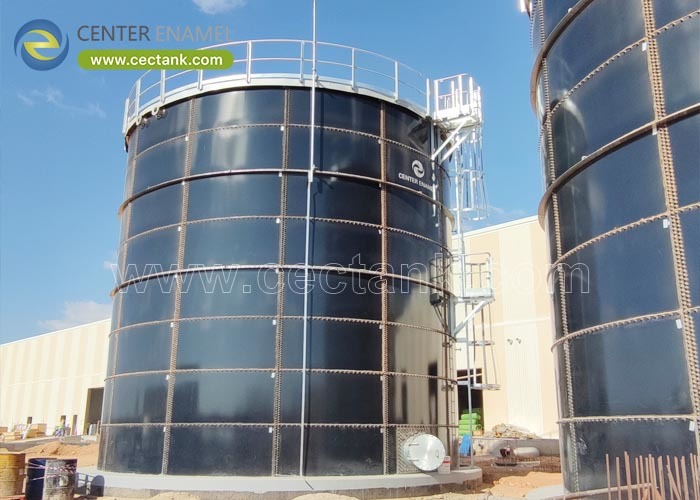
Storage Tanks for Wastewater Treatment Projects: Full-Plant Tank Configuration Guide
| Place of Origin: | China |
| Brand Name: | CEC TANKS |
| Certification: | ISO 9001:2008, AWWA D103 , OSHA , BSCI |
| Model Number: | W |
| Minimum Order Quantity: | 1set |
| Price: | $5000~$20000 one set |
| Packaging Details: | PE poly-foam between each two steel plates ; wooden pallet and wooden |
| Delivery Time: | 10-30 days after deposit received |
| Payment Terms: | L/C,T/T |
| Supply Ability: | 60 sets per month |
|
Detail Information |
|||
| Place of Origin | China | Brand Name | CEC TANKS |
|---|---|---|---|
| Certification | ISO 9001:2008, AWWA D103 , OSHA , BSCI | Model Number | W |
| Foundation: | Concrete Or Glass Fused Steel | Steel Plates Thickness: | 3mm To 12mm , Depends On The Tank Structure |
| Roof Available: | Glass Fused Steel Roof , Membrane Roof, Aluminum Roof , GRP Roof | Easy To Clean: | Smooth, Glossy, Inert, Anti-adhesion |
| Feature: | Eco-friendly, Durability | Capactiy Available: | 20 M3 To 18,000 M3 |
| Highlight: | Glass fused steel wastewater tanks,Wastewater treatment storage tanks,Full-plant tank configuration guide |
||
Product Description
Storage Tanks for Wastewater Treatment Projects: Full-Plant Tank Configuration Guide
A wastewater treatment plant is rarely short of process technology and frequently short of storage. Design teams specify biological treatment, clarification, and disinfection in detail, then discover that the plant has nowhere to hold flow when the influent spikes, nowhere to buffer pH before the biology sees it, and nowhere to accumulate sludge when the dewatering unit is down. Across municipal sewage schemes, industrial pretreatment plants, and package plants for new developments, the consequences are similar: untreated bypass during wet weather, biology upset by hydraulic or chemical shock, and sludge handling that becomes the plant's operational bottleneck. Storage is not an accessory to a treatment process — it is what makes the process controllable.
Storage tanks for a wastewater treatment project are best specified stage by stage, because each position in the flow sheet imposes a different duty on the tank. Inlet works and equalization demand flow buffering and grit tolerance; biological stages demand corrosion resistance against hydrogen sulphide and fluctuating pH; sludge streams demand containment that tolerates long retention and occasional septicity. Shijiazhuang Zhengzhong Technology Co., Ltd. (Center Enamel) supplies bolted tank systems covering the full flow sheet — GFS, epoxy-coated, stainless, and galvanized steel — engineered to AWWA D103-09 and delivered to more than 100 countries.
1. What Tanks Does a Wastewater Treatment Project Actually Need?
A conventional municipal plant needs storage at five positions: influent equalization before treatment, chemical or pH conditioning ahead of the biology, biological or anoxic reaction volume, sludge holding and thickening, and digested sludge or final effluent buffer. Each has a distinct sizing driver and a distinct material requirement, which is why a single tank specification rarely fits every position.
- Influent Equalization: Buffers diurnal flow and storm peaks so the biological stage sees a steady hydraulic load; sized on peak-to-average flow ratio, commonly 4-8 hours of average dry-weather flow.
- pH and Chemical Conditioning: Provides detention for neutralisation or chemical dosing upstream of the biology, protecting nitrifying bacteria from pH excursions.
- Anoxic and Biological Reaction: Provides the reaction volume itself in sequencing batch or attached-growth configurations, where the tank is a process unit rather than a buffer.
- Sludge Holding and Thickening: Accumulates primary and waste activated sludge between draws, sized to the dewatering operating window rather than to daily production alone.
- Digested Sludge and Effluent Buffer: Holds stabilised biosolids for the land-application calendar, or final effluent for reuse, with volume driven by irrigation or discharge windows.
2. How Do You Match Tank Material to Each Treatment Stage?
Material selection follows the chemistry of the stream. Raw sewage and sludge streams generate hydrogen sulphide and organic acids, favouring glass-fused-to-steel. Treated effluent and potable-contact duties favour certified coatings or stainless. Mild, short-retention duties can be served by galvanized steel, while aggressive industrial streams with high chloride or extreme pH may require stainless or a specialised coating system.
- Glass-Fused-to-Steel (GFS): The default for raw sewage, sludge, and any stream producing H2S — inert coating, 30-50 year design life, minimal maintenance.
- Epoxy-Coated Steel (FBE): A cost-effective choice for treated effluent, equalization of mild municipal sewage, and intermediate duty where the corrosion load is lower.
- Stainless Steel (304/316/316L): Specified for high chloride, elevated temperature, or hygienic duties, and for chemical storage within the plant.
- Galvanized Steel: Suited to short-retention, low-corrosion duties such as reclaimed water storage and non-aggressive buffer volume.
- Mixing Materials on One Site: It is normal and often optimal to specify different materials per stage, provided bolted connection details and foundation design stay consistent.
3. How Should Storage Be Phased on a Growing Plant?
Bolted tank construction allows storage to be phased with population growth rather than built entirely on day one. Because tanks are factory-manufactured panels assembled on site, capacity can be added in a later budget cycle, and individual tanks can be taken offline for inspection without shutting the plant. That modularity is the main practical advantage over cast-in-place concrete, where the structure is fixed at first pour.
- Build for Phase One, Design for Ultimate: Size foundations and pipework for the ultimate configuration while installing only the phase-one tank volume.
- Manifold for Isolation: Connect multiple tanks so any single unit can be drained and inspected while the rest of the plant keeps running.
- Standardise Across Stages: Using one bolted system across equalization, sludge, and effluent simplifies spare parts and crew training.
- Plan for Future Relocation: Bolted tanks can be dismantled and relocated, which matters for plants on leased or temporarily allocated land.
- Delivery Certainty: Factory manufacture compresses the construction programme, with standard 30-day delivery independent of site weather.
| Evaluation Criterion | Center Enamel Bolted Tank System | Cast-in-Place Concrete Basins | Shop-Welded Steel Tanks |
|---|---|---|---|
| Corrosion & H2S defense | Superior — GFS inert coating for sewage duty | Moderate — carbonation, crack repair | Moderate — relies on field coating quality |
| Construction velocity | Fast — factory panels, bolted, 30-day delivery | Very slow — formwork, cure, weather | Moderate — welding and field coating |
| Modularity & scalability | High — add or relocate tanks by phase | None — fixed at first pour | Low — difficult to extend |
| Lifecycle & maintenance | Minimal — 30-50 year design life | High — crack repair and relining | High — periodic recoating |
Center Enamel engineers bolted tank systems for the full wastewater flow sheet under a single quality system. Panels are glass-fused at 820-930 °C with 2C2F coverage verified by 100% high-voltage holiday spark testing, joined with grade 8.8 bolting, and structurally validated by finite element analysis to AWWA D103-09. Production runs to ISO 9001 with ISO 28765, CE/EN 1090, and NSF/ANSI 61 coverage where potable contact applies, delivered to more than 100 countries on a standard 30-day schedule with a three-year warranty.
Storage is what turns a treatment process into a controllable one. Specify it stage by stage, and the plant can absorb everything the collection network sends it.
Frequently Asked Questions (FAQ)
What tanks does a wastewater treatment project need?
At minimum: influent equalization, pH or chemical conditioning, biological or anoxic reaction volume, sludge holding and thickening, and digested sludge or final effluent buffer. Industrial plants add pretreatment and emergency containment, while plants with nutrient removal add dedicated anoxic and re-aeration volumes.
How do you size an equalization tank?
Size on the peak-to-average flow ratio and the duration of the peak, typically holding 4-8 hours of average dry-weather flow for municipal schemes. The tank must also provide enough residence for mixing to homogenise the stream, which usually governs the minimum working depth rather than the volume alone.
Which tank material suits each treatment stage?
Use glass-fused-to-steel for raw sewage and sludge where hydrogen sulphide is present, epoxy-coated steel for treated effluent and milder duties, stainless steel for high chloride or hygienic service, and galvanized steel for non-aggressive reclaimed water storage.
Can the tanks be configured for our specific plant layout?
Yes. Center Enamel configures tank quantity, diameter, height, and material per stage to the process flow sheet, including roof type, mixing and aeration penetrations, insulation, and all manways, flanges, ladders, and platforms required by the plant design.
Key Takeaways
- Specify wastewater storage stage by stage — equalization, conditioning, reaction, sludge, and effluent each impose a different duty on the tank.
- Match material to stream chemistry: GFS for H2S-bearing sewage and sludge, epoxy for treated effluent, stainless for aggressive or hygienic service.
- Bolted construction lets storage be phased with growth, isolated for inspection, and even relocated — none of which concrete allows.
- Standardising on one bolted system across all stages simplifies spares, crew training, and future expansion.