-
Glass Fused To Steel Tanks (690)
-
Stainless Steel Tanks (434)
-
Fusion Bonded Epoxy Tanks (592)
-
Galvanized Steel Tanks (321)
-
Aluminum Dome Roofs (1336)
-
Wastewater Storage Tanks (237)
-
Welded Steel Tanks (457)
-
Pressure Vessels (295)
-
Anaerobic Digester (202)
-
Industrial Water Tanks (349)
-
Glass Lined Steel Tanks (180)
-
Bolted Steel Tanks (389)
-
Sludge Storage Tank (115)
-
Biogas Storage Tank (173)
-
Leachate Storage Tanks (133)
-
Agricultural Water Storage Tanks (179)
-
Fire Water Tank (166)
-
Grain Storage Silos (146)
-
Biogas Projects (424)
-
Wastewater Treatment Projects (1389)
-
Double Membrane Roof (223)

|
Enamel Anaerobic Digestion Tanks Provider: How to Choose a Digester Tank Supplier
| Place of Origin: | China |
| Brand Name: | CEC TANKS |
| Certification: | ISO 9001:2008, AWWA D103 , OSHA , BSCI |
| Model Number: | W |
| Minimum Order Quantity: | 1set |
| Price: | $5000~$20000 one set |
| Packaging Details: | PE poly-foam between each two steel plates ; wooden pallet and wooden |
| Delivery Time: | 10-30 days after deposit received |
| Payment Terms: | L/C,T/T |
| Supply Ability: | 60 sets per month |
|
Detail Information |
|||
| Place of Origin | China | Brand Name | CEC TANKS |
|---|---|---|---|
| Certification | ISO 9001:2008, AWWA D103 , OSHA , BSCI | Model Number | W |
| Tank Body Color: | Dark Green / Can Be Customized | Corrosion Integrity: | Excellent |
| Steel Plates Thickness: | 3mm To 12mm , Depends On The Tank Structure | Chemical Resistance: | Excellent |
| Size Of Panel: | 2.4M * 1.2M | Easy To Clean: | Smooth, Glossy, Inert, Anti-adhesion |
| Highlight: | enamel anaerobic digestion tanks,glass fused steel digester tanks,digester tank supplier selection |
||
Product Description
Enamel Anaerobic Digestion Tanks Provider: How to Choose a Digester Tank Supplier
An anaerobic digester is one of the most hostile environments a storage tank will ever face. On farm digesters, municipal sludge facilities, and food-waste plants alike, the liquor attacks from several directions at once: hydrogen sulphide generated by sulphate-reducing bacteria, volatile fatty acids produced during hydrolysis, free ammonia, abrasive grit carried in with the feedstock, and a thermal load that never stops because the biology cannot be paused. Conventional containment fails predictably under that combination — concrete carbonates and cracks, epoxy and paint systems blister and delaminate, and each relining cycle takes the asset offline during the very weeks the plant is expected to be earning. Choosing the coating, and the provider behind it, is therefore the single decision that determines whether a digester runs for decades or becomes a maintenance liability.
Enamel anaerobic digestion tanks solve this by fusing glass to steel at 820-930 °C, creating a metallurgically bonded, chemically inert surface rather than a film that merely sits on the substrate. For developers evaluating an enamel anaerobic digestion tanks provider, the decisive questions are enameling process control, coating verification, structural engineering, and delivered reference scale. Shijiazhuang Zhengzhong Technology Co., Ltd. (Center Enamel) has manufactured glass-fused-to-steel (GFS) tanks since becoming China's first GFS tank producer, backed by enameling research and close to 200 enameling patents, with bolted tank systems delivered to more than 100 countries and a standard 30-day delivery window.
1. Why Is Enamel the Preferred Coating for Anaerobic Digestion Tanks?
Enamel is preferred because the digester environment attacks chemically, thermally, and mechanically at the same time, and only a fused inorganic coating resists all three simultaneously. Glass-fused-to-steel delivers chemical inertness, thermal stability, and abrasion resistance in one surface, where organic coatings soften under sustained heat and concrete loses alkalinity as it carbonates.
- Chemical Inertness: The fused glass layer is inert to hydrogen sulphide, volatile fatty acids, and free ammonia, so the coating does not react with the digesting liquor across a pH range that destroys paint systems.
- Thermal Stability: Continuous duty at mesophilic 35-38 °C or thermophilic 50-55 °C without softening or loss of adhesion, because the coating was formed above 820 °C in the first place.
- Abrasion Resistance: A surface hardness of 6.0 on the Mohs scale withstands grit, sand, and continuous mechanical mixing without the scouring that thins organic linings.
- Non-Delaminating Bond: Unlike epoxy or paint, the enamel is fused into the steel substrate, so there is no interface for moisture to creep under and lift the coating away in blisters.
- Gas Tightness: Precision bolted seams with engineered sealant retain biogas at 55-65% methane content, protecting both energy yield and site safety.
2. How Do You Evaluate an Enamel AD Tank Provider?
Evaluate a provider against four gates: whether they own and control the enameling furnace, whether every panel is electrically tested, whether the shell design is structurally validated, and whether they can show reference digesters of comparable volume. Providers that outsource firing or spot-check coatings rarely hold up once the tank is in continuous biological service.
- Enameling Process Control: In-house furnace firing at 820-930 °C with double-coat double-fire (2C2F) coverage as standard, and triple-coat (3C3F) available for aggressive service.
- Coating Verification: 100% high-voltage holiday spark testing of every panel, with coating adhesion measured at 3450 N/cm² and thickness verified before the panel leaves the factory.
- Structural Engineering: Shell and roof design validated by finite element analysis to AWWA D103-09, using grade 8.8 bolting and factory-controlled panel tolerances.
- Reference Scale: Operating digesters of comparable volume and climate — not only small demonstration units — ideally including projects above 10,000 m³.
- Certification Coverage: ISO 9001 quality management, ISO 28765 for glass-lined tanks, CE/EN 1090 structural compliance, plus ISO 45001 for site safety.
3. What Sizes and Configurations Are Available?
Enamel AD tanks are supplied across a wide band, from roughly 20 m³ for farm-scale plant up to very large municipal units, in three functional roles: the digester itself, the gasholder or gas storage vessel, and digestate storage. Roof configuration is selected to match whether the vessel holds liquid, gas, or both.
- Digester Tanks: The reactor vessel, configured for mesophilic or thermophilic duty with heating, insulation, and mixing penetrations built into the panel layout.
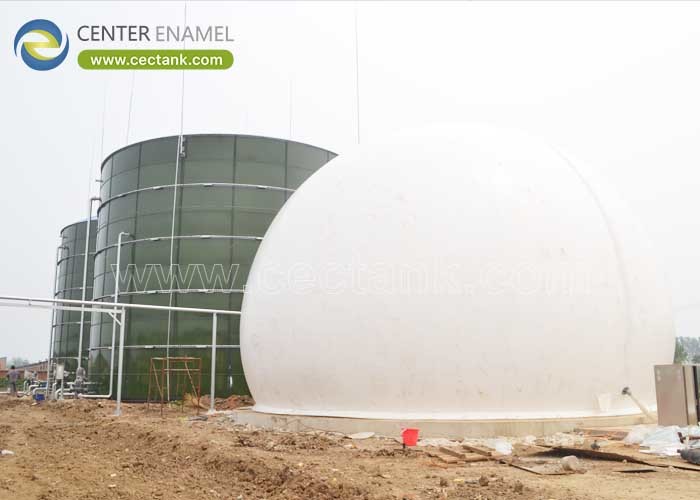
- Gasholders and Gas Storage: Dedicated gas vessels, often using a double-membrane roof over a GFS shell to decouple gas storage volume from digestion volume.
- Digestate Storage: Post-digestion storage sized to the land-application calendar, typically the largest tank volume on an agricultural site.
- Roof Options: GFS self-supporting roofs, aluminium geodesic domes for wide spans with no internal columns, or membrane covers for gas service.
- Capacity Band: Project configurations from 20 m³ to beyond 20,000 m³, with multiple tanks manifolded where a single vessel would exceed transport limits.
| Evaluation Criterion | Center Enamel GFS Enamel AD Tanks | Cast-in-Place Concrete Digester | Epoxy-Coated Steel Digester |
|---|---|---|---|
| Corrosion & H2S defense | Superior — inert fused glass, 820-930 °C bond | Moderate — carbonation and micro-cracking | Moderate — organic film degrades in H2S |
| Thermal & abrasion duty | High — 6.0 Mohs, continuous 35-55 °C | Moderate — sound but crack-prone | Low-Moderate — softens under heat |
| Construction velocity | Fast — factory panels, bolted, 30-day delivery | Very slow — formwork, cure, weather windows | Moderate — shop coated, field assembled |
| Lifecycle & maintenance | Minimal — 30-50 year design life | High — crack repair and relining | High — periodic recoating cycles |
Center Enamel engineers enamel digestion tanks for continuous biological duty: panels glass-fused at 820-930 °C for a bond that cannot delaminate, 2C2F coverage verified by 100% high-voltage holiday spark testing, grade 8.8 bolted connections, and shell geometry validated by finite element analysis to AWWA D103-09. Production runs under an ISO 9001 quality system with ISO 28765 and CE/EN 1090 coverage, with tanks delivered to more than 100 countries on a standard 30-day schedule and backed by a three-year warranty.
A digester coating does not fail gradually — it fails at the moment the bond lets go. Fuse the glass into the steel above 820 °C and there is no bond left to lose.
Frequently Asked Questions (FAQ)
What is an enamel anaerobic digestion tank?
It is a bolted steel digester vessel whose internal surface is covered with a glass enamel fused to the steel at 820-930 °C. The result is an inert, non-porous lining that resists hydrogen sulphide, organic acids, and abrasion while retaining biogas, making it the standard containment choice for agricultural, municipal, and industrial anaerobic digestion.
Why is enamel better than epoxy for digesters?
Epoxy is an organic film applied to the steel surface, so it can soften under sustained temperature, blister if moisture reaches the interface, and require periodic recoating. Enamel is fused into the substrate at furnace temperature, giving a bond with no interface to lift, a 6.0 Mohs surface that resists grit, and a 30-50 year design life without a relining programme.
What temperature do enamel digester tanks operate at?
The coating itself is formed above 820 °C, so process temperature is never the limiting factor. Digesters routinely run at mesophilic 35-38 °C or thermophilic 50-55 °C, with insulation and heating integrated into the tank design rather than added as a retrofit.
Can enamel AD tanks be customized to a specific feedstock?
Yes. Center Enamel configures digester volume, height-to-diameter ratio, heating and insulation package, mixing penetrations, and roof type to the feedstock and loading rate. Gasholder capacity, digestate storage volume, and the full complement of manways, flanges, ladders, and platforms are all specified to the individual plant.
Key Takeaways
- Enamel AD tanks fuse glass to steel at 820-930 °C, producing an inert coating with no interface to delaminate — unlike epoxy or paint systems.
- The coating survives simultaneous chemical, thermal, and abrasive attack, which is exactly the combination that destroys conventional digester linings.
- Evaluate a provider on furnace control, 100% spark testing, FEA-validated structural design, and reference digesters of comparable volume.
- One provider can cover the digester, gasholder, and digestate storage, keeping coating chemistry and bolted connection details consistent across the site.