-
Glass Fused To Steel Tanks (690)
-
Stainless Steel Tanks (434)
-
Fusion Bonded Epoxy Tanks (592)
-
Galvanized Steel Tanks (321)
-
Aluminum Dome Roofs (1336)
-
Wastewater Storage Tanks (237)
-
Welded Steel Tanks (457)
-
Pressure Vessels (295)
-
Anaerobic Digester (202)
-
Industrial Water Tanks (349)
-
Glass Lined Steel Tanks (180)
-
Bolted Steel Tanks (389)
-
Sludge Storage Tank (115)
-
Biogas Storage Tank (173)
-
Leachate Storage Tanks (133)
-
Agricultural Water Storage Tanks (179)
-
Fire Water Tank (166)
-
Grain Storage Silos (146)
-
Biogas Projects (424)
-
Wastewater Treatment Projects (1389)
-
Double Membrane Roof (223)

|
GFS Tanks for Wastewater Treatment Projects: Why Fused Glass Outlasts Alternatives
| Place of Origin: | China |
| Brand Name: | CEC TANKS |
| Certification: | ISO 9001:2008, AWWA D103 , OSHA , BSCI |
| Model Number: | W |
| Minimum Order Quantity: | 1set |
| Price: | $5000~$20000 one set |
| Packaging Details: | PE poly-foam between each two steel plates ; wooden pallet and wooden |
| Delivery Time: | 10-30 days after deposit received |
| Payment Terms: | L/C,T/T |
| Supply Ability: | 60 sets per month |
|
Detail Information |
|||
| Place of Origin | China | Brand Name | CEC TANKS |
|---|---|---|---|
| Certification | ISO 9001:2008, AWWA D103 , OSHA , BSCI | Model Number | W |
| Tank Body Color: | Dark Green / Can Be Customized | Corrosion Integrity: | Excellent |
| Steel Plates Thickness: | 3mm To 12mm , Depends On The Tank Structure | Chemical Resistance: | Excellent |
| Size Of Panel: | 2.4M * 1.2M | Easy To Clean: | Smooth, Glossy, Inert, Anti-adhesion |
| Highlight: | glass fused steel wastewater tanks,fused glass steel treatment tanks,durable glass fused steel tanks |
||
Product Description
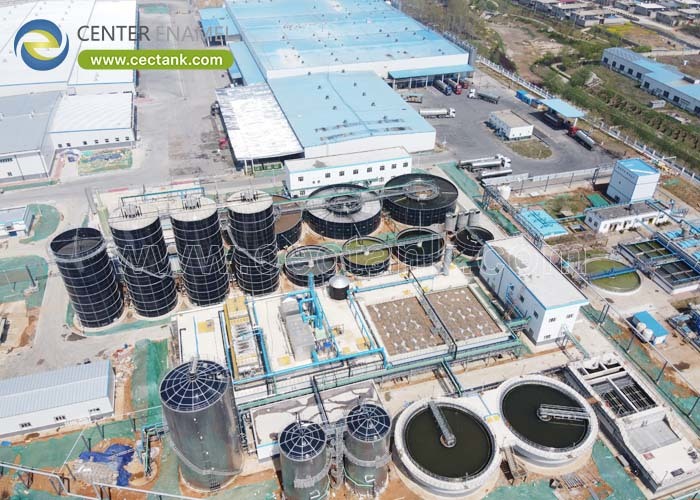
GFS Tanks for Wastewater Treatment Projects: Why Fused Glass Outlasts Alternatives
Wastewater is not a single chemical environment but a moving one. The same collection network that delivers near-neutral sewage on a dry Tuesday can deliver septic, sulphide-rich, low-pH flow after a long retention in a hot rising main. Across municipal treatment plants, pumping station wet wells, and industrial pretreatment schemes, that variability is what defeats containment specified for an average condition. Concrete loses alkalinity as it carbonates and is attacked by biogenic sulphuric acid. Epoxy linings survive the average and fail at the extremes, blistering where hydrogen sulphide has oxidised at the surface. Painted steel requires a relining programme that takes the tank out of service precisely when the plant can least afford it.
GFS tanks for wastewater treatment projects use a coating that is not applied to the steel but fused into it. Panels are fired at 820-930 °C so that the glass melts and bonds metallurgically with the substrate, producing a surface that is inert to hydrogen sulphide, organic acids, and the fluctuating pH of a real sewage stream. Shijiazhuang Zhengzhong Technology Co., Ltd. (Center Enamel) supplies bolted GFS tanks engineered to AWWA D103-09 for municipal and industrial wastewater duty in more than 100 countries.
1. How Does Hydrogen Sulphide Damage Wastewater Tanks?
Sulphate-reducing bacteria in septic sewage produce hydrogen sulphide, which dissolves in moisture on the tank wall and is oxidised by bacteria into sulphuric acid. That biogenic acid attacks cementitious materials and many coatings directly, which is why corrosion in wastewater tanks concentrates at and above the water line rather than below it.
- Generation: Sulphate-reducing bacteria generate H2S wherever sewage becomes septic, which happens readily in warm climates and in long retention times.
- Oxidation to Acid: At the tank wall, H2S dissolves in condensate and is oxidised biologically to sulphuric acid, the agent that actually destroys the surface.
- Attack Above the Water Line: Because the mechanism requires oxygen, corrosion concentrates on the vapour-space wall and underside of the roof — the areas least protected by the liquid itself.
- Concrete Vulnerability: Biogenic sulphuric acid dissolves the cement paste, exposing aggregate and reinforcement and initiating structural deterioration rather than surface wear.
- Coating Vulnerability: Organic coatings soften, permeate, and blister under sustained acid exposure, and once the bond lifts the corrosion spreads beneath the film.
2. Why Does a Fused Glass Coating Resist That Mechanism?
Resistance comes from chemistry and from bond type together. The fired glass surface is inorganic and inert, so biogenic sulphuric acid has nothing to dissolve, and because the coating is fused into the steel there is no interface for acid to reach and lift. The result is a vapour-space surface that behaves like the liquid-space surface over the life of the tank.
- Chemical Inertness: Fired glass is unaffected by the sulphuric acid, organic acids, and fluctuating pH that characterise real sewage streams.
- No Interface to Attack: Fusion above 820 °C removes the coating boundary, so there is no pathway for acid to creep beneath the surface and cause delamination.
- Verified Continuity: Every panel is tested at 1500 V, so the coating has no pinholes through which acid could reach the steel substrate.
- Abrasion Resistance: At 6.0 Mohs, the surface withstands grit and the scouring action of mixed sewage and cleaning operations.
- Triple-Coat Option: Where industrial discharge makes the stream unusually aggressive, 3C3F coating provides additional thickness and defect tolerance.
3. How Do GFS Tanks Fit a Wastewater Project Programme?
Beyond chemistry, GFS tanks suit project delivery because they are factory-manufactured and bolted. Capacity is not governed by site weather, the programme is predictable, and tanks can be phased, isolated, or relocated as the plant evolves — advantages that matter most on live sites where outage windows are short.
- Programme Predictability: Factory manufacture on a standard 30-day window, independent of the curing and weather constraints that govern concrete construction.
- Phased Capacity: Install for current load and add vessels later, matching capital spend to actual population growth rather than to a forecast.
- Isolation for Maintenance: Multiple tanks can be manifolded so one unit is drained and inspected while the plant continues to operate.
- Relocatable Asset: Bolted construction allows dismantling and relocation, which matters on leased sites and in temporary treatment schemes.
- Single-Supplier Scope: Equalization, anoxic, sludge holding, and effluent buffer tanks can be supplied on one coating system and one connection standard.
| Evaluation Criterion | Center Enamel GFS Wastewater Tanks | Cast-in-Place Concrete | Epoxy-Coated Steel (FBE) |
|---|---|---|---|
| Biogenic H2S acid resistance | Superior — inert fired glass, no interface | Poor — cement paste is dissolved | Moderate — softens and blisters at extremes |
| Fluctuating pH tolerance | High — wide operating pH envelope | Low — acid attack in low-pH events | Moderate — narrower envelope |
| Construction velocity | Fast — bolted panels, 30-day delivery | Very slow — formwork and cure | Fast — shop coated, moderate assembly |
| Service life & maintenance | 30-50 years, minimal intervention | Variable — crack repair and relining | Shorter — periodic recoating |
Center Enamel engineers GFS wastewater tanks for the full range of municipal and industrial duty: panels glass-fused at 820-930 °C with 2C2F coverage as standard and 3C3F available where the stream is unusually aggressive, every panel verified by 100% high-voltage holiday spark testing at 1500 V, adhesion measured at 3450 N/cm², and hardness at 6.0 Mohs. Shells are bolted with grade 8.8 fasteners, validated by finite element analysis to AWWA D103-09, produced to ISO 9001 with ISO 28765 and CE/EN 1090 coverage, and delivered to more than 100 countries on a standard 30-day schedule with a three-year warranty.
Sewage corrodes the vapour space, not the tank floor. If your coating only survives immersed, you have specified for the wrong half of the tank.
Frequently Asked Questions (FAQ)
Why is GFS used for wastewater treatment tanks?
Because sewage generates hydrogen sulphide that oxidises to sulphuric acid at the tank wall, and fused glass is inert to that acid while having no coating interface for it to attack. The result is a tank that performs in the vapour space as well as below the water line, over a 30-50 year design life.
How does hydrogen sulphide damage storage tanks?
Sulphate-reducing bacteria produce H2S in septic sewage. It dissolves in condensate on the wall and is oxidised biologically to sulphuric acid, which dissolves cement paste in concrete and softens or blisters organic coatings. Because oxygen is required, the damage concentrates above the water line and under the roof.
How does GFS compare with concrete and epoxy in sewage?
Concrete is dissolved by biogenic sulphuric acid and requires crack repair and relining. Epoxy survives average conditions but softens and blisters at pH extremes and under sustained acid exposure. GFS resists the full range because the inert fired surface has nothing for the acid to dissolve and no interface to lift.
Can GFS wastewater tanks be configured to our project?
Yes. Center Enamel configures tank quantity, capacity, geometry, coating system (2C2F or 3C3F), roof type, insulation, and all manways, flanges, ladders, platforms, and instrumentation to the process flow sheet and site layout.
Key Takeaways
- Sewage corrosion concentrates in the vapour space, where H2S oxidises to sulphuric acid — specify coatings for that zone specifically.
- Fused glass is inert to biogenic acid and has no interface to lift, so it performs above and below the water line alike.
- Every panel is spark tested at 1500 V, so there are no pinholes through which acid can reach the steel.
- Bolted GFS construction gives predictable 30-day delivery, phased capacity, isolation for maintenance, and future relocatability.