-
Glass Fused To Steel Tanks (690)
-
Stainless Steel Tanks (434)
-
Fusion Bonded Epoxy Tanks (592)
-
Galvanized Steel Tanks (321)
-
Aluminum Dome Roofs (1336)
-
Wastewater Storage Tanks (237)
-
Welded Steel Tanks (457)
-
Pressure Vessels (295)
-
Anaerobic Digester (202)
-
Industrial Water Tanks (349)
-
Glass Lined Steel Tanks (180)
-
Bolted Steel Tanks (389)
-
Sludge Storage Tank (115)
-
Biogas Storage Tank (173)
-
Leachate Storage Tanks (133)
-
Agricultural Water Storage Tanks (179)
-
Fire Water Tank (166)
-
Grain Storage Silos (146)
-
Biogas Projects (424)
-
Wastewater Treatment Projects (1389)
-
Double Membrane Roof (223)

|
How Do Organic Waste Biogas Projects Secure Feedstock? Contracts and Supply Strategy
| Place of Origin: | China |
| Brand Name: | CEC TANKS |
| Certification: | ISO 9001:2008, AWWA D103 , OSHA , BSCI |
| Model Number: | W |
| Minimum Order Quantity: | 1set |
| Price: | $5000~$20000 one set |
| Packaging Details: | PE poly-foam between each two steel plates ; wooden pallet and wooden |
| Delivery Time: | 10-30 days after deposit received |
| Payment Terms: | L/C,T/T |
| Supply Ability: | 60 sets per month |
|
Detail Information |
|||
| Place of Origin | China | Brand Name | CEC TANKS |
|---|---|---|---|
| Certification | ISO 9001:2008, AWWA D103 , OSHA , BSCI | Model Number | W |
| Tank Body Color: | Dark Green / Can Be Customized | Corrosion Integrity: | Excellent |
| Steel Plates Thickness: | 3mm To 12mm , Depends On The Tank Structure | Chemical Resistance: | Excellent |
| Size Of Panel: | 2.4M * 1.2M | Easy To Clean: | Smooth, Glossy, Inert, Anti-adhesion |
| Highlight: | organic waste biogas feedstock contracts,biogas project supply strategy,glass fused steel tanks |
||
Product Description
How Do Organic Waste Biogas Projects Secure Feedstock? Contracts and Supply Strategy
Across municipal source-separated organics programmes, supermarket distribution centres, and food-processing plants, the same failure repeats: a digester is built to nameplate capacity and then starved. A council re-tenders its collection zone mid-contract. A hauler redirects food scrap to a competitor paying a higher gate fee. One plastic-laden load settles into the tank as an inert raft that no mixer can resuspend. When feedstock stops, the biology does not pause politely — volatile fatty acids accumulate, pH falls, and a reactor can sour within days. For lenders, an unsecured feedstock base remains the fastest way to convert a bankable project into an idle asset, because the tank, the gasholder, and the upgrading train all earn nothing while the feedstock is missing.
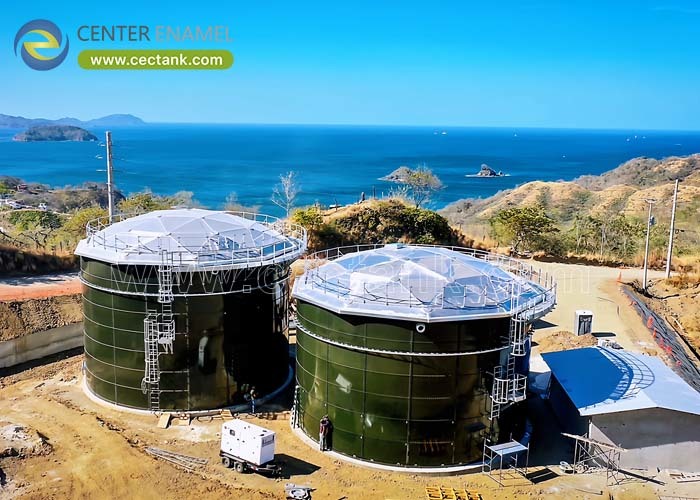
Organic waste biogas projects secure feedstock through long-term municipal collection contracts, commercial food-waste hauler networks, and — critically — exclusive or preferred-supplier agreements that reserve the organic fraction of municipal solid waste (OFMSW) or commercial food scrap for a single plant. Success hinges on pairing a legally secured volume with tight quality specifications covering purity, moisture, and contamination limits, plus a gate-fee or tipping-fee structure that makes supply economically rational for both sides. To convert that contracted tonnage into predictable gas output, developers pair the supply strategy with containment built for continuous duty: glass-fused-to-steel (GFS) digester tanks, gasholders, and digestate storage engineered by Shijiazhuang Zhengzhong Technology Co., Ltd. (Center Enamel), China's first GFS tank manufacturer, backed by enameling research and close to 200 enameling patents, with tank systems delivered to more than 100 countries.
1. What Does a Resilient Feedstock Supply Pyramid Look Like?
A resilient plant stacks three supply tiers — a contracted municipal base, a commercial middle, and an industrial top-up — so that no single counterparty can starve the digester. Most developers also carry one to two weeks of on-site buffer as the shock absorber between collection and feeding, which is what keeps the reactor running when a collection round is missed.
- Base Tier — Municipal SSO: Source-separated organics delivered under a multi-year council contract; the steady, high-volume backbone that anchors the plant's gas forecast and its debt service.
- Middle Tier — Commercial Food Waste: Supermarket, restaurant, and food-processor scrap collected through hauler partnerships; typically delivers a higher biogas yield per tonne than municipal SSO.
- Top-Up Tier — Industrial Organic Residues: Brewery, dairy, and beverage residues used to lift methane yield, priced on gate fee and scheduled around seasonal availability.
- Buffer Storage — 1–2 Weeks: On-site silage or wet-feed buffer sized so a missed collection never idles the reactor; Center Enamel supplies bolted GFS and epoxy-coated silos for this duty.
- Why Stacking Matters: Diversification across tiers and counterparties is the cheapest insurance available — it turns a single point of failure into a managed, priced supply risk.
2. How Do You Guarantee Feedstock Quality at the Gate?
Volume without quality is worthless, so the supply contract must carry the specification. Agreements set organic purity at a target of 85–95%, cap moisture, and limit contamination to plastics below 2–3% with zero tolerance for hazardous or inert loads. Those limits only bite when paired with rejection rights for off-spec deliveries, on-site incoming inspection, and a scheduled laboratory spot-check programme — together they keep the digester fed with digestible organics rather than hidden plastic and glass.
- Contractual Purity Target: 85–95% organic content written into the agreement, with a defined testing method and sampling frequency so the number is enforceable rather than aspirational.
- Contamination Caps: Plastics held below 2–3% by mass and zero tolerance for hazardous or inert material, which otherwise accumulates as dead volume and reduces effective tank capacity.
- Rejection Rights: The plant retains the contractual right to turn away off-spec loads — the single clause that makes every other quality specification enforceable.
- Gate Inspection and Laboratory Checks: Visual inspection of every delivery backed by scheduled laboratory analysis, with results returned to the supplier as a compliance record.
- Downstream Equipment Protection: Clean feedstock protects mixers, pumps, and the glass-fused lining from abrasive inert material, preserving the tank's 30–50 year design life.
3. What Contract Structures Keep Gas Flowing and Lenders Confident?
Four contract structures carry most organic waste biogas projects: a long-term municipal SSO concession, commercial hauler offtake agreements, direct generator contracts, and gate-fee tolling. Each is then reinforced with a minimum-guarantee or take-or-pay clause, so the supplier's commercial incentive is aligned with the plant's utilisation target of above 90% — the threshold lenders underwrite against.
- Municipal SSO Concession (10–25 Years): Grants an exclusive collection zone; the strongest volume lock available and the structure lenders weight most heavily in their base case.
- Commercial Hauler Offtake (3–7 Years): Sets a minimum tonnes-per-month commitment, delivering mid-term volume certainty without exposure to municipal tender cycles.
- Generator Direct (1–5 Years): Supermarkets and food processors on a fixed collection schedule, with quality specifications attached to each individual stream.
- Gate-Fee Tolling (Rolling): Per-tonne acceptance from waste brokers; flexible top-up volume priced at the gate, useful for filling short-term shortfalls.
- Take-or-Pay / Minimum Guarantee: Penalises chronic shortfall, aligning the counterparty's economics with the plant's uptime and gas-revenue target.
| Contract Type | Counterparty | Term | Key Clause |
| Municipal SSO concession | City / municipality | 10–25 yr | Exclusive collection zone |
| Commercial hauler offtake | Waste haulers | 3–7 yr | Minimum tonnes/month |
| Generator direct | Supermarkets, F&B | 1–5 yr | Fixed schedule + specs |
| Gate-fee tolling | Waste brokers | Rolling | Per-tonne acceptance |
| Evaluation Criterion | Center Enamel Integrated Feedstock Strategy | Broker / Spot Tolling Only | Single-Source Municipal Contract |
| Volume security & exclusivity | Superior — contracted, exclusive, diversified across tiers | Weak — spot-priced, no volume commitment | Moderate — high volume, single counterparty |
| Quality assurance & rejection rights | High — 85–95% purity spec'd and tested at the gate | Low — variable and frequently untested | Moderate — spec'd but limited leverage |
| Buffer storage & uptime resilience | High — 1–2 week buffer with GFS containment | None — reactor fully exposed to shortfall | Moderate — occasional buffer only |
| Bankability for financing | Strong — above 90% utilisation provable to lenders | Weak — not financeable on its own | Moderate — concentration risk discounts debt |
Center Enamel's feedstock-ready containment is engineered for continuous duty rather than intermittent batch work. Digester panels are glass-fused to steel at 820–930 °C, producing a chemically bonded coating that cannot delaminate, with double-coat double-fire (2C2F) coverage verified by 100% high-voltage holiday spark testing. Tanks are bolted with grade 8.8 fasteners and structurally validated by finite element analysis to AWWA D103-09, manufactured under an ISO 9001 quality system with ISO 28765, CE/EN 1090, and NSF/ANSI 61 coverage. Systems are produced in China with a standard 30-day delivery window, installed in more than 100 countries, and backed by a three-year warranty on the tank system.
Feedstock is not a procurement footnote — it is the first process unit of the plant. Secure the tonnes in writing, spec the purity at the gate, and buffer two weeks of flow; the digester will do the rest.
Frequently Asked Questions (FAQ)
What contracts secure municipal organic waste?
A long-term (10–25 year) municipal SSO concession granting an exclusive collection zone is the strongest lock. Complement it with 3–7 year hauler offtake agreements and direct generator contracts with supermarkets or food processors to add volume and yield diversity, so no single tender cycle can remove the whole supply base at once.
How do you guarantee feedstock quality?
Write purity, moisture, and contamination caps into the contract — target 85–95% organics with plastics below 2–3% — retain rejection rights for off-spec loads, and run incoming inspection alongside scheduled laboratory checks. Quality clauses are what protect the digester from plastic and inert shock that would otherwise settle as unusable dead volume.
What is an exclusive feedstock agreement?
It reserves a defined organic waste stream — such as the source-separated organics of a city or the food scrap of a retail chain — for one biogas plant, blocking competitors from bidding for the same material. Exclusivity is the provision that turns a hopeful supply into a bankable, financeable feedstock base.
Why is feedstock security critical for financing?
Lenders underwrite on predictable cash flow. A secured, contracted volume with quality clauses and penalty-backed minimums demonstrates that the plant will run above 90% utilisation, which is what unlocks debt and lowers the cost of capital for the entire project.
Can the buffer and digester tanks be customized to the supply model?
Yes. Center Enamel sizes feedstock buffer silos, digester tanks, gasholders, and digestate storage to the contracted tonnage and collection rhythm. Customization covers capacity and height-to-diameter ratio, roof configuration including GFS roofs, aluminium geodesic domes, or membrane covers, heating and insulation for mesophilic operation at 35–38 °C, and the full complement of manways, flanges, ladders, and platforms.
Key Takeaways
- Feedstock security is a three-tier structure — a contracted municipal SSO base, a commercial food-waste middle, and an industrial residue top-up — never a single source.
- Exclusivity is the clause that matters most: a 10–25 year municipal concession plus 3–7 year hauler offtake converts a hopeful supply into a bankable volume.
- Quality must be written into the contract — 85–95% organic purity, plastics below 2–3%, rejection rights, and gate inspection — or the digester absorbs the contamination.
- Pair contracted tonnage with one to two weeks of on-site buffer storage and continuous-duty GFS containment to hold utilisation above 90%.