-
Glass Fused To Steel Tanks (596)
-
Stainless Steel Tanks (434)
-
Fusion Bonded Epoxy Tanks (592)
-
Galvanized Steel Tanks (321)
-
Aluminum Dome Roofs (1336)
-
Wastewater Storage Tanks (232)
-
Welded Steel Tanks (457)
-
Pressure Vessels (295)
-
Anaerobic Digester (202)
-
Industrial Water Tanks (349)
-
Glass Lined Steel Tanks (180)
-
Bolted Steel Tanks (389)
-
Sludge Storage Tank (115)
-
Biogas Storage Tank (173)
-
Leachate Storage Tanks (133)
-
Agricultural Water Storage Tanks (179)
-
Fire Water Tank (166)
-
Grain Storage Silos (146)
-
Biogas Projects (424)
-
Wastewater Treatment Projects (1228)
-
Double Membrane Roof (223)


|
Cow Dung to Biogas in Indonesia: A Sustainable Approach with GFS Tanks and CSTR
| Place of Origin: | China |
| Brand Name: | CEC TANKS |
| Certification: | ISO 9001:2008, AWWA D103 , OSHA , BSCI |
| Model Number: | W |
| Minimum Order Quantity: | 1set |
| Price: | $5000~$20000 one set |
| Packaging Details: | PE poly-foam between each two steel plates ; wooden pallet and wooden |
| Delivery Time: | 10-30 days after deposit received |
| Payment Terms: | L/C,T/T |
| Supply Ability: | 60 sets per month |
|
Detail Information |
|||
| Place of Origin | China | Brand Name | CEC TANKS |
|---|---|---|---|
| Certification | ISO 9001:2008, AWWA D103 , OSHA , BSCI | Model Number | W |
| Tank Body Color: | Dark Green / Can Be Customized | Corrosion Integrity: | Excellent |
| Steel Plates Thickness: | 3mm To 12mm , Depends On The Tank Structure | Chemical Resistance: | Excellent |
| Size Of Panel: | 2.4M * 1.2M | Easy To Clean: | Smooth, Glossy, Inert, Anti-adhesion |
| Highlight: | Cow dung biogas GFS tanks,Biogas production CSTR Indonesia,Sustainable wastewater treatment biogas |
||
Product Description
Indonesia's vast agricultural landscape supports a massive cattle population, essential for rural economies across Java, Sumatra, and Sulawesi. However, the concentration of these large herds results in the accumulation of vast quantities of cow dung. Without proper management, this manure poses serious environmental threats, including surface water pollution, soil degradation, and the emission of greenhouse gases like methane. The informal and traditional disposal methods fail to address these sanitation risks and represent a missed opportunity to create value from a significant agricultural byproduct. There is a growing need for mechanized, modern systems that can efficiently process these organic wastes, turning a major disposal burden into a valuable resource for local energy production and sustainable farming practices.
The conversion of cow dung into biogas is a transformative process that harnesses the power of anaerobic digestion. In this controlled, oxygen-free environment, specialized microorganisms break down the complex organic compounds in the manure. This biological process produces biogas, a clean and renewable fuel source. The benefits are substantial: the process significantly reduces waste volume, mitigates odor, and produces a nutrient-rich digestate that serves as a superior organic fertilizer. By replacing chemical fertilizers and fossil fuels, this circular economy model improves agricultural productivity and enhances local energy independence, contributing to a greener and more sustainable agricultural sector for Indonesia.
Center Enamel stands at the forefront of this transition as a professional Biogas Project Contractor, offering comprehensive design solutions tailored to the unique infrastructure needs of biogas projects in Indonesia. Our team of experts conducts thorough site assessments to understand the specific volume of waste and energy requirements, ensuring that each plant is engineered for maximum output. By focusing on site-specific hydraulic retention times and material handling flow, we minimize operational downtime and maximize the lifecycle of the facility, ensuring a long-term, reliable energy solution for Indonesian agricultural stakeholders.
The Continuous Stirred-Tank Reactor (CSTR) is the core processing unit that converts organic waste into biogas and digestate. It is an advanced anaerobic treatment technology specifically designed to handle high-concentration organic slurries like cow dung. The reactor employs a powerful mechanical stirring device to maintain a homogeneous mixture of raw materials and anaerobic microorganisms within a closed, temperature-controlled environment.
By ensuring continuous feeding and a complete, uniform mixing state, the CSTR process significantly enhances the degradation rate of organic matter. This ensures a stable and optimized biogas yield compared to conventional, unmixed systems. The uniformity of the environment is critical for maximizing pathogen reduction and stabilizing the digested output, making it the preferred core technology for large-scale livestock waste treatment facilities in tropical climates like Indonesia. Recent studies confirm that optimized conditions in CSTRs, such as controlled stirring, can boost methane yields by over 34%.
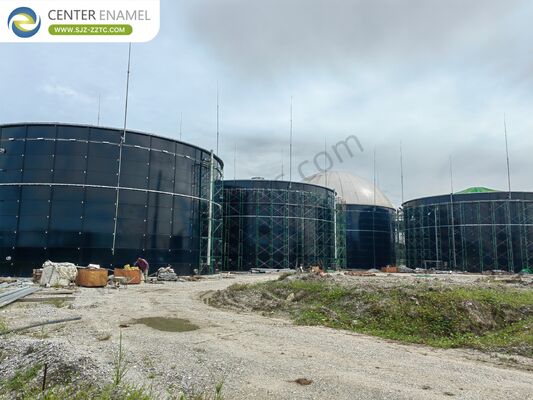
Center Enamel utilizes high-performance Glass-Fused-to-Steel (GFS) Tanks, which provide an inert and durable storage environment essential for anaerobic processes. The GFS technology combines the strength of steel with the corrosion resistance of glass, ensuring structural integrity against the harsh chemical environments of fermentation. This durability is critical for withstanding the aggressive biological and chemical conditions inside a biogas reactor.
These tanks are paired with specialized Double Membrane Roofs. This combination is highly favored for biogas applications due to its excellent air-tightness and odor control—features that are essential for methane containment and worker safety. The double membrane design is space-efficient and cost-effective, providing a dynamic gas storage volume that adapts to fluctuations in biogas production. This integrated architecture optimizes capital expenditure by eliminating the need for separate external gas holders and significantly reduces the structural footprint.
Beyond GFS Tanks and double membrane roofs, Center Enamel manufactures a diverse range of specialized storage tanks and protective roofing systems:
- Galvanized Steel Tanks: Utilizing a specialized galvanizing process to create a tough, wear-resistant protective coating, offering excellent corrosion resistance in Indonesia's humid climate.
- Fusion Bonded Epoxy (FBE) Tanks: Developed with innovative coating technology to provide superior chemical resistance and robust performance.
- Stainless Steel Tanks: High-quality AISI 304/316 options designed for handling highly corrosive environments or high-purity liquid storage.
- Aluminum Geodesic Dome Roofs: Lightweight, clear-span structures offering excellent load-bearing capacity, minimal maintenance, and complete corrosion resistance.
- Aluminum Alloy Trough Deck Roofs: An economical option for basic weather protection and odor control where airtight sealing is not a requirement.
- FRP (Fiber Reinforced Plastic) Roofs: Versatile structures, available in dome or flat designs, for non-air-tight applications.
A complete biogas plant is supported by a suite of ancillary equipment that ensures seamless operation. This includes Gas Holders for storage, Solid-Liquid Separators to process digestate, and Torch Systems for flaring. Key processing equipment includes Dehydration and Desulfurization Tanks to condition the raw biogas for use, Lifting Pumps, and Screw Sludge Dewatering Machines for efficient waste handling.
As a leading Biogas Project Contractor, Center Enamel provides a true turnkey solution for clients in Indonesia and beyond. Our position as a global leader is built on decades of experience, a commitment to quality, and a comprehensive EPC approach.
- Proven Track Record: With over 10,000 successful installations in more than 100 countries, including numerous projects in Southeast Asia, we have the expertise to handle the most complex biogas projects.
- Manufacturing Excellence: As the largest GFS Tanks manufacturer in Asia, we control every aspect of production, from enamel frit manufacturing to panel fabrication, ensuring unmatched quality.
- International Certifications: Our products comply with a wide array of international standards, including AWWA D103, ISO 28765, NSF/ANSI 61, and CE/EN1090, guaranteeing safety and performance.
- Comprehensive Services: From initial feasibility studies and engineering design to global logistics and on-site supervision, we deliver a seamless, integrated service. This ensures that the Cow Dung Treatment process is efficient, reliable, and economically viable for the long term.
Indonesia's potential for producing renewable energy from agricultural waste is immense. By implementing advanced technologies like the CSTR and utilizing robust GFS Tanks, cow dung transforms from an environmental liability into a valuable resource. Center Enamel, as a premier Biogas Project Contractor, is perfectly positioned to help Indonesia achieve its renewable energy and sustainability goals, offering world-class engineering, equipment, and project management services for a cleaner, greener future.
1. What is the role of a Biogas Project Contractor?
A Biogas Project Contractor provides end-to-end services for developing a biogas plant. This includes engineering design, procurement of all necessary equipment (like GFS Tanks and CSTR systems), construction, and often commissioning. They ensure the project is completed on time, within budget, and functions as designed, handling everything from site assessment to operational handover.
2. What is Cow Dung Treatment and why is it important?
Cow Dung Treatment refers to the management and processing of cattle manure. Modern treatment involves anaerobic digestion to convert the organic matter into biogas and a stable fertilizer (digestate). This is vital because it prevents the pollution of water and soil, reduces harmful methane emissions, and recovers valuable energy and nutrients from a waste product, creating a circular economic benefit.
3. Why choose GFS Tanks for biogas projects?
GFS Tanks are the preferred choice for biogas projects due to their superior corrosion resistance and longevity. The glass-fused-to-steel coating creates an impermeable, inert barrier that stands up to the acidic conditions inside a digester. They are easy to install, require minimal maintenance, and have a service life exceeding 30 years, making them a cost-effective and reliable storage solution.