-
Glass Fused To Steel Tanks (896)
-
Stainless Steel Tanks (434)
-
Fusion Bonded Epoxy Tanks (660)
-
Galvanized Steel Tanks (321)
-
Aluminum Dome Roofs (1336)
-
Wastewater Storage Tanks (280)
-
Welded Steel Tanks (457)
-
Pressure Vessels (524)
-
Anaerobic Digester (217)
-
Industrial Water Tanks (424)
-
Glass Lined Steel Tanks (180)
-
Bolted Steel Tanks (389)
-
Sludge Storage Tank (115)
-
Biogas Storage Tank (173)
-
Leachate Storage Tanks (133)
-
Agricultural Water Storage Tanks (179)
-
Fire Water Tank (166)
-
Grain Storage Silos (146)
-
Biogas Projects (424)
-
Wastewater Treatment Projects (1872)
-
Double Membrane Roof (223)
|
Welded Pressure Vessel Versus Seamless And Bolted Construction
| Place of Origin: | China |
| Brand Name: | Center Enamel |
| Certification: | ISO 9001,CE, NSF/ANSI 61, WRAS, ISO 28765, LFGB, BSCI, ISO 45001 |
| Minimum Order Quantity: | 1 Sets |
| Price: | 2000 |
| Delivery Time: | 2 months |
| Payment Terms: | L/C,T/T |
| Supply Ability: | 200 sets / days |
|
Detail Information |
|||
Product Description
A welded pressure vessel is built from formed plate and heads joined by welding, which is the dominant route for medium and large vessels. Seamless, bolted and cast constructions exist for specific size, pressure or service reasons.
This comparison explains how the construction method changes size limits, inspection burden, joint efficiency and cost, and how to choose a route for a given duty.
Four Construction RoutesWelded construction assembles plate courses and formed heads with longitudinal and circumferential welds. Seamless construction starts from a hollow billet or pierced tube, so the shell has no longitudinal seam.
Bolted construction uses flanged sections with gaskets and bolting, allowing disassembly. Cast construction pours the shape in one piece, useful for complex geometries but limited in size and inspection.
Why Welding Dominates Large VesselsPlate can be rolled to almost any practical diameter and length, so welded construction is the only economic route for large storage and process vessels. Heads are formed separately and welded to the shell.
Welding also allows internal features — trays, baffles, coils and reinforcement pads — to be attached during fabrication, which is difficult in a seamless shell.
Where Seamless Is PreferredSeamless construction removes the longitudinal weld, which is often the most heavily examined joint in a welded vessel. It is favoured for small diameters, high pressures and services where weld integrity is a concern.
The trade-off is a hard size limit set by available billet and piercing equipment, plus higher unit cost. A seamless shell cannot be extended indefinitely to match a large process duty.
Joint Efficiency And Design ThicknessIn welded construction the allowable joint efficiency depends on the type of joint and the extent of radiographic or ultrasonic examination. A fully examined joint permits a higher efficiency and therefore less thickness.
This links inspection to material cost: paying for full examination can reduce plate thickness. The design must state the examination level so the thickness basis is unambiguous.
Bolted Construction And MaintainabilityBolted vessels or sections are chosen where frequent internal access is needed, or where transport limits make a monolithic welded vessel impractical. Gasket selection then becomes part of the pressure-boundary design.
The trade-off is more sealing surfaces, more bolting to maintain, and gasket compatibility with the fluid and temperature. Bolted joints need controlled assembly and periodic retightening.
Cast And Special ConstructionsCast construction suits complex shapes and certain corrosion-resistant alloys where forming and welding are difficult. It is generally limited by size, defect inspection and the difficulty of repairing cast pressure parts.
Clad and lined constructions — a carbon steel shell with a corrosion-resistant layer — form another family, where the structural and corrosion functions are split between materials.
Inspection Burden By RouteA welded vessel carries a weld map, procedure qualifications and seam examination records. A seamless shell removes much of that seam work but still requires thickness, material and final test verification.
Bolted construction shifts attention to gasket seating and bolt condition; cast construction needs careful casting-level inspection. Each route concentrates inspection in a different place.
Choosing The RouteStart with diameter, length and pressure, then add service, access and transport constraints. Large diameter almost always means welded; small high-pressure shells may justify seamless; frequent access favours bolted sections.
Finally check the fabrication capability and code route available at the destination. A construction method that cannot be inspected or certified to the required code is not a valid option.
Construction Route ComparisonAspect |
Welded |
Seamless |
Bolted |
Cast |
Typical size |
Small to very large |
Small / medium |
Medium |
Small / complex |
Longitudinal seam |
Yes |
None |
Bolted joint |
None |
Joint efficiency lever |
Examination level |
No seam |
Gasket/bolt design |
Casting quality |
Disassembly |
No |
No |
Yes |
No |
Inspection focus |
Welds + NDT |
Wall + material |
Seals + bolts |
Casting defects |
Relative cost |
Economic at scale |
Higher per size |
Moderate |
Application-specific |
Input |
Route implication |
Shell diameter and length |
Sets feasibility of seamless |
Design pressure |
Drives thickness and seam quality |
Corrosive service |
May require clad or cast alloy |
Need for internal access |
Favours bolted sections |
Transport limits |
May force site welding or bolted |
Examination level |
Sets welded joint efficiency |
Code and marking |
Constrains acceptable routes |
Welded construction is the default for modern pressure vessels because plate can be formed to almost any size and internals can be added freely. Seamless, bolted and cast routes solve narrower problems.
Choose the route from diameter, pressure, service, access and transport constraints, then confirm that the inspection and code route at the destination can certify it.
About Center EnamelCenter Enamel is a pressure vessel and process equipment manufacturer based in China, producing stainless steel and carbon steel pressure vessels, separators, reactors, heat exchangers and storage tanks for chemical, oil and gas, power, food, pharmaceutical and water-treatment applications.
The company works under ASME VIII Div.1, GB/T 150 and ISO 9001, and can supply CE/PED marking for the EU market with material traceability, documented welding procedures, NDT and hydrostatic testing in the delivered data book.
- Certifications: ASME, ISO 9001, CE/PED, NSF/ANSI 61, WRAS, ISO 28765, LFGB, BSCI, ISO 45001.
- Standards: ASME VIII Div.1, GB/T 150, EN 13445 where required by the destination market.
- Commercial terms: Minimum order quantity 1 unit, typical lead time about 2 months, L/C or T/T.
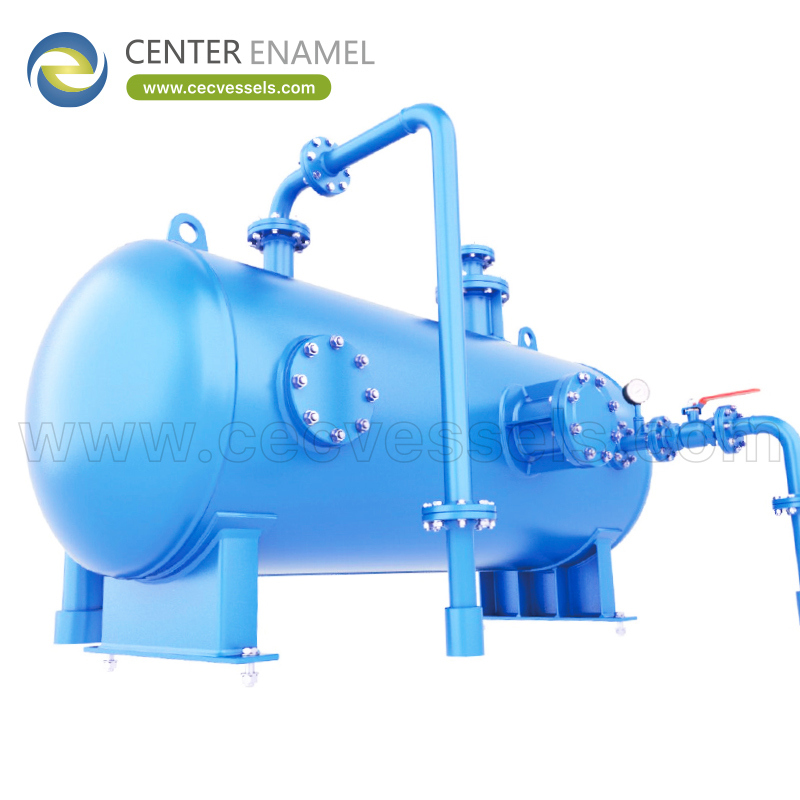
A vessel assembled from formed plate courses and heads joined by welding, the common route for medium and large vessels.
Why not make every vessel seamless?Seamless shells are limited by billet and piercing equipment size and cost more per unit, so large vessels are impractical.
Does seamless mean no inspection needed?No. Wall thickness, material and final testing still apply; only the longitudinal seam work is removed.
What is joint efficiency?A factor in thickness calculation that depends on joint type and the extent of nondestructive examination.
How does NDT reduce vessel cost?Full examination can permit higher joint efficiency, reducing required wall thickness and plate weight.
When is a bolted vessel used?Where frequent internal access is needed or transport limits prevent a single welded unit.
What maintenance do bolted joints need?Gasket compatibility, controlled assembly torque and periodic retightening.
Are cast pressure vessels common?They are used for complex shapes and certain alloys, but are limited in size and inspection.
What is a clad vessel?A carbon steel structural shell with a corrosion-resistant layer, splitting strength and corrosion duties.
Can internals be added to a seamless shell?With difficulty; welded construction is far more flexible for trays, coils and baffles.
Which seam is most critical in a welded vessel?The longitudinal seam is typically the most heavily loaded and most closely examined.
Does construction method affect inspection code?It changes where inspection effort concentrates and which records the data book must contain.
Can a welded vessel be disassembled?Generally no; flange connections on nozzles allow limited access but not full disassembly.
What drives material choice in corrosive service?The fluid and temperature, often leading to clad, lined or alloy construction.
What is the lead time for a welded engineered vessel?About two months from a China manufacturer, subject to code, size and inspection scope.
Suggested CTA: Request a technical quotation with your duty, pressure, temperature and fluid data, or discuss the applicable code and compliance route with a Center Enamel engineer.