-
Glass Fused To Steel Tanks (896)
-
Stainless Steel Tanks (434)
-
Fusion Bonded Epoxy Tanks (660)
-
Galvanized Steel Tanks (321)
-
Aluminum Dome Roofs (1336)
-
Wastewater Storage Tanks (280)
-
Welded Steel Tanks (457)
-
Pressure Vessels (524)
-
Anaerobic Digester (217)
-
Industrial Water Tanks (424)
-
Glass Lined Steel Tanks (180)
-
Bolted Steel Tanks (389)
-
Sludge Storage Tank (115)
-
Biogas Storage Tank (173)
-
Leachate Storage Tanks (133)
-
Agricultural Water Storage Tanks (179)
-
Fire Water Tank (166)
-
Grain Storage Silos (146)
-
Biogas Projects (424)
-
Wastewater Treatment Projects (1872)
-
Double Membrane Roof (223)
|
Pressure Vessel Vs Reactor Function And Design Compared
| Place of Origin: | China |
| Brand Name: | Center Enamel |
| Certification: | ISO 9001,CE, NSF/ANSI 61, WRAS, ISO 28765, LFGB, BSCI, ISO 45001 |
| Minimum Order Quantity: | 1 Sets |
| Price: | 2000 |
| Delivery Time: | 2 months |
| Payment Terms: | L/C,T/T |
| Supply Ability: | 200 sets / days |
|
Detail Information |
|||
Product Description
Pressure Vessel Vs Reactor Function And Design Compared
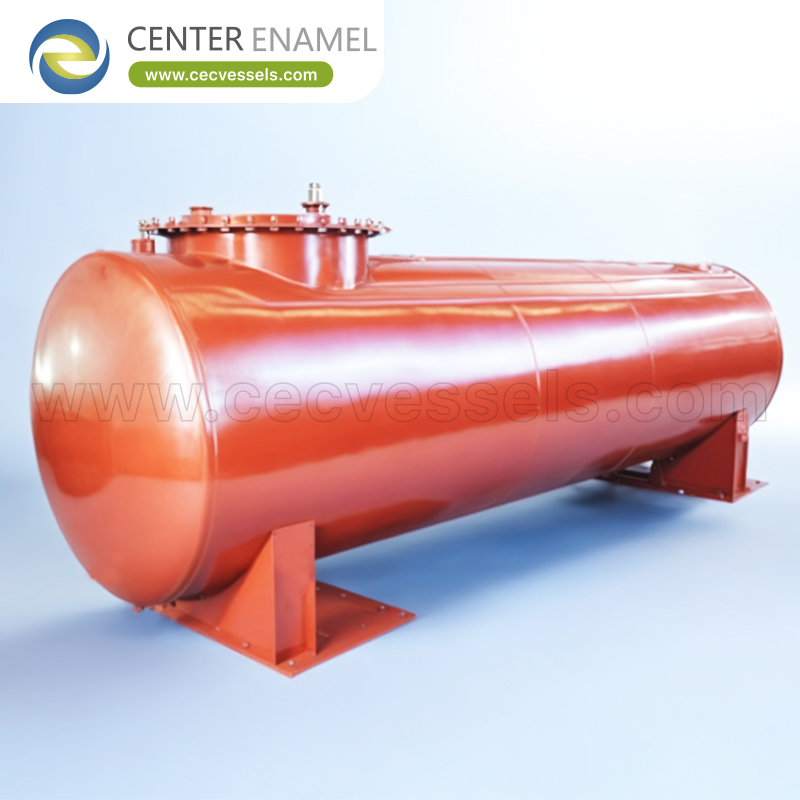
A reactor is a pressure vessel designed to carry out a reaction, not a separate class of equipment. The difference is function: a general vessel contains, stores or separates a fluid; a reactor provides the conditions and mixing for a chemical or biological transformation.
This guide compares the two by internals, agitation, heat transfer, control and the design questions each one must answer.
A Reactor Is A Functional Subset
Most reactors are pressure vessels with added features: an agitator, a heating or cooling jacket or coil, baffles, and ports for dosing, sampling and instrumentation. The pressure boundary is still designed to the vessel code.
So the classification is not vessel or reactor in a structural sense. It is whether the equipment's job is to hold a fluid or to make something happen to it under controlled conditions.
Containment Vessels: The Simpler Job
A storage or buffer vessel is designed around pressure, volume, corrosion allowance and nozzle loads. Its contents are essentially the same at the outlet as at the inlet.
Internals are minimal, and the design focus is integrity and inventory. There is no need to manage reaction rate, mixing uniformity or heat removal.
What A Reactor Adds
Reactors add process functions inside the same shell: mixing to keep reactants in contact, heat transfer to hold a temperature window, and sometimes gas dispersion, solids suspension or vacuum operation.
Each added function creates a design input. Agitation introduces shaft loads and vibration; a jacket adds a second pressure boundary; baffles change flow and heat transfer.
Agitation And Mechanical Loads
The agitator and its shaft must be sized for the fluid's viscosity and density, and the nozzle that carries the shaft becomes a loaded opening in the head or shell. The support must tolerate the resulting moment.
Mixing also drives the choice of impeller and baffles. A design that ignores these mechanical loads risks seal failure, excessive vibration or fatigue at the agitator nozzle.
Heat Transfer And Temperature Control
Many reactions are exothermic or need a narrow temperature band. Jackets, internal coils or external loops remove or add heat, and their surfaces must be sized against the reaction heat load.
Thermal control affects safety as well as yield. A reaction that cannot shed its heat can run away, so heat-removal capacity is a design requirement rather than a convenience.
Materials And Cleanliness
Reactor material selection considers the reactants, products, catalysts and cleaning agents, as well as temperature and pressure. Corrosion products can contaminate a product or poison a catalyst.
Pharmaceutical and food reactors add surface finish, drainability and cleanability requirements. A vessel used only for storage rarely carries that burden.
Control And Instrumentation
A reactor normally carries temperature, pressure, level and often pH or concentration instruments, with control loops that adjust heating, cooling, dosing and agitation.
A simple vessel may need only level and pressure indication. The instrument and control scope is therefore a major practical difference even when the shells look identical.
Which One Does My Duty Need
If the fluid only needs to be held, buffered or separated, a vessel is sufficient and simpler. If a reaction, dissolution, crystallization or biological growth must be controlled, specify a reactor.
Describe the process — reactants, reaction heat, viscosity, mixing goal, temperature window and batch or continuous operation — so the mechanical design can serve the process rather than fight it.
Containment Vessel Versus Reactor
Aspect |
General pressure vessel |
Reactor |
Primary job |
Contain / store / separate |
Carry out a controlled reaction |
Agitation |
Rare |
Common, with shaft loads |
Heat transfer |
Often minimal |
Jacket or coil, sized to reaction heat |
Internals |
Few |
Baffles, coils, distributors |
Instrumentation |
Level / pressure mainly |
T, P, level, pH, dosing loops |
Material driver |
Fluid corrosion |
Reactants, products, cleanliness |
Design complexity |
Pressure containment |
Pressure plus process functions |
Reactor Duty Inputs
Input |
Design consequence |
Reaction heat load |
Sizes jacket / coil |
Fluid viscosity and density |
Sizes agitator and motor |
Temperature window |
Sets control strategy |
Corrosive species |
Sets material / lining |
Batch or continuous |
Sets operating mode |
Solids or gas phase |
Sets baffle and impeller type |
Cleanliness requirement |
Sets finish and drainability |
Conclusion
A reactor is a pressure vessel with added process functions. The shell still follows vessel rules, but agitation, heat transfer, internals and control make the design a joint mechanical and process problem.
Define the reaction duty first — heat, mixing, temperature and cleanliness — then specify the vessel features that deliver it, rather than ordering a shell and adding equipment later.
About Center Enamel
Center Enamel is a pressure vessel and process equipment manufacturer based in China, producing stainless steel and carbon steel pressure vessels, separators, reactors, heat exchangers and storage tanks for chemical, oil and gas, power, food, pharmaceutical and water-treatment applications.
The company works under ASME VIII Div.1, GB/T 150 and ISO 9001, and can supply CE/PED marking for the EU market with material traceability, documented welding procedures, NDT and hydrostatic testing in the delivered data book.
- Certifications: ASME, ISO 9001, CE/PED, NSF/ANSI 61, WRAS, ISO 28765, LFGB, BSCI, ISO 45001.
- Standards: ASME VIII Div.1, GB/T 150, EN 13445 where required by the destination market.
- Commercial terms: Minimum order quantity 1 unit, typical lead time about 2 months, L/C or T/T.
Frequently Asked Questions (FAQ)
Is a reactor a pressure vessel?
Yes in most cases. It is a pressure vessel designed with added features to carry out a reaction.
What is the core difference between a vessel and a reactor?
Function: a vessel contains or separates a fluid; a reactor provides controlled conditions for a transformation.
What equipment does a reactor add?
Agitation, heat transfer surfaces, baffles, dosing and sampling ports, and process instrumentation.
Why does agitation affect mechanical design?
The shaft and its nozzle carry loads and moments, and vibration can cause seal failure or fatigue.
How is reactor heat transfer sized?
Against the reaction heat load and the required temperature window, using a jacket, coil or external loop.
What is a runaway reaction?
A reaction whose heat release exceeds heat removal, causing temperature and rate to escalate.
Does material selection differ for reactors?
Yes. Reactants, products, catalysts and cleaning agents all influence the grade, beyond simple corrosion.
What cleanliness requirements apply?
Pharmaceutical and food reactors may need specific surface finish, drainability and clean-in-place capability.
Can a storage vessel be converted to a reactor?
Usually not economically, because agitation nozzles, heat transfer and controls must be engineered into the design.
What is a jacket on a reactor?
An outer chamber around the vessel through which a heating or cooling medium circulates.
Why are baffles used?
To improve mixing and prevent the liquid from simply rotating with the impeller.
What determines batch versus continuous operation?
The process chemistry and production strategy; it changes the control and sizing approach.
Do reactors need more instrumentation?
Typically yes: temperature, pressure, level and often pH or concentration with control loops.
Which code governs a reactor shell?
The same pressure vessel code that governs any unfired vessel in the destination market.
What is the lead time for an engineered reactor?
About two months from a China manufacturer, subject to design, size and inspection scope.
Suggested CTA: Request a technical quotation with your duty, pressure, temperature and fluid data, or discuss the applicable code and inspection route with a Center Enamel engineer.