-
Glass Fused To Steel Tanks (896)
-
Stainless Steel Tanks (434)
-
Fusion Bonded Epoxy Tanks (660)
-
Galvanized Steel Tanks (321)
-
Aluminum Dome Roofs (1336)
-
Wastewater Storage Tanks (280)
-
Welded Steel Tanks (457)
-
Pressure Vessels (524)
-
Anaerobic Digester (217)
-
Industrial Water Tanks (424)
-
Glass Lined Steel Tanks (180)
-
Bolted Steel Tanks (389)
-
Sludge Storage Tank (115)
-
Biogas Storage Tank (173)
-
Leachate Storage Tanks (133)
-
Agricultural Water Storage Tanks (179)
-
Fire Water Tank (166)
-
Grain Storage Silos (146)
-
Biogas Projects (424)
-
Wastewater Treatment Projects (1872)
-
Double Membrane Roof (223)
|
How Does A Pressure Vessel Work Stress And Containment
| Place of Origin: | China |
| Brand Name: | Center Enamel |
| Certification: | ISO 9001,CE, NSF/ANSI 61, WRAS, ISO 28765, LFGB, BSCI, ISO 45001 |
| Minimum Order Quantity: | 1 Sets |
| Price: | 2000 |
| Delivery Time: | 2 months |
| Payment Terms: | L/C,T/T |
| Supply Ability: | 200 sets / days |
|
Detail Information |
|||
Product Description
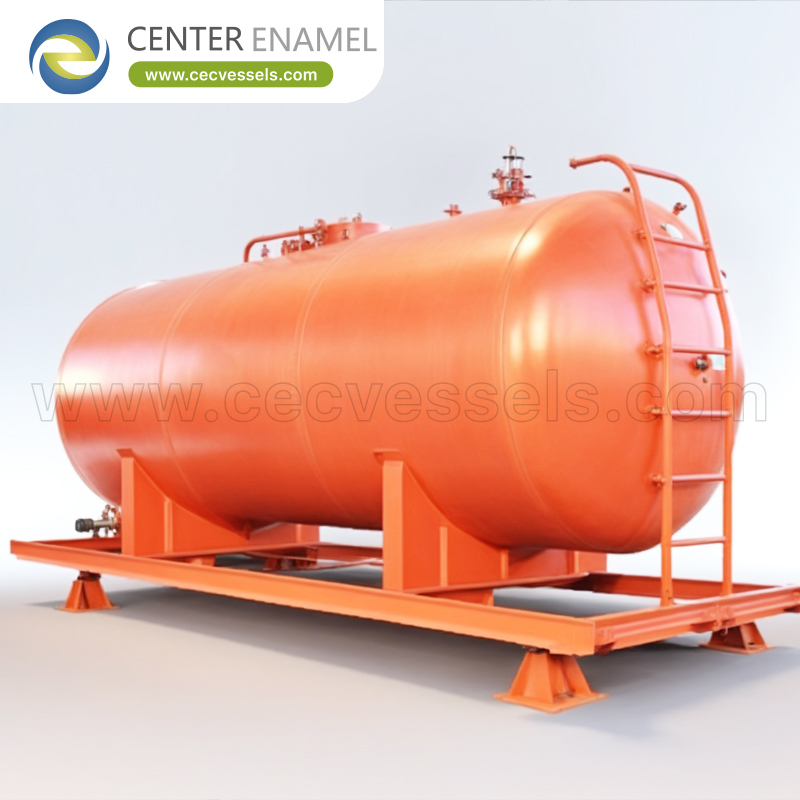
How Does A Pressure Vessel Work Stress And Containment
A pressure vessel works by balancing the force of internal pressure against the strength of its walls. The fluid pushes outward in every direction; the shell and heads are shaped and sized so the metal carries that load without deforming or failing.
This page explains the physics in practical terms — how pressure creates stress, why vessels are round, what wall thickness does and how relief devices keep the vessel within its limits.
Pressure Acts In All Directions
Pressure in a confined fluid acts perpendicular to every surface it touches. In a cylindrical vessel that means the shell is pushed outward radially and the heads are pushed along the vessel axis.
The design must resist both effects. Treating pressure as a single directional load is a common misconception that leads to poor appreciation of why heads and shell need different consideration.
Hoop And Longitudinal Stress
Internal pressure creates hoop stress around the circumference and longitudinal stress along the axis. For a thin cylinder the hoop stress is roughly twice the longitudinal stress, which is why longitudinal seams are examined so closely.
Wall thickness is calculated from these stresses using an allowable stress for the material, with allowances for corrosion and joint efficiency. The result is the minimum thickness the vessel must retain in service.
Why Curved Heads Work
A flat plate under pressure bends heavily; a curved surface carries load mainly in membrane tension, which metal handles far better. Elliptical, torispherical and hemispherical heads are shaped to exploit that behaviour.
The junction between head and shell is a stress concentration, so head geometry is controlled by code. A tighter knuckle radius raises local stress and requires more thickness or closer examination.
Geometry And Efficiency
Spherical vessels distribute pressure most efficiently and need the least thickness for a given pressure and diameter, but they are harder and costlier to fabricate. Cylinders with curved heads are the practical compromise.
This is why most process vessels are cylindrical and why rectangular or flat-sided tanks are confined to near-atmospheric service where pressure stress is negligible.
The Role Of The Relief Device
A vessel is designed for a maximum allowable working pressure. If pressure can rise above it — through fire, blocked outflow or thermal expansion — a relief valve opens to discharge fluid and limit the pressure.
The relief device is sized for defined scenarios. An undersized or incorrectly set device leaves the boundary exposed to pressure it was never designed to carry.
Containment Of Stored Energy
A pressurized vessel holds stored energy, and the bigger the pressure and volume the greater the energy. Integrity is therefore about preventing a sudden release, not merely stopping a slow leak.
That is why material toughness, weld quality and inspection matter: a defect that would be tolerable in an atmospheric tank can initiate a fast fracture in a pressurized shell.
What Changes In Different Vessel Types
The basic principle is the same for every vessel, but the internal work differs. A separator uses velocity reduction and internals to split phases; a reactor adds mixing and heat transfer; a heat exchanger passes two fluids across a wall.
In each case the pressure boundary behaves the same way. What changes is the internal geometry and the process taking place inside it.
External Pressure And Vacuum
When outside pressure exceeds inside pressure, the shell is loaded in compression and can buckle at a pressure far lower than the internal-pressure strength would suggest.
Vacuum vessels and jacketed equipment therefore need a separate buckling check, often with stiffening rings, and must be protected against accidental vacuum during operation or cleaning.
Forces And Design Responses
Force / condition |
Effect on vessel |
Design response |
Internal pressure |
Outward radial load |
Wall thickness by hoop stress |
End loading |
Axial load on heads |
Curved head geometry |
Corrosion |
Loss of thickness |
Corrosion allowance |
Fire / blocked outlet |
Pressure rise |
Sized relief valve |
External pressure |
Buckling |
Stiffeners + buckling check |
Thermal cycling |
Fatigue |
Detail design + examination |
Key Working Principle Terms
Term |
Meaning |
Design pressure |
Pressure used to size the boundary |
MAWP |
Maximum allowable working pressure |
Hoop stress |
Circumferential stress from pressure |
Joint efficiency |
Strength factor for examined welds |
Membrane stress |
In-plane stress in curved wall |
Relief set pressure |
Pressure at which device opens |
Buckling |
Collapse under external pressure |
Conclusion
A pressure vessel contains pressure by converting it into manageable stresses in a curved, correctly sized wall. Shape handles the load, thickness resists it, and relief devices stop it exceeding the design limit.
Understanding hoop stress, head geometry, corrosion allowance and external-pressure buckling explains why vessels are built the way they are and why inspection focuses on wall thickness and welds.
About Center Enamel
Center Enamel is a pressure vessel and process equipment manufacturer based in China, producing stainless steel and carbon steel pressure vessels, separators, reactors, heat exchangers and storage tanks for chemical, oil and gas, power, food, pharmaceutical and water-treatment applications.
The company works under ASME VIII Div.1, GB/T 150 and ISO 9001, and can supply CE/PED marking for the EU market with material traceability, documented welding procedures, NDT and hydrostatic testing in the delivered data book.
- Certifications: ASME, ISO 9001, CE/PED, NSF/ANSI 61, WRAS, ISO 28765, LFGB, BSCI, ISO 45001.
- Standards: ASME VIII Div.1, GB/T 150, EN 13445 where required by the destination market.
- Commercial terms: Minimum order quantity 1 unit, typical lead time about 2 months, L/C or T/T.
Frequently Asked Questions (FAQ)
How does a pressure vessel work?
It balances the outward force of pressure against the strength of a curved, correctly sized shell and heads.
Why are most vessels cylindrical?
Cylinders with curved heads distribute pressure stress efficiently and are easier to fabricate than spheres.
What is hoop stress?
The circumferential stress in the shell caused by internal pressure, roughly twice the longitudinal stress.
Why does wall thickness matter?
It provides the strength to resist pressure and the allowance for corrosion over the vessel's life.
What do curved heads do?
They carry pressure mainly in membrane tension and avoid the bending a flat end would suffer.
What is MAWP?
Maximum allowable working pressure, the highest pressure permitted at the design temperature.
Why is a relief valve needed?
To discharge fluid and limit pressure if fire, blockage or thermal expansion pushes it above the allowed limit.
What is stored energy in a vessel?
The energy held by a pressurized fluid, released suddenly if the boundary fails.
Can external pressure damage a vessel?
Yes. External pressure can buckle a shell at a much lower level than its internal-pressure strength.
Why do welds get examined?
Weld defects can concentrate stress and initiate failure in a pressurized boundary.
Does the principle change for a reactor?
No. The boundary works the same way; the reactor simply adds internals, mixing and heat transfer.
What is a corrosion allowance?
Extra thickness added so the vessel keeps the required thickness after expected material loss.
How does joint efficiency affect thickness?
Higher examination allows a higher efficiency factor and therefore a thinner permissible wall.
What causes thermal fatigue?
Repeated heating and cooling that cycles stress and can initiate cracks at details.
What is the lead time for an engineered vessel?
About two months from a China manufacturer, subject to code, size and inspection scope.
Suggested CTA: Request a technical quotation with your duty, pressure, temperature and fluid data, or discuss the applicable code and inspection route with a Center Enamel engineer.