-
Glass Fused To Steel Tanks (896)
-
Stainless Steel Tanks (434)
-
Fusion Bonded Epoxy Tanks (660)
-
Galvanized Steel Tanks (321)
-
Aluminum Dome Roofs (1336)
-
Wastewater Storage Tanks (280)
-
Welded Steel Tanks (457)
-
Pressure Vessels (485)
-
Anaerobic Digester (217)
-
Industrial Water Tanks (384)
-
Glass Lined Steel Tanks (180)
-
Bolted Steel Tanks (389)
-
Sludge Storage Tank (115)
-
Biogas Storage Tank (173)
-
Leachate Storage Tanks (133)
-
Agricultural Water Storage Tanks (179)
-
Fire Water Tank (166)
-
Grain Storage Silos (146)
-
Biogas Projects (424)
-
Wastewater Treatment Projects (1832)
-
Double Membrane Roof (223)
|
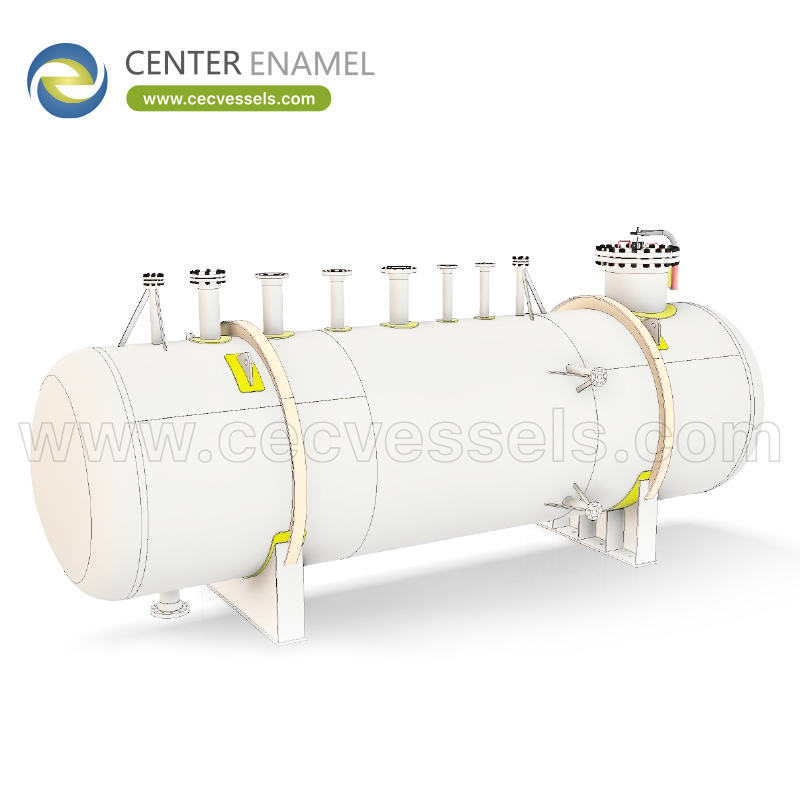
Separation Pressure Vessel Knockout Drum And Flash Drum Selection
| Place of Origin: | China |
| Brand Name: | Center Enamel |
| Certification: | ISO 9001,CE, NSF/ANSI 61, WRAS, ISO 28765, LFGB, BSCI, ISO 45001 |
| Minimum Order Quantity: | 1 Sets |
| Price: | 2000 |
| Delivery Time: | 2 months |
| Payment Terms: | L/C,T/T |
| Supply Ability: | 200 sets / days |
|
Detail Information |
|||
Product Description
Separation Pressure Vessel Knockout Drum And Flash Drum Selection
A separation pressure vessel removes entrained liquid from a gas stream, or splits a mixed stream into phases, so downstream compressors, flares and columns are protected from slugs and carryover.
This guide covers how knockout drums, flash drums and gas-liquid separators are selected - vessel orientation, residence time, mist eliminator sizing - and shows a verified large separator delivered as the reference project.
What A Separator Actually Does
A vapor-liquid separator slows the gas so heavier liquid droplets fall out by gravity, then holds the liquid until it is drawn off by a level controller. A mist eliminator near the gas outlet catches the fine droplets gravity cannot.
The same principle serves many names - knockout drum, flash drum, compressor suction scrubber, vent scrubber - and the choice between them is about where in the plant the vessel sits and what it protects.
Vertical Versus Horizontal Orientation
Vertical separators suit high gas-to-liquid ratios and compact footprints; horizontal separators suit high liquid volumes and easier liquid-level control with larger surge capacity.
The orientation also affects the gas cross-section and therefore the velocity at the demister, so it is a design decision tied to the actual flow rates, not a default.
Residence Time And Liquid Holdup
Liquid residence time sets how long the separated phase stays in the vessel before draw-off; typical values range from a couple of minutes for gas-condensate separation to longer for reflux or amine service.
Enough holdup prevents the liquid level from reaching the gas outlet during surges, which is exactly the failure that sends liquid slugs downstream.
Mist Eliminator And Gas Velocity
A demister (wire mesh or vane pack) removes droplets down to roughly 3 to 10 microns, but only below a maximum gas velocity at the demister cross-section; above it the device floods and re-entrains liquid.
Sizing the vessel diameter to keep gas velocity under that limit is the core of separator design, and it is why a separator cannot simply be made 'bigger' without checking the velocity.
Level Control And Liquid Draw-Off
A level instrument and dump or level-control valve hold the liquid in a safe band; a high-high level usually trips the upstream or protects the compressor, while low level protects against gas blow-by.
This control logic is part of the vessel specification, because the separator only protects equipment while its level stays within the designed envelope.
Material And Code For Separation Duty
Separator shells follow ASME VIII Div.1 or GB/T 150; material follows the stream - carbon steel for non-corrosive gas, stainless or clad for corrosive or acidic service, with NACE for sour gas.
Internals (demister, inlet device, vortex breaker) are specified for the service, and the data book records the material, NDE and test evidence for the whole assembly.
Specification Checklist For Buyers
State the stream composition, gas and liquid flow rates, the design pressure and temperature, the required residence time or surge, the corrosivity and the code/marking in the purchase order.
Confirm the builder sizes the vessel on gas velocity and level control - not just volume - and verify a sample data book that includes the demister specification.
Separator Orientation Choice
Factor |
Vertical |
Horizontal |
Gas/liquid ratio |
High |
Lower |
Liquid volume |
Limited |
Large |
Footprint |
Small |
Larger |
Surge capacity |
Less |
More |
Velocity control |
Cross-section |
Cross-section |
Separator Specification Inputs
Input |
Why it matters |
Gas + liquid rate |
Sets diameter/velocity |
Stream corrosivity |
Drives material |
Residence / surge |
Liquid holdup |
Demister type |
Droplet removal |
Level control |
Protects downstream |
Code + marking |
Pressure approval |
Conclusion
A separation pressure vessel is selected on gas velocity, liquid residence time and level control - not volume alone - with the orientation and demister chosen for the actual stream.
The Uzbekistan natural gas separator below shows a large verified unit delivered to that discipline, with gas-liquid separation as the A-level reference for this article.
Project Case Study: Uzbekistan Natural Gas Separation Vessel (A-Level)
Item |
Detail |
Project |
Uzbekistan Natural Gas Pressure Vessel Project |
Application |
Polymer separation (gas-liquid separation) |
Equipment |
Polymer separator, 1 unit |
Dimensions |
3.9 x 4.1 x 7.5 m |
Volume |
119.925 m3 (geometric) |
Rating |
A-level: natural gas separator |
Note |
Large separator; A-level direct match for separation vessel article |
Why This Demonstrates Separation Capability
Delivering a single large separator of nearly 120 m3 geometric volume required consistent welding procedure qualification and a material-traceability system sized for a heavy-wall gas vessel.
For a buyer, this is the kind of gas-liquid separation coordination - shell, internals and level control - that separates a fabrication shop from a process-equipment manufacturer.
Engineering Points Worth Noting
At 119.9 m3 the vessel sits at the upper end of fabricated separator size, where diameter, gas cross-section and liquid holdup must all be reconciled in one geometry.
The gas-velocity and level-control discipline used here is the same method applied to smaller knockout drums and compressor suction scrubbers in any separation duty.
About Center Enamel
Center Enamel is a pressure vessel and process equipment manufacturer based in China, producing stainless steel and carbon steel pressure vessels, separators, reactors, heat exchangers and storage tanks for chemical, oil and gas, power, food, pharmaceutical and water-treatment applications.
Manufacturing is carried out under ASME VIII Div.1, GB/T 150 and ISO 9001 with CE/PED and NACE MR0175 / ISO 15156 options for sour service. Each unit is supplied with material traceability, hydrostatic or pneumatic testing, NDT and export documentation.
- Material range: Stainless steel (304 / 316L), duplex, carbon steel with rubber or epoxy lining for corrosion duty.
- Standards: ASME VIII Div.1, GB/T 150, ISO 9001, CE/PED, NACE MR0175 / ISO 15156.
- Commercial terms: Minimum order quantity 1 unit, typical lead time about 2 months, L/C or T/T.
Frequently Asked Questions (FAQ)
What is a separation pressure vessel?
A code vessel that removes entrained liquid from a gas stream or splits a mixed stream into phases to protect downstream equipment.
What is a knockout drum?
A separator that knocks liquid out of a gas stream before compressors or flares, often with a demister for fine droplets.
What is a flash drum?
A separator where a liquid partially flashes into vapor as it enters, separating the phases at the design pressure.
Vertical or horizontal separator?
Vertical for high gas/liquid ratios and small footprint; horizontal for high liquid volume and more surge capacity.
What residence time is typical?
From a couple of minutes for gas-condensate to longer for reflux or amine service, set by the duty.
What does a mist eliminator do?
Removes droplets down to about 3 to 10 microns, but only below the maximum gas velocity at its cross-section.
Why not just make it bigger?
Above the demister velocity the device floods and re-entrains liquid; sizing is on gas velocity, not volume alone.
How is level control handled?
A level instrument and dump/level valve hold liquid in a safe band; high-high level usually trips to protect the compressor.
Which material for separators?
Carbon steel for non-corrosive gas; stainless or clad for corrosive/acidic; NACE for sour gas.
Which code applies?
ASME VIII Div.1 or GB/T 150, with CE/PED where applicable; the data book records material, NDE and test.
What is the Uzbekistan case?
A verified natural-gas polymer separator, 1 unit, 3.9 x 4.1 x 7.5 m, 119.925 m3, A-level, used as the reference for this article.
Why is velocity the core?
Because the separator only works while gas velocity stays under the demister limit that prevents re-entrainment.
What documents prove compliance?
Material certs, WPS/PQR, NDT, hydrostatic test and the data report, plus demister specification.
How long to fabricate?
About 2 months from a China manufacturer for an engineered separator scheduled around certification.
What should the PO state?
Stream composition, gas/liquid rates, pressure/temperature, residence/surge, corrosivity and code/marking.
Suggested CTA: Request a technical quotation with your duty, pressure, temperature and fluid data, or discuss your project with a Center Enamel engineer for a sized proposal.
Tags: Separation Pressure Vessel, Knockout Drum, Gas Liquid Separator