-
Glass Fused To Steel Tanks (896)
-
Stainless Steel Tanks (434)
-
Fusion Bonded Epoxy Tanks (660)
-
Galvanized Steel Tanks (321)
-
Aluminum Dome Roofs (1336)
-
Wastewater Storage Tanks (280)
-
Welded Steel Tanks (457)
-
Pressure Vessels (485)
-
Anaerobic Digester (217)
-
Industrial Water Tanks (384)
-
Glass Lined Steel Tanks (180)
-
Bolted Steel Tanks (389)
-
Sludge Storage Tank (115)
-
Biogas Storage Tank (173)
-
Leachate Storage Tanks (133)
-
Agricultural Water Storage Tanks (179)
-
Fire Water Tank (166)
-
Grain Storage Silos (146)
-
Biogas Projects (424)
-
Wastewater Treatment Projects (1832)
-
Double Membrane Roof (223)
|
LPG Pressure Vessel Bullet And Sphere Storage Design
| Place of Origin: | China |
| Brand Name: | Center Enamel |
| Certification: | ISO 9001,CE, NSF/ANSI 61, WRAS, ISO 28765, LFGB, BSCI, ISO 45001 |
| Minimum Order Quantity: | 1 Sets |
| Price: | 2000 |
| Delivery Time: | 2 months |
| Payment Terms: | L/C,T/T |
| Supply Ability: | 200 sets / days |
|
Detail Information |
|||
Product Description
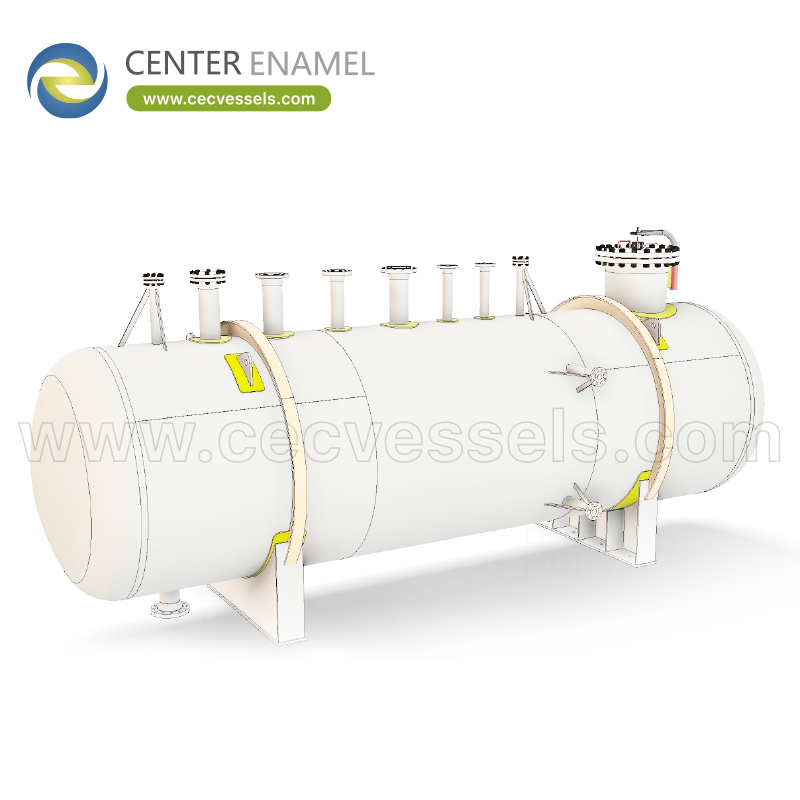
LPG Pressure Vessel Bullet And Sphere Storage Design
An LPG pressure vessel stores propane, butane or mixtures as a liquid under its own vapour pressure at ambient temperature - typically around 1.7 MPa for propane at 50 C - so it is a pressurised, not cryogenic, store.
This guide covers bullet versus sphere selection, material and corrosion allowance, safety relief and the ASME / EN 13445 / PED codes that govern LPG storage vessels.
LPG Storage Context
LPG is stored as a refrigerated or, more commonly, pressurised liquid. Pressurised storage keeps the fluid liquid at ambient temperature by holding it at its vapour pressure, which rises with temperature.
That temperature-pressure relationship sets the design pressure: propane at 50 C reaches about 1.7 MPa, so the vessel is rated for the worst-case summer or fire scenario, not the average day.
Bullets Versus Spheres
Horizontal 'bullet' vessels are common for rail, terminal and plant storage where a long horizontal form fits the site and transfer layout; they are simpler to fabricate and transport as a single piece.
Spheres give the most volume per surface area and are preferred for very large storage where the economy of the shape offsets the more complex fabrication and foundation.
Material And Corrosion Allowance
LPG vessels use carbon steel qualified for the temperature and the welded construction; a corrosion allowance is added for internal and external corrosion, with the allowance following the service environment.
Coastal or semi-marine sites may call for enhanced coating (such as C5M per ISO 12944) and stricter corrosion allowance, because LPG terminals are often in corrosive atmospheres.
Safety Relief And Fire Cases
LPG vessels need adequately sized pressure-relief to handle both normal thermal expansion and the fire case, where external heat boils liquid and drives a large vapour relief load.
The relief and the disposal path are designed to a code fire scenario, because an under-sized relief on an LPG vessel is a major hazard, not a minor omission.
Codes: ASME, EN 13445, PED
LPG storage vessels follow ASME VIII Div.1, EN 13445 or the relevant national standard, with PED marking for the EU market and the applicable seismic and wind limits for the site.
The design must also meet any local pressure-equipment regulation, so the applicable code and marking are named in the specification rather than assumed.
LPG Versus Cryogenic Storage
Unlike LNG, LPG pressurised storage needs no cryogenic insulation - it relies on the vapour pressure at ambient temperature, which simplifies the shell but demands correct pressure rating and relief.
The distinction matters at specification time: choosing pressurised LPG versus refrigerated LPG changes the materials, insulation and codes entirely.
Specification Checklist For Buyers
State the fluid (propane/butane/mix), the design pressure and temperature including fire case, the capacity, the shape preference, the site environment and the code/marking in the purchase order.
Confirm the builder sizes relief for the fire case and qualifies the material and corrosion allowance, then verify the data book before award.
LPG Bullet Versus Sphere
Factor |
Bullet (horizontal) |
Sphere |
Volume efficiency |
Lower |
Highest per area |
Fabrication |
Simpler |
More complex |
Transport |
Single piece |
Field assembly |
Site fit |
Long horizontal |
Compact footprint |
Use |
Rail/terminal/plant |
Very large storage |
LPG Vessel Specification Inputs
Input |
Why it matters |
Fluid (propane/butane) |
Sets vapour pressure |
Design pressure |
Incl. fire case |
Design temperature |
Ambient + sun |
Capacity / shape |
Bullet vs sphere |
Site environment |
Corrosion allowance |
Code + marking |
ASME/EN13445/PED |
Conclusion
An LPG pressure vessel stores propane or butane as a pressurised liquid at ambient temperature, rated for the worst-case vapour pressure and fire case, in a horizontal bullet or a sphere per the capacity and site.
Specify the fluid, design pressure including fire case, shape, environment and code, confirm relief is sized for the fire scenario, and verify the data book before award.
About Center Enamel
Center Enamel is a pressure vessel and process equipment manufacturer based in China, producing stainless steel and carbon steel pressure vessels, separators, reactors, heat exchangers and storage tanks for chemical, oil and gas, power, food, pharmaceutical and water-treatment applications.
Manufacturing is carried out under ASME VIII Div.1, GB/T 150 and ISO 9001 with CE/PED and NACE MR0175 / ISO 15156 options for sour service. Each unit is supplied with material traceability, hydrostatic or pneumatic testing, NDT and export documentation.
- Material range: Stainless steel (304 / 316L), duplex, carbon steel with rubber or epoxy lining for corrosion duty.
- Standards: ASME VIII Div.1, GB/T 150, ISO 9001, CE/PED, NACE MR0175 / ISO 15156.
- Commercial terms: Minimum order quantity 1 unit, typical lead time about 2 months, L/C or T/T.
Frequently Asked Questions (FAQ)
What is an LPG pressure vessel?
A vessel storing propane, butane or mixes as a pressurised liquid at ambient temperature, rated for the fluid's vapour pressure.
What pressure is LPG stored at?
Propane reaches about 1.7 MPa at 50 C, so the vessel is rated for the worst-case temperature and fire scenario.
Bullet or sphere?
Horizontal bullets suit rail, terminal and plant storage; spheres suit very large storage with best volume-per-area economy.
Why not cryogenic insulation?
Pressurised LPG relies on vapour pressure at ambient temperature, so no cryogenic insulation is needed - but correct rating and relief are essential.
What material is used?
Carbon steel qualified for the temperature and welding, with a corrosion allowance for internal and external corrosion.
Why C5M coating for terminals?
Coastal LPG sites are corrosive; C5M per ISO 12944 plus stricter allowance protect the shell.
What is the fire-case relief?
Relief sized for external-fire boiling of liquid, a major hazard case that must be designed, not omitted.
Which codes apply?
ASME VIII Div.1, EN 13445 or national standard, with PED for the EU and site seismic/wind limits.
How is LPG different from LNG?
LPG is ambient pressurised; LNG is cryogenic at about minus 162 C with special materials and insulation.
What documents prove compliance?
Material certs, WPS/PQR, NDT, hydrostatic test, relief sizing and the data report.
How long to fabricate?
About 2 months from a China manufacturer for an engineered vessel, longer for large spheres needing field assembly.
What should the PO state?
Fluid, design pressure/temperature incl. fire case, capacity, shape, environment and code/marking.
Why size relief for fire case?
An under-sized LPG relief is a major hazard; the fire scenario drives the relief and disposal design.
Is corrosion allowance needed?
Yes, for internal and external corrosion; the amount follows the service environment.
Can one vessel serve propane and butane?
Only if rated for the higher vapour pressure of the mix; specify the actual fluid or worst case.
Suggested CTA: Request a technical quotation with your duty, pressure, temperature and fluid data, or discuss your project with a Center Enamel engineer for a sized proposal.