-
Glass Fused To Steel Tanks (896)
-
Stainless Steel Tanks (434)
-
Fusion Bonded Epoxy Tanks (660)
-
Galvanized Steel Tanks (321)
-
Aluminum Dome Roofs (1336)
-
Wastewater Storage Tanks (280)
-
Welded Steel Tanks (457)
-
Pressure Vessels (485)
-
Anaerobic Digester (217)
-
Industrial Water Tanks (384)
-
Glass Lined Steel Tanks (180)
-
Bolted Steel Tanks (389)
-
Sludge Storage Tank (115)
-
Biogas Storage Tank (173)
-
Leachate Storage Tanks (133)
-
Agricultural Water Storage Tanks (179)
-
Fire Water Tank (166)
-
Grain Storage Silos (146)
-
Biogas Projects (424)
-
Wastewater Treatment Projects (1832)
-
Double Membrane Roof (223)

|
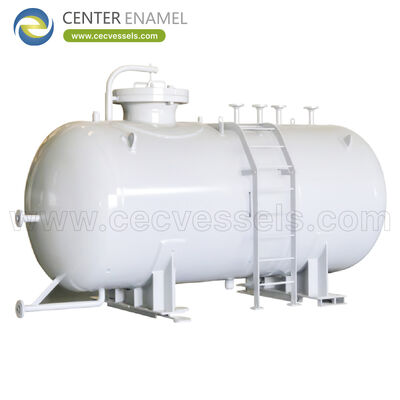
Hydrogen Pressure Vessel Composite Type IV And High Pressure Storage
| Place of Origin: | China |
| Brand Name: | Center Enamel |
| Certification: | ISO 9001,CE, NSF/ANSI 61, WRAS, ISO 28765, LFGB, BSCI, ISO 45001 |
| Minimum Order Quantity: | 1 Sets |
| Price: | 2000 |
| Delivery Time: | 2 months |
| Payment Terms: | L/C,T/T |
| Supply Ability: | 200 sets / days |
|
Detail Information |
|||
Product Description
Hydrogen Pressure Vessel Composite Type IV And High Pressure Storage
A hydrogen pressure vessel stores the lightest gas at very high pressure - typically 350 or 700 bar for mobility - which pushes storage far beyond the materials and codes of an ordinary industrial vessel.
This guide covers composite Type IV construction, the pressure classes, on-board versus station storage, hydrogen embrittlement and the UN / ISO / GB standards that apply alongside ASME.
Why Hydrogen Storage Is Different
Hydrogen's low density means you must compress it hard to store useful energy, so mobility vessels run at 350 or 700 bar. That pressure and the gas's behaviour demand a different construction than a 10-bar process vessel.
Hydrogen also embrittles some metals and can leak through tiny gaps, so material choice and seal design are first-order safety items, not afterthoughts.
Composite Type IV Construction
Type IV vessels use a non-metallic (typically polymer) liner wrapped in a carbon-fibre composite overwrap that carries the pressure load; the liner only provides a gas-tight barrier, not strength.
This gives a lightweight, conformable tank suited to vehicles; the composite does the structural work while the liner holds the hydrogen. Type I to III use increasing metal content instead.
Pressure Classes: 350 And 700 Bar
350 bar is common for heavier mobility and some station buffer; 700 bar is the light-vehicle standard where every kilogram saved matters. The class sets the composite design, the fitting rating and the testing regime.
Station storage often blends lower-pressure metal buffers with high-pressure composite to manage fill and draw-down efficiently across the duty cycle.
On-Board Versus Station Storage
On-board vessels are conformable composite Type IV units built to the vehicle fuel standard; station storage uses both composite and large metal pressure vessels as buffers at various pressures.
The duties differ: a vehicle tank sees repeated fast fills and vibration, while a station buffer sees slower cycles at higher total volume - each specified to its own standard.
Hydrogen Embrittlement And Material
At high pressure, hydrogen can embrittle steels and some alloys, so metal pressure parts use embrittlement-resistant grades and the design limits stress to control crack growth.
Composite and polymer liners avoid the metal-embrittlement path entirely for the pressure boundary, which is a reason Type IV dominates on-board storage.
Codes Beyond ASME
Hydrogen vehicular storage follows UN R134 / ISO 19881 and, in China, GB/T 35544 for on-board compressed hydrogen; station and bulk storage use ASME VIII Div.1 or Div.3 and relevant national standards.
The regulatory set is broader than a standard industrial vessel, so the applicable standard must be named in the specification rather than assumed.
Safety: Venting And Thermal Relief
Hydrogen vessels need controlled venting and thermal-relief provisions because a fire or heat input can raise internal pressure fast; the safety system is part of the vessel specification, not an add-on.
Bundling, isolation and vent routing are designed so a single-unit event does not cascade, following the installed standard's safety requirements.
Specification Checklist For Buyers
State the duty (on-board or station), the pressure class, the capacity, the hydrogen purity, the standard (UN/ISO/GB/ASME) and the safety provisions in the purchase order.
Confirm the builder certifies to the named hydrogen standard and validates the composite and liner, then verify the certification and test evidence before award.
Hydrogen Vessel Types
Type |
Liner |
Pressure carrier |
Type I |
Metal |
Metal wall |
Type III |
Metal |
Metal + composite |
Type IV |
Polymer |
Composite overwrap |
Station metal |
Metal |
ASME VIII Div.1/3 |
All |
Gas-tight |
Standard named |
Hydrogen Vessel Specification Inputs
Input |
Why it matters |
Duty (on-board/station) |
Sets type |
Pressure class |
350 or 700 bar |
Capacity |
Energy stored |
H2 purity |
Material/liner fit |
Standard |
UN/ISO/GB/ASME |
Safety provisions |
Vent + thermal relief |
Conclusion
A hydrogen pressure vessel stores gas at 350 or 700 bar in composite Type IV construction, with embrittlement-resistant metal parts and a code set - UN R134 / ISO 19881 / GB/T 35544 on-board, ASME VIII for stations - broader than ordinary industrial vessels.
Name the standard and duty explicitly, confirm composite and liner validation, and verify the certification and safety provisions before award.
About Center Enamel
Center Enamel is a pressure vessel and process equipment manufacturer based in China, producing stainless steel and carbon steel pressure vessels, separators, reactors, heat exchangers and storage tanks for chemical, oil and gas, power, food, pharmaceutical and water-treatment applications.
Manufacturing is carried out under ASME VIII Div.1, GB/T 150 and ISO 9001 with CE/PED and NACE MR0175 / ISO 15156 options for sour service. Each unit is supplied with material traceability, hydrostatic or pneumatic testing, NDT and export documentation.
- Material range: Stainless steel (304 / 316L), duplex, carbon steel with rubber or epoxy lining for corrosion duty.
- Standards: ASME VIII Div.1, GB/T 150, ISO 9001, CE/PED, NACE MR0175 / ISO 15156.
- Commercial terms: Minimum order quantity 1 unit, typical lead time about 2 months, L/C or T/T.
Frequently Asked Questions (FAQ)
What is a hydrogen pressure vessel?
A vessel storing compressed hydrogen, typically 350 or 700 bar, using composite Type IV construction for mobility and metal buffers for stations.
Why such high pressure?
Hydrogen's low density means hard compression is needed to store useful energy; 700 bar is the light-vehicle standard.
What is Type IV construction?
A polymer liner wrapped in carbon-fibre composite; the composite carries the pressure, the liner only provides a gas-tight barrier.
How do 350 and 700 bar differ?
They set the composite design, fitting rating and test regime; 700 bar is for weight-sensitive vehicles, 350 for heavier mobility and buffers.
What is hydrogen embrittlement?
High-pressure hydrogen can embrittle some metals; resistant grades and stress limits are used, or composite/polymer boundaries avoid it.
Which codes apply?
UN R134 / ISO 19881 and GB/T 35544 on-board; ASME VIII Div.1 or Div.3 for station and bulk storage.
On-board versus station storage?
On-board is conformable Type IV to the vehicle fuel standard; stations blend composite and large metal buffers at various pressures.
Why is venting important?
Fire or heat can raise pressure fast, so controlled venting and thermal relief are part of the vessel safety specification.
Are these ASME vessels?
Station/bulk storage can be ASME VIII; on-board vehicular follows UN/ISO/GB hydrogen standards, not just ASME.
What documents prove compliance?
The named-standard certification, composite/liner validation, test records and safety-device evidence.
How is a hydrogen vessel tested?
Per the applicable standard - proof and cycle testing for composite, plus the pressure and NDE regime the standard requires.
How long to deliver?
Lead time depends on type and certification; engineered composite units are scheduled around validation, often longer than a standard vessel.
What should the PO state?
Duty, pressure class, capacity, H2 purity, named standard and safety provisions.
Why name the standard explicitly?
The regulatory set is broader than a normal industrial vessel; assuming ASME alone can miss the hydrogen standard.
Is hydrogen storage the same as natural gas?
No; hydrogen's density, embrittlement and leakage behaviour demand different materials, pressures and codes.
Suggested CTA: Request a technical quotation with your duty, pressure, temperature and fluid data, or discuss your project with a Center Enamel engineer for a sized proposal.