-
Glass Fused To Steel Tanks (896)
-
Stainless Steel Tanks (434)
-
Fusion Bonded Epoxy Tanks (660)
-
Galvanized Steel Tanks (321)
-
Aluminum Dome Roofs (1336)
-
Wastewater Storage Tanks (280)
-
Welded Steel Tanks (457)
-
Pressure Vessels (451)
-
Anaerobic Digester (202)
-
Industrial Water Tanks (364)
-
Glass Lined Steel Tanks (180)
-
Bolted Steel Tanks (389)
-
Sludge Storage Tank (115)
-
Biogas Storage Tank (173)
-
Leachate Storage Tanks (133)
-
Agricultural Water Storage Tanks (179)
-
Fire Water Tank (166)
-
Grain Storage Silos (146)
-
Biogas Projects (424)
-
Wastewater Treatment Projects (1752)
-
Double Membrane Roof (223)

|
China Amine Recovery Separator Manufacturer Delivering High Efficiency Phase Separation for Industrial Gas Processing
| Place of Origin: | China |
| Brand Name: | Center Enamel |
| Certification: | ISO 9001,CE, NSF/ANSI 61, WRAS, ISO 28765, LFGB, BSCI, ISO 45001 |
| Minimum Order Quantity: | 1 Sets |
| Price: | 2000 |
| Delivery Time: | 2 months |
| Payment Terms: | L/C,T/T |
| Supply Ability: | 200 sets / days |
|
Detail Information |
|||
Product Description
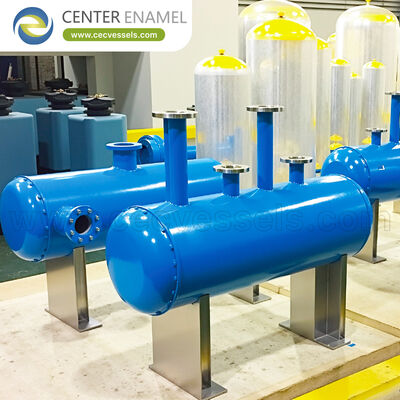
China Amine Recovery Separator Manufacturer Delivering High Efficiency Phase Separation for Industrial Gas Processing
An amine recovery separator is a vessel that captures and returns amine solvent from treated gas or condensate so the solvent can re-enter the regeneration loop instead of leaving the plant as loss. In industrial gas processing, where amine circulation rates are high, even small per-pass losses accumulate into significant operating cost and effluent load.
The practical answer to solvent loss is a correctly sized recovery separator placed downstream of the contactor and the regeneration overhead, combined with mesh-demister and coalescing internals sized for the actual entrainment rather than a generic rule. This article explains how to specify that vessel, what materials resist amine degradation products, and how to verify a supplier's design before purchase.
What An Amine Recovery Separator Does
In an amine loop, lean amine absorbs acid gases and returns as rich amine; some solvent is inevitably carried overhead as mist or dissolved in condensate. A recovery separator intercepts that entrained and coalesced amine, returns it to the system, and reduces both makeup demand and wastewater treatment load.
Unlike a primary contactor, the recovery unit is not where acid-gas absorption happens. Its job is mechanical phase separation only: separate liquid amine droplets from gas, or free amine from water condensate, with low pressure drop so it does not disturb the upstream process.
Recovery Versus Main Gas Sweetening
A common confusion is treating the recovery separator as the sweetening vessel. The contactor performs acid-gas removal; the recovery separator protects the solvent balance. Specifying them with the same duty basis leads to an undersized recovery stage and chronic solvent loss.
From a procurement view, the recovery separator is a support unit whose value is measured by solvent return efficiency and the purity of the recovered stream, not by acid-gas removal capacity.
Internal Selection: Demister And Coalescer
Most losses are fine mist, so a structured mesh or vane demister is the primary device. Where amine is present as dispersed droplets in condensate, a coalescing pack ahead of the drain improves recovery.
- Demister: captures mist entrainment above a defined droplet size.
- Coalescer: grows small dispersed droplets so they separate by density.
- Settling section: provides residence time for free-phase separation before outlet.
Material Considerations
Recovered amine often contains heat-stable salts and degradation products that raise corrosion risk. 316L stainless steel is a common choice for amine service; carbon steel is acceptable only where the service is well-defined and monitored.
Where the recovered stream is hot and the solvent is aggressively degraded, specify corrosion allowance and verifying mill certificates for the actual heat number used in fabrication.
- 316L stainless steel: default for amine-contacted surfaces. Preferred where degradation products are expected.
- Corrosion allowance: reserve wall for long service. Typically added to the design thickness per service review.
Key Sizing Inputs
Suppliers need gas and liquid flow, operating pressure and temperature, expected entrainment loading, and the solvent concentration. Without the entrainment basis, any vendor can only quote a generic vessel that may underperform.
Provide the maximum (not average) upset flow, because recovery separators spend most of their life near design but are judged during upsets when solvent carryover peaks.
Verification And Acceptance
Acceptance should confirm the demister area matches the entrainment basis, the nozzle orientations suit the plot, and a pressure test per the governing code was performed. Request the test and inspection records before shipment.
A practical check is to ask the vendor to state, in writing, the droplet size their demister is rated for and the velocity at which re-entrainment begins.
Amine Recovery Versus Sweetening Duty
| Aspect | Recovery Separator | Main Contactor |
|---|---|---|
| Primary function | Return entrained/coalesced amine | Absorb acid gas into amine |
| Key internal | Demister + coalescer | Packed or tray absorption |
| Performance metric | Solvent return efficiency | Acid-gas removal |
| Typical pressure drop | Low | Higher by design |
Indicative Specification Ranges
| Parameter | Typical Basis | Note |
|---|---|---|
| Design code | ASME VIII Div.1 / GB/T 150 | CE/PED on request |
| Material | 316L / carbon steel | Per amine service review |
| Demister | Mesh or vane | Sized to entrainment basis |
| MOQ | 1 unit | Single skid acceptable |
| Lead time | About 2 months | Confirm at order |
Conclusion
An amine recovery separator is a mechanical protection device for the solvent loop; its value is measured in returned solvent and reduced effluent, not in acid-gas removal. Size it from the real entrainment basis, choose 316L where degradation is expected, and verify the demister rating and test records before accepting the unit.
About the Manufacturer
Center Enamel (Shijiazhuang Zhengzhong Technology Co., Ltd.) designs and fabricates pressure vessels, separators and heat exchangers in China for chemical, energy, water and gas-processing applications.
Manufacturing is governed by ASME VIII Div.1 and GB/T 150, with supplementary CE/PED and ISO 9001 quality systems. Material programs cover stainless steel (304/316L), carbon steel and clad constructions, with NACE MR0175 / ISO 15156 control applied for sour or hydrogen service.
Minimum order quantity is 1 unit, typical lead time is about 2 months, and commercial terms are L/C or T/T, supported by full material traceability, pressure testing and export documentation.
Frequently Asked Questions (FAQ)
What is the difference between an amine recovery separator and a contactor?
The contactor absorbs acid gas; the recovery separator returns entrained or coalesced amine to the loop. They are support versus primary duty and must not be specified with the same basis.
Why does solvent loss matter in industrial gas processing?
High circulation rates make even small per-pass losses expensive in makeup solvent and wastewater load, so recovery efficiency has a direct operating-cost impact.
Which material is typical for amine recovery service?
316L stainless steel is common because amine degradation products can raise corrosion risk; carbon steel is used only where the service is well defined and monitored.
What internal controls amine carryover?
A mesh or vane demister captures mist, and a coalescing pack helps where amine is dispersed in condensate before the settling section.
What flow data should I provide to a supplier?
Gas and liquid flow, pressure, temperature, entrainment loading and solvent concentration, plus the maximum upset flow rather than only the average.
How is recovery performance verified?
Confirm the demister area matches the entrainment basis and ask the vendor to state the rated droplet size and the re-entrainment velocity in writing.
Can the recovery separator also remove acid gas?
No. It performs only phase separation; acid-gas removal is the contactor's function.
Is a corrosion allowance needed?
Where hot, degraded amine is expected, a corrosion allowance and verified mill certificates are prudent and should be specified.
What design code applies to these vessels?
ASME VIII Div.1 and GB/T 150 are typical, with CE/PED available on request for export projects.
What pressure drop is acceptable?
As low as practical so the recovery stage does not disturb upstream pressure balance; the demister should be sized to avoid re-entrainment at upset flow.
Should the unit be skidded?
Often yes for small recovery stages, which simplifies hook-up, but the layout must match the existing pipe orientation.
What acceptance documents are expected?
Material certificates, weld records, pressure test report and inspection records covering the demister and nozzles.
Does NACE apply to amine recovery?
NACE MR0175 / ISO 15156 control is applied where the service is sour or hydrogen-associated, even in a recovery duty.
How long is the typical lead time?
About 2 months is typical, with a minimum order quantity of one unit, but confirm at order with the final specification.
What commercial terms are common?
L/C or T/T are typical, with full material traceability and export documentation provided at shipment.
Suggested CTA: Discuss your amine solvent balance and request a recovery-separator specification sized to your entrainment basis.