-
Glass Fused To Steel Tanks (719)
-
Stainless Steel Tanks (434)
-
Fusion Bonded Epoxy Tanks (592)
-
Galvanized Steel Tanks (321)
-
Aluminum Dome Roofs (1336)
-
Wastewater Storage Tanks (237)
-
Welded Steel Tanks (457)
-
Pressure Vessels (295)
-
Anaerobic Digester (202)
-
Industrial Water Tanks (349)
-
Glass Lined Steel Tanks (180)
-
Bolted Steel Tanks (389)
-
Sludge Storage Tank (115)
-
Biogas Storage Tank (173)
-
Leachate Storage Tanks (133)
-
Agricultural Water Storage Tanks (179)
-
Fire Water Tank (166)
-
Grain Storage Silos (146)
-
Biogas Projects (424)
-
Wastewater Treatment Projects (1420)
-
Double Membrane Roof (223)


|
UASB Process and CBG Plant EPC Solutions for Poultry Farm Wastewater Treatment in South Africa
| Place of Origin: | China |
| Brand Name: | CEC TANKS |
| Certification: | ISO 9001:2008, AWWA D103 , OSHA , BSCI |
| Model Number: | W |
| Minimum Order Quantity: | 1set |
| Price: | $5000~$20000 one set |
| Packaging Details: | PE poly-foam between each two steel plates ; wooden pallet and wooden |
| Delivery Time: | 10-30 days after deposit received |
| Payment Terms: | L/C,T/T |
| Supply Ability: | 60 sets per month |
|
Detail Information |
|||
| Place of Origin | China | Brand Name | CEC TANKS |
|---|---|---|---|
| Certification | ISO 9001:2008, AWWA D103 , OSHA , BSCI | Model Number | W |
| Tank Body Color: | Dark Green / Can Be Customized | Corrosion Integrity: | Excellent |
| Steel Plates Thickness: | 3mm To 12mm , Depends On The Tank Structure | Chemical Resistance: | Excellent |
| Size Of Panel: | 2.4M * 1.2M | Easy To Clean: | Smooth, Glossy, Inert, Anti-adhesion |
| Highlight: | UASB process poultry farm wastewater,CBG plant EPC wastewater treatment,poultry farm wastewater treatment South Africa |
||
Product Description
South Africa's poultry industry is a cornerstone of its agricultural sector, yet it generates highly concentrated wastewater that demands sophisticated treatment. This article explores how the UASB Process and integrated CBG Plant EPC Solutions are transforming Poultry Farm Wastewater Treatment across South Africa. By combining high-efficiency anaerobic digestion with durable infrastructure, poultry operations can convert waste streams into compressed biogas (CBG) while meeting stringent environmental standards.
Poultry farm wastewater in South Africa originates from intensive broiler and layer operations concentrated in major agricultural regions. The effluent comprises poultry litter (a mixture of manure, spilled feed, and bedding materials), washwater from poultry houses, and processing effluent from slaughter operations. This wastewater is characterized by extreme organic load, high pathogen content, and significant nutrient concentrations, particularly ammoniacal nitrogen.
Typical pollutant levels include COD values of 4,800–5,200 mg/L, BOD5 of 1,800–2,000 mg/L, and ammonia nitrogen of 280–300 mg/L. Untreated poultry wastewater leads to eutrophication of water bodies, soil degradation, and air quality deterioration from ammonia and hydrogen sulfide emissions. For South African poultry farms, effective wastewater treatment is essential for protecting both environmental and public health while meeting regulatory requirements under the National Water Act.
Modern poultry farm wastewater treatment follows a systematic process designed for maximum pollutant removal and resource recovery. The treatment train begins with screening and grit removal to remove feathers, viscera, sand, and bone fragments, protecting downstream biological treatment equipment. Dissolved air flotation (DAF) systems then remove fats, oils, and grease, achieving up to 90% fat removal.
The conditioned wastewater subsequently enters the UASB reactor where specialized microbial consortia break down complex organic compounds through hydrolysis, acidogenesis, acetogenesis, and methanogenesis. Research has demonstrated that UASB systems treating poultry wastewater can achieve COD removal efficiencies exceeding 80% under optimal conditions. Following anaerobic treatment, aerobic polishing through moving bed biofilm reactors (MBBR) further reduces organic load and nitrogen levels. The treated effluent requires final clarification and disinfection to meet discharge standards.
The Upflow Anaerobic Sludge Blanket (UASB) process serves as a cornerstone technology for poultry farm wastewater treatment in South Africa. In the UASB reactor, wastewater flows upward through a dense blanket of anaerobic microorganisms, which rapidly degrade complex organic pollutants without requiring mechanical mixing. The three-phase separator efficiently captures biogas while returning active sludge to the reactor, maintaining high biomass concentration.
UASB technology offers particular advantages for South African poultry farms due to its simple structure, low operating cost, and adaptability to organic load shocks. Studies have shown that UASB systems with acclimatised seed sludge can maintain COD removal efficiencies above 80% even at increased organic loading rates. Energy recovery from commercial-scale UASB reactors treating poultry wastewater can reach approximately 790 kWh per day from a 60 m³ reactor, offsetting a significant portion of farm energy demand.
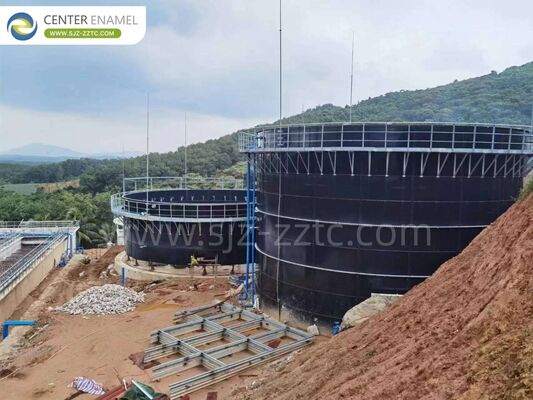
Glass-Fused-to-Steel (GFS) tanks manufactured by Center Enamel provide the optimal storage and reaction solution for South African poultry farm wastewater treatment projects. The specialized manufacturing process, fusing glass to steel at temperatures exceeding 820°C, creates an inert, corrosion-resistant barrier that withstands the aggressive chemical environment of anaerobic digestion. The glass coating provides exceptional resistance against ammonia, organic acids, and hydrogen sulfide common in poultry wastewater.
GFS tanks deliver outstanding corrosion resistance, withstanding the hostile internal environment where decomposition generates corrosive substances. The precision-engineered design with specialized sealants guarantees a superior, permanent gas-tight seal at every seam, maximizing methane capture and utilization. With service life exceeding 30 years and minimal maintenance requirements, GFS tanks provide long-term durability essential for South African agricultural projects.
Center Enamel provides a comprehensive portfolio of storage options meeting South Africa's varied project requirements. Glass-Fused-to-Steel tanks offer the premium solution with unmatched corrosion resistance and double coating layer construction. Fusion Bonded Epoxy (FBE) tanks utilize innovative coating technology for specialized applications. Stainless steel tanks meet requirements for harsh environments.
Cover solutions include Aluminum Geodesic Dome Roofs offering corrosion resistance and clear span capability. Glass-Fused-to-Steel Roofs provide air-tightness for pressurized operation and odor control. Double Membrane Roofs deliver superior air-tightness for biogas collection and storage, providing dynamic gas storage with pressure regulation and explosion protection. These diverse solutions ensure appropriate infrastructure for various project scales.
A complete poultry farm wastewater treatment system requires various support equipment working in coordination. Double Membrane Gas Holders collect and hold biogas generated during treatment, providing a dynamic, hermetic reservoir that ensures maximum gas capture and stable supply for downstream utilization. The specialized multi-layered composite fabric construction resists corrosive biogas elements, ensuring long-term integrity.
Solid-liquid separators play a crucial role in primary treatment, effectively removing suspended solids from poultry manure. Submersible mixers maintain proper solids suspension in equalization and storage tanks, while lifting pumps ensure reliable flow through the treatment train. Dehydration and desulfurization equipment removes moisture and hydrogen sulfide from biogas before energy utilization, protecting downstream equipment and maintaining gas quality.
Center Enamel serves as a comprehensive CBG Plant EPC Solutions provider for South African poultry farm wastewater treatment projects, offering full turnkey services from engineering design through equipment manufacturing and construction. Key advantages include:
Professional engineering design customized for South Africa's specific influent characteristics, climatic parameters, and regulatory requirements. As the EPC provider, Center Enamel assumes total responsibility for the entire system's performance, from pre-treatment design to biogas utilization output, protecting clients from common technology integration failures.
Integrated project management covering design, procurement, construction, commissioning, and after-sales support. The fixed-price EPC contract eliminates budget overruns and ensures predictable timelines. Factory prefabrication of modular GFS tanks eliminates on-site welding, shortens construction periods, and allows for easy future expansion.
Technical excellence through advanced manufacturing capabilities and international certifications including ISO 9001, NSF/ANSI 61, and ISO 28765. Center Enamel delivers customized anaerobic technologies tailored to poultry waste characteristics, including UASB, CSTR, USR, and IC processes.
Poultry farm wastewater treatment in South Africa demands comprehensive solutions combining advanced anaerobic technology with durable equipment. The UASB Process and integrated CBG Plant EPC Solutions are transforming the industry, enabling efficient organic waste processing while generating renewable compressed biogas. Center Enamel's integrated solutions, combining UASB technology with high-quality GFS storage equipment, provide the reliability and performance needed to address South African poultry wastewater challenges while supporting sustainable agricultural development.