-
Glass Fused To Steel Tanks (896)
-
Stainless Steel Tanks (434)
-
Fusion Bonded Epoxy Tanks (660)
-
Galvanized Steel Tanks (321)
-
Aluminum Dome Roofs (1336)
-
Wastewater Storage Tanks (280)
-
Welded Steel Tanks (457)
-
Pressure Vessels (505)
-
Anaerobic Digester (217)
-
Industrial Water Tanks (404)
-
Glass Lined Steel Tanks (180)
-
Bolted Steel Tanks (389)
-
Sludge Storage Tank (115)
-
Biogas Storage Tank (173)
-
Leachate Storage Tanks (133)
-
Agricultural Water Storage Tanks (179)
-
Fire Water Tank (166)
-
Grain Storage Silos (146)
-
Biogas Projects (424)
-
Wastewater Treatment Projects (1852)
-
Double Membrane Roof (223)

|
Fire Water Tank Spain: EN 12845 And Local Fire-Service Compliance
| Place of Origin: | China |
| Brand Name: | CEC TANKS |
| Certification: | ISO 9001:2008, AWWA D103 , OSHA , BSCI |
| Model Number: | W |
| Minimum Order Quantity: | 1set |
| Price: | $5000~$20000 one set |
| Packaging Details: | PE poly-foam between each two steel plates ; wooden pallet and wooden |
| Delivery Time: | 10-30 days after deposit received |
| Payment Terms: | L/C,T/T |
| Supply Ability: | 60 sets per month |
|
Detail Information |
|||
| Place of Origin | China | Brand Name | CEC TANKS |
|---|---|---|---|
| Certification | ISO 9001:2008, AWWA D103 , OSHA , BSCI | Model Number | W |
| Feature: | Eco-friendly, Durability | Tank Material: | Glass Fused To Steel |
| Chemical Resistance: | Excellent | Size Of Panel: | 2.4M * 1.2M |
| Easy To Clean: | Smooth, Glossy, Inert, Anti-adhesion | Capactiy Available: | 20 M3 To 20,000 M3 |
| Highlight: | EN 12845 fire water tank,Spain compliant fire water tank,industrial fire water tank |
||
Product Description
A fire water tank in Spain stores the reserve that supplies sprinklers, hydrants and hose reels during a fire, and its specification is driven by the hydraulic demand and the authority having jurisdiction rather than by storage convenience. The reserve must be dedicated, reliably available and sized to the most demanding design fire and duration, and the Spanish fire service has the final say on access, fittings and reserve. Center Enamel supplies Glass-Fused-to-Steel, Fusion-Bonded Epoxy and galvanized bolted tanks engineered for fire reserve duty, with more than 30,000 installed tank projects across 100-plus countries. This article sets out the demand-led specification baseline a Spanish fire-water project should work from.
A fire-water tank is sized from the spray or sprinkler system's design flow multiplied by the required duration, plus any hose-stream allowance and a reserve for refilling uncertainty. That calculation, not a round number, fixes the usable volume. The tank must keep that volume available at all times, which means a dedicated drawdown range that cannot be consumed by process or domestic use. In practice the effective volume is the band between the minimum usable level and the overflow, not the shell's geometric capacity.
- Design flow times duration sets the required volume.
- Add hose-stream allowance and refill uncertainty.
- Effective volume is the usable level band, not geometric capacity.
- The reserve must be dedicated and always available.
For a fire-water tank in Spain the automatic-sprinkler design is commonly based on EN 12845, with NFPA 22 used where a project follows the US standard, while the local fire service sets access, signage, fittings and the accepted reserve. The Spanish national building code (CTE) and any regional fire regulation add conditions, and the water authority may govern the refill source. Confirm the design standard, the fire-service acceptance criteria and the refill arrangement with the authority having jurisdiction before ordering; a tank accepted on paper but not by the local brigade is a failed installation.
- Confirm EN 12845 or NFPA 22 basis with the fire authority.
- Confirm local fire-service access, fittings and signage rules.
- Confirm CTE and regional fire conditions.
- Confirm the refill source and water-authority terms.
A thermal store, chilled-water buffer, data-center water reservoir or fire reserve sits idle or cycles slowly for most of its life, so the internal finish and the shell discipline matter more than the nameplate rating. Glass-Fused-to-Steel panels are fired at 820-930 degrees C to give a smooth inert skin at 0.25-0.45 mm thickness, adhesion above 3,450 N/cm2 and 100 percent 1,500 V DC spark testing per panel. Fusion-Bonded Epoxy bolted tanks (Resicoat R4-ES interior 180-280 micrometres, Interpon D2015 exterior 150-250 micrometres, adhesion above 16 MPa) and hot-dip galvanized bolted tanks cover specified or cost-sensitive duties. Stainless 304 or 316 is chosen where the fluid is low-mineral or a factory-fabricated vessel is preferred. The caveat is that lining choice follows fluid chemistry and code duty, so the specifier should confirm pH, chloride load and pressure class rather than assume one construction fits every duty.
- GFS bolted: inert enamel, low roughness, no field recoating.
- FBE bolted: documented epoxy lining for a specified duty.
- Hot-dip galvanized: lower cost, zinc shell protection.
- Stainless 304/316 for low-mineral or pressure-vessel duty.
Sizing starts from the real duty calculation - thermal charge/discharge profile, chilled-water temperature swing, makeup and process balance, or fire hydraulic demand - not from a catalogue number. The coating thickness of 0.25-0.45 mm for GFS or 180-280 micrometres for FBE, a 30-50 year tank lifecycle, the NSF/ANSI 61 or WRAS potable-contact option where relevant, and the local freeze or seismic margin then set the shell, roof and appurtenances. Every figure below is checked against the applicable standard and the authority having jurisdiction in the destination country.
| Design parameter | Typical value or range | Why it matters |
|---|---|---|
| Design fire flow | Site-specific L/s or m3/h | Primary volume driver |
| Duration | Minutes or hours per standard | Sets stored volume |
| Hose-stream allowance | Additional flow/duration | Added reserve |
| Usable level band | Min operating to overflow | Defines effective volume |
| Coating thickness | 0.25-0.45 mm enamel / 180-280 um FBE | Idle-water integrity |
| Adhesion | above 3,450 N/cm2 (GFS) | Lining integrity |
| Spark test | 1,500 V DC per panel | Holiday verification |
| Design lifecycle | 30-50 years | Long-term standby duty |
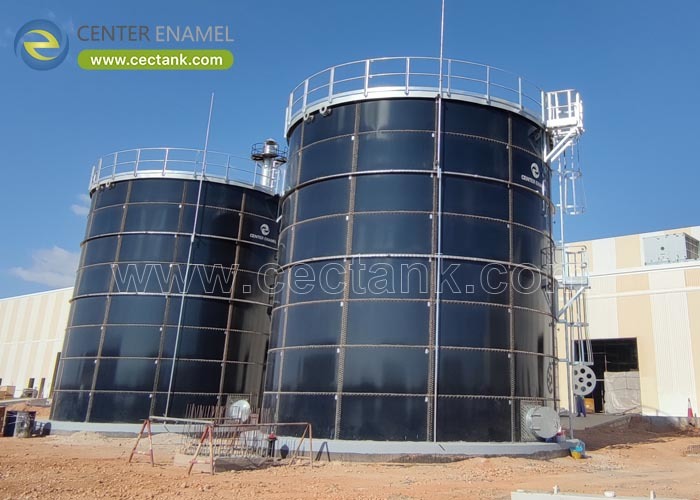
The figure below is a REAL Center Enamel delivery cited here as manufacturing-capability evidence for the tank type discussed, NOT as a claimed thermal-energy-storage, chilled-water, data-center water or fire-water delivery in the named country. Center Enamel's verified project record (case_library.csv) holds no dedicated TES, chilled-water, data-center-water or Netherlands/Spain/France/UK/Belgium fire-water tank project for this specific duty; where a real in-country tank exists it is cited as the closest analogue, never as the named application. This reference demonstrates the ability to engineer large coated, stainless and bolted water tanks for demanding duty, not a claim about this specific application or geography. Where the source did not record a diameter or height, the field reads Not Provided and is never estimated.
| Project | Country | Tank type | Volume | Year | Relevance |
|---|---|---|---|---|---|
| Chile fire-protection water tank | Chile | GFS bolted tank | 134 m3 | 2026 | Real fire-water tank (capability analogue, not Spain delivery) |
Start with the fire strategy document: design flow, duration, hose allowance and the standard basis. Convert that to a usable volume and state the usable level band explicitly, then require the supplier to document the shell, lining and fittings against it. Reject a proposal that quotes geometric capacity without a usable band or a fire-service acceptance plan. Because the local brigade has final authority in Spain, involve it early and keep the tank documentation aligned with the accepted fire strategy.
- Start from design flow, duration and hose allowance.
- State the usable level band, not just geometric capacity.
- Document shell, lining and fittings against the fire strategy.
- Involve the local fire service before ordering.
From the design fire flow multiplied by the required duration, plus hose-stream allowance and refill uncertainty - not from a round nominal number.
No - the effective reserve is the band between the minimum operating level and the overflow, and only that band is guaranteed available for fire service.
Automatic-sprinkler design is commonly based on EN 12845, with NFPA 22 where the project follows the US standard; the local fire service sets acceptance conditions.
The local fire service, which sets access, fittings, signage and the accepted reserve - a tank not accepted by the brigade is a failed installation.
GFS enamel, FBE or galvanized bolted tanks are common for fire reserve, chosen by water quality, corrosion exposure and budget.
Only with a dedicated, permanently available fire band and documented controls that prevent process draw from consuming the reserve.
Thickness (0.25-0.45 mm for GFS or 180-280 micrometres for FBE), adhesion above 3,450 N/cm2 for GFS and 100 percent 1,500 V DC spark testing per panel.
Yes - a documented refill source and time agreed with the water authority so the reserve can be restored after a discharge.
About 30 days ex-works for a 1,000-10,000 m3 vessel, with on-site bolted erection in weeks.
A 30-50 year shell lifecycle is expected, with the lining and appurtenances driving the maintenance plan under long-term standby.
Yes - the lining should be warranted separately because standby water chemistry can stress the coating over decades.
A verified single shell of 20,000 m3 was delivered in 2016, setting the upper bound for one bolted tank.
No - it is a real fire-protection water tank cited as manufacturing-capability evidence, not a claimed Spain fire project.
Yes - GFS, FBE and galvanized bolted tanks sized from the real hydraulic demand with documentation for fire-authority review.
Because local acceptance criteria for access, fittings and reserve vary, and a late change to satisfy the brigade can be costly after manufacture.
A fire-water tank in Spain is sized from the design flow, duration and hose allowance, with the reserve defined by the usable level band rather than geometric capacity. Build to EN 12845 or the agreed standard, involve the local fire service early and document the shell and lining against the accepted fire strategy.
Suggested CTA: Fix the design flow, duration and usable level band, and agree the standard basis with the local fire service before ordering a Spain fire-water tank.