-
Glass Fused To Steel Tanks (807)
-
Stainless Steel Tanks (434)
-
Fusion Bonded Epoxy Tanks (592)
-
Galvanized Steel Tanks (321)
-
Aluminum Dome Roofs (1336)
-
Wastewater Storage Tanks (252)
-
Welded Steel Tanks (457)
-
Pressure Vessels (295)
-
Anaerobic Digester (202)
-
Industrial Water Tanks (349)
-
Glass Lined Steel Tanks (180)
-
Bolted Steel Tanks (389)
-
Sludge Storage Tank (115)
-
Biogas Storage Tank (173)
-
Leachate Storage Tanks (133)
-
Agricultural Water Storage Tanks (179)
-
Fire Water Tank (166)
-
Grain Storage Silos (146)
-
Biogas Projects (424)
-
Wastewater Treatment Projects (1540)
-
Double Membrane Roof (223)
|
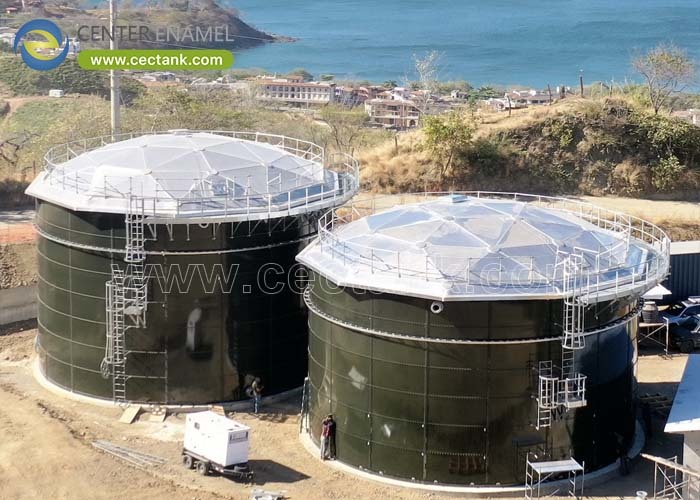
Fusion Bonded Epoxy Potable Water Tanks
| Place of Origin: | China |
| Brand Name: | CEC TANKS |
| Certification: | ISO 9001:2008, AWWA D103 , OSHA , BSCI |
| Model Number: | W20160706001 |
| Minimum Order Quantity: | 1set |
| Price: | $5000~$20000 one set |
| Packaging Details: | PE poly-foam between each two steel plates ; wooden pallet and wooden box |
| Delivery Time: | 0-60 days after deposit received |
| Payment Terms: | L/C,T/T |
| Supply Ability: | 60 sets per month |
|
Detail Information |
|||
Product Description
Fusion Bonded Epoxy Potable Water Tanks
A fusion bonded epoxy (FBE) potable water tank is a bolted steel vessel whose interior is coated with a seamless 200-400 um epoxy layer cured to resist corrosion and approved for drinking contact. Engineered by Shijiazhuang Zhengzhong Technology Co., Ltd. (Center Enamel), the lining meets NSF/ANSI 61 and WRAS, and the bolted shell follows AWWA D103-09 for a 30-50 year service life.
What an FBE Potable Water Tank Is
A fusion bonded epoxy potable water tank is a bolted steel tank with a 200-400 um epoxy lining applied to the steel and cured so the water never contacts bare metal. Capacities reach 20-60,000 m3, the lining is verified to NSF/ANSI 61 for potable contact, and the bolted shell uses 8.8-grade fasteners for a 30-50 year life in municipal and industrial water duty.
- Lining: 200-400 um epoxy.
- Contact: NSF/ANSI 61.
- Range: 20-60,000 m3.
- Life: 30-50 years.
How the Epoxy Lining Protects Water
The FBE layer is a continuous barrier fused to the steel at the panel stage, so there are no field welds inside the tank and no bare-metal paths for rust. Because the lining is inert and NSF/ANSI 61 approved, the stored water keeps its taste and chemistry, and the 8.8-grade bolted seams carry a gasket that keeps the 30-50 year structure sealed without coating damage.
- Barrier: seamless epoxy.
- No weld: inside the shell.
- Approved: NSF/ANSI 61.
- Seal: gasketed bolts.
Key Types, Components, and Features
The family covers the FBE bolted water tank, the epoxy-lined roof, and the aluminum or enamel roof options for tropical and cold sites. Core parts are the 200-400 um epoxy panels, the 8.8-grade bolt set, the manways, the overflow, and the connection nozzles. A documented NSF/ANSI 61 and WRAS lining certificate is the feature that qualifies the tank for potable duty.
- Shell: epoxy bolted.
- Roof: aluminum or enamel.
- Bolts: 8.8-grade.
- Cert: NSF/ANSI 61.
Applications of FBE Water Tanks
They serve municipal drinking water, rural water supply, firefighting reserves, and industrial process water where a clean, corrosion-free lining matters. A 30-50 year FBE tank is also used for desalination backwash and for agricultural storage where WRAS or NSF/ANSI 61 approval is required by the authority. The inert lining is why the same tank serves both hot and cold climates.
- Municipal: drinking water.
- Fire: reserve supply.
- Industrial: process water.
- Desal: backwash.
Technical Considerations
Technically the steel is blasted and the 200-400 um epoxy is applied and cured under controlled heat, then each panel is inspected before bolting. The shell is calculated to AWWA D103-09, the lining is verified to NSF/ANSI 61 and WRAS, and the bolt torque is recorded. Design life runs 30-50 years with routine visual inspection of the gaskets.
- Coat: 200-400 um cured.
- Code: AWWA D103-09.
- Approval: NSF/ANSI 61, WRAS.
- Life: 30-50 years.
| Design parameter | Typical value or range | Why it matters |
|---|---|---|
| Capacity range | 20-5,000 m3 | Small to mid leachate |
| FBE coat | 250-450 µm | Cured powder epoxy |
| Cure temperature | 180-220 °C | Powder fusion |
| pH tolerance | 1-14 | Aggressive leachate |
| Holiday test | 1500 V | Every panel checked |
| Adhesion | ASTM D4541 | Pull-off verified |
| Design life | 30-50 years | With inspection |
| Bolt grade | 8.8 | Joint integrity |
| Code basis | AWWA D103-09 / ISO 28765 | Design authority |
| Limitation to check | Impact and repair | Confirm touch-up |
How to Select an FBE Potable Tank
Select by matching the stored volume (20-60,000 m3), the water quality authority (NSF/ANSI 61, WRAS, or local), and the site climate to an FBE tank with a documented lining certificate and 8.8-grade bolts. Ask the supplier for the AWWA D103-09 calculation, the lining thickness record, and the reference plants. Reject any offer that cannot show the NSF/ANSI 61 approval.
- Match: volume and climate.
- Confirm: NSF/ANSI 61.
- Demand: lining record.
- Verify: AWWA D103-09.
Project Case Study
A verified Fusion Bonded Epoxy (FBE) drinking-water project in Thailand used a 1,165 m3 bolted tank built in 2025 to supply a community with NSF/ANSI 61-approved water. The 200-400 um epoxy lining was inspected before bolting and the 8.8-grade seams held a 30-50 year structure, demonstrating the FBE potable standard in a tropical site.
- Project: Thailand potable water
- Location: Thailand, Asia
- Industry: Municipal water
- Application: Drinking water
- Product: FBE / epoxy-coated bolted tank
- Capacity: 1,165 m3
- Quantity: 1 tank
- Material: Fusion Bonded Epoxy steel
- Standards: NSF/ANSI 61 / AWWA D103-09
- Year: 2025
About Shijiazhuang Zhengzhong Technology Co., Ltd.
Shijiazhuang Zhengzhong Technology Co., Ltd. (Center Enamel) operates coating lines for both Glass-Fused-to-Steel and Fusion Bonded Epoxy (FBE) panels, founded in 2008 and exporting to more than 100 countries. Its FBE program is verified to NSF/ANSI 61 and WRAS for potable contact and is documented under ISO 9001 quality control, giving buyers a traceable lining certificate.
- Founded: 2008 in China.
- Coatings: GFS and FBE.
- Approval: NSF/ANSI 61, WRAS.
- QC: ISO 9001.
Advantages and Limitations
Advantages are the seamless NSF/ANSI 61 lining, the absence of interior field welds, and a 30-50 year corrosion-free life at lower cost than stainless. Limitations are that the epoxy must be confirmed for the exact water chemistry and temperature, and the site must provide a level foundation. The tank is not for fuel or aggressive solvents.
- Pros: seamless lining.
- Pros: no weld inside.
- Limit: confirm chemistry.
- Limit: foundation.
Comparison With Other Water Tanks
Against GFS, FBE is the choice when a specific epoxy approval is mandated; against welded painted steel it wins on a 30-50 year lining life; against stainless it wins on capital cost for 20-60,000 m3. The table contrasts the common materials for potable duty so the choice matches the approval and the budget.
- FBE: NSF/ANSI 61.
- GFS: glass enamel.
- Welded: shorter life.
- Stainless: higher cost.
| Criterion | GFS bolted tank | Welded steel tank | Concrete tank | FRP tank |
|---|---|---|---|---|
| Corrosion defense | Vitreous enamel, inert | Coating-dependent | Good but porous | Liner-dependent |
| Construction | Bolted, fast on site | Welded, slower | Cast in place | Molded / shop |
| Capacity ceiling | Up to 60,000 m3 | Up to 150,000 m3 | Very large | Limited (<5,000 m3) |
| Design life | 30-50 years | 30-50 years | 40-60 years | 20-30 years |
| Best fit | Corrosive, modular | Very large, generic | Heavy civil works | Small, neat chemical |
A fusion bonded epoxy potable water tank is defined by a 200-400 um lining verified to NSF/ANSI 61 and WRAS, bolted with 8.8-grade fasteners, and built to AWWA D103-09 for a 30-50 year life. Specify the approval, demand the lining certificate, and the tank will deliver clean water reliably.
- Spec: NSF/ANSI 61.
- Verify: lining cert.
- Confirm: AWWA D103-09.
Frequently Asked Questions (FAQ)
What is a fusion bonded epoxy potable water tank?
It is a bolted steel tank whose interior carries a 200-400 um epoxy lining cured to resist corrosion and approved to NSF/ANSI 61 for drinking-water contact, with a 30-50 year design life.
Is the epoxy safe for drinking water?
Yes, when the lining is verified to NSF/ANSI 61 and, where required, WRAS; always ask the supplier for the current approval certificate for the exact panel type.
What capacity is available?
Single FBE bolted tanks range from 20 m3 to 60,000 m3, and larger reserves are served by multiple parallel tanks.
What standards apply?
The shell follows AWWA D103-09, the lining is verified to NSF/ANSI 61 and WRAS, and the program is documented under ISO 9001.
How is it installed?
Panels are bolted on a prepared foundation by local crews under supplier supervision; no interior field welding protects the epoxy lining.
When is FBE preferred over GFS?
FBE is preferred when a project specification names an epoxy approval or when the water chemistry favors epoxy over vitreous enamel; both share bolted, 30-50 year construction.
Send your water volume, the required approval (NSF/ANSI 61, WRAS, or local), and the site climate to our engineering team for an FBE tank specification and reference list.