-
Glass Fused To Steel Tanks (807)
-
Stainless Steel Tanks (434)
-
Fusion Bonded Epoxy Tanks (592)
-
Galvanized Steel Tanks (321)
-
Aluminum Dome Roofs (1336)
-
Wastewater Storage Tanks (252)
-
Welded Steel Tanks (457)
-
Pressure Vessels (295)
-
Anaerobic Digester (202)
-
Industrial Water Tanks (349)
-
Glass Lined Steel Tanks (180)
-
Bolted Steel Tanks (389)
-
Sludge Storage Tank (115)
-
Biogas Storage Tank (173)
-
Leachate Storage Tanks (133)
-
Agricultural Water Storage Tanks (179)
-
Fire Water Tank (166)
-
Grain Storage Silos (146)
-
Biogas Projects (424)
-
Wastewater Treatment Projects (1540)
-
Double Membrane Roof (223)

|
EPC Solutions for Food Waste Transformation
| Place of Origin: | China |
| Brand Name: | CEC TANKS |
| Certification: | ISO 9001:2008, AWWA D103 , OSHA , BSCI |
| Model Number: | W |
| Minimum Order Quantity: | 1set |
| Price: | $5000~$20000 one set |
| Packaging Details: | PE poly-foam between each two steel plates ; wooden pallet and wooden |
| Delivery Time: | 10-30 days after deposit received |
| Payment Terms: | L/C,T/T |
| Supply Ability: | 60 sets per month |
|
Detail Information |
|||
| Place of Origin | China | Brand Name | CEC TANKS |
|---|---|---|---|
| Certification | ISO 9001:2008, AWWA D103 , OSHA , BSCI | Model Number | W |
| Coating Thickness: | 0.25mm~0.40mm , Two Layer Of Coating Internal And External | Adhesion: | 3,450N/cm |
| Service Life: | ≥30 Years | Steel Grade: | ART 310 |
| Size Of Panel: | 2.4M * 1.2M | Acid And Alkalinity Proof: | Standard Coating Suits For PH3 - PH11, Special Coating Suits For PH1 - PH14 |
| Capactiy Available: | 20 M3 To 18,000 M3 | Easy To Clean: | Smooth, Glossy, Inert, Anti-adhesion |
| Steel Plates Thickness: | 3mm - 12mm , Depends On The Diameter & Height | Usage: | Waste Water Treatment , Sewage Treatment, Effluent Treatment, Ect. |
| Easy To Cle: | Smooth, Glossy, Inert, Anti-adhesion | Warranty Period: | 2 Years Free Of Charge |
| Installation: | By Jacking Machine Or Steel Pole, Fast In Installation | Defect Free: | Minimum Maintenance Needed |
| Impact Resistance: | Excellent | Highlight: | EPC Solutions food waste transformation,Wastewater storage tanks for food waste,EPC Solutions wastewater treatment systems |
Product Description
EPC Solutions for Food Waste Transformation
EPC solutions for food waste transformation deliver a turnkey anaerobic digestion plant where one contractor owns the design, the Glass-Fused-to-Steel (GFS) digester tanks, the process equipment, and the commissioning. Engineered by Shijiazhuang Zhengzhong Technology Co., Ltd. (Center Enamel), the package uses 0.25-0.45 mm enamel tanks holiday-tested at 1500 V and is built to AWWA D103-09 and ISO 28765.
What an EPC Food-Waste Solution Is
An EPC food-waste solution is a single-contract package that converts food waste into biogas, typically using 20-60,000 m3 of Glass-Fused-to-Steel (GFS) digester tanks rated for 5-30 mbar. One responsible party designs the process, supplies the 8.8-grade bolted tanks, installs the roof and mixers, and commissions the plant, removing the split-responsibility risk of buying equipment only.
- Model: one contract.
- Tanks: 20-60,000 m3 GFS.
- Gas: 5-30 mbar.
- Bolts: 8.8-grade.
How the Turnkey Plant Works
Food waste is pre-treated, fed to the GFS digester where mesophilic bugs convert organics to methane at 35-38 C, and the 5-30 mbar biogas is stored in a double-membrane holder. The 0.25-0.45 mm enamel shell resists the acid start-up and alkaline digestate, and the 1500 V holiday test confirms the seal before the 8-20 week schedule reaches commissioning.
- Temp: 35-38 C mesophilic.
- Holder: 5-30 mbar.
- Test: 1500 V seal.
- Schedule: 8-20 weeks.
Key Components and Features
Core components are the GFS digester tank, the double-membrane gas holder, the feed and discharge nozzles, the mixer, and the aluminum geodesic dome roof where specified. Features include a 3450 N/cm2 enamel adhesion, a 30-50 year tank life, and an ISO 9001 / ISO 45001 quality and safety system. The package is documented from design calculation to commissioning record.
- Tank: GFS digester.
- Holder: double membrane.
- Roof: geodesic option.
- QC: ISO 9001 / 45001.
Applications of Food-Waste EPC
They serve municipal food-waste programs, food processors, breweries, and livestock operations that want energy and odor control from organic waste. A 30-50 year GFS tank and a single EPC contract suit first-time owners who need one responsible party. The inert enamel tolerates both the acid start-up and the alkaline mature digestate at pH 6.5-8.5.
- Municipal: food waste.
- Processor: brewery waste.
- Farm: manure co-digest.
- Owner: first-time.
Technical Considerations
Technically the EPC scope covers process design, GFS tank supply with 0.25-0.45 mm enamel fused at 820-930 C, 1500 V holiday testing, 8.8-grade bolting, and on-site commissioning. The tanks are calculated to AWWA D103-09 and ISO 28765, the gas system to 5-30 mbar, and the schedule runs 8-20 weeks depending on civil works.
- Fuse: 820-930 C enamel.
- Test: 1500 V holiday.
- Bolts: 8.8-grade.
- Weeks: 8-20 schedule.
| Design parameter | Typical value or range | Why it matters |
|---|---|---|
| Scope | Design to commissioning | Single-contract delivery |
| Engineering | Process + tank + roof | Integrated package |
| Tank supply | GFS / FBE / stainless | Material matched to duty |
| Typical capacity | 200-20,000 m3 | Single site or parallel |
| Commissioning | On-site supervision | Local crew training |
| Schedule | 8-20 weeks | Site dependent |
| Quality system | ISO 9001 / ISO 45001 | Documented QC |
| Standards | AWWA D103-09 / ISO 28765 | International basis |
| Limitation to check | Civil foundation | Owner or EPC split |
How to Select an EPC Partner
Select by confirming one responsible contract, a documented GFS tank with 1500 V test and 8.8-grade bolts, and references from operating food-waste plants. Ask for the AWWA D103-09 and ISO 28765 calculation, the ISO 9001 / ISO 45001 certificates, and the commissioning plan. Reject any split bid that cannot name who owns the tank-to-process interface.
- Confirm: single contract.
- Demand: 1500 V record.
- Verify: ISO 9001 / 45001.
- Check: references.
Project Case Study
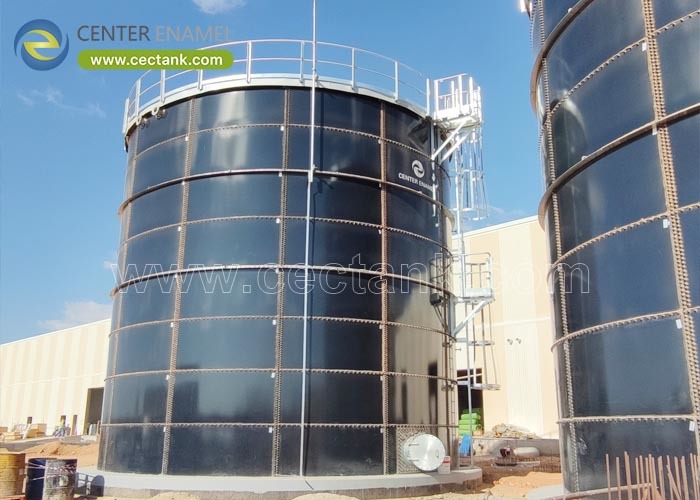
A verified food-processing wastewater project in Congo (DRC) used five 4,947 m3 Glass-Fused-to-Steel (GFS) bolted tanks built in 2026 to treat organic food-process streams and recover energy. The 0.25-0.45 mm enamel coat was holiday-tested at 1500 V and the 8.8-grade bolted seams held the structure, demonstrating an integrated organic-waste solution in Africa.
- Project: Congo food-processing wastewater
- Location: Congo (DRC), Africa
- Industry: Food processing
- Application: Organic waste to energy
- Product: GFS bolted tank
- Capacity: 4,947 m3
- Quantity: 5 tanks
- Material: Glass-Fused-to-Steel
- Standards: AWWA D103-09 / ISO 28765
- Year: 2026
About Shijiazhuang Zhengzhong Technology Co., Ltd.
Shijiazhuang Zhengzhong Technology Co., Ltd. (Center Enamel) provides both tank supply and integrated EPC packages, founded in 2008 with exports to more than 100 countries and nearly 200 enamel patents. Its engineering team designs the GFS digester, the roof, and the process interface under ISO 9001 / ISO 45001, giving food-waste owners a single accountable supplier.
- Founded: 2008 in China.
- Scope: tank plus EPC.
- Reach: 100+ countries.
- System: ISO 9001 / 45001.
Advantages and Limitations
Advantages are single-contract accountability, a 30-50 year GFS tank, and a faster 8-20 week path than coordinating many vendors. Limitations are that civil foundation scope must be defined (owner or EPC), and very low pH below 2 needs a confirmed lining. The EPC model suits first-time owners more than in-house engineering teams.
- Pros: single contract.
- Pros: 8-20 weeks.
- Limit: civil scope.
- Limit: pH below 2.
Comparison of Delivery Models
Against equipment-only supply, EPC removes the interface risk between tank and process; against owner-built, it transfers schedule risk to the contractor. The table contrasts the three delivery models so the owner picks the responsibility level that matches their team and their risk appetite, with the 8-20 week EPC schedule as the benchmark.
- EPC: one contract.
- Equipment: split risk.
- Owner: self-coordinated.
- Best: first-time owner.
| Aspect | EPC / turnkey | Equipment-only supply | Build by others |
|---|---|---|---|
| Single responsibility | Yes, one contract | Split responsibilities | Multiple parties |
| Design integration | Full process + tank | Tank only | Coordinated by owner |
| Schedule risk | Contractor held | Shared | Owner held |
| Commissioning | Included | Usually extra | Owner led |
| Best for | First-time owners | Experienced teams | In-house engineers |
EPC solutions for food waste transformation succeed when one contractor owns the GFS digester (0.25-0.45 mm enamel, 1500 V tested, 8.8-grade bolts), the process, and the commissioning under ISO 9001 / ISO 45001. Specify the single contract, verify the references, and the plant reaches biogas at 5-30 mbar reliably.
- Spec: single contract.
- Verify: 1500 V test.
- Confirm: ISO 9001 / 45001.
Frequently Asked Questions (FAQ)
What does EPC mean for a food-waste plant?
EPC means one contractor designs, supplies the Glass-Fused-to-Steel digester tanks and process equipment, installs, and commissions the plant, taking single responsibility from design to start-up.
What tank is used in the EPC package?
The digester is a Glass-Fused-to-Steel tank with a 0.25-0.45 mm enamel fused at 820-930 C, holiday-tested at 1500 V, bolted with 8.8-grade fasteners, and rated for 30-50 years.
What biogas pressure is designed?
The double-membrane holder stores biogas at 5-30 mbar, typical for anaerobic digestion, and the tank shell is calculated to AWWA D103-09 and ISO 28765.
How long does an EPC project take?
A typical package runs 8-20 weeks from design to commissioning, depending on civil foundation works and site access.
What information is needed for a quotation?
Provide the food-waste type and tonnage per day, the target biogas or energy output, the site location and climate, and whether civil works are owner or contractor scope.
Is the EPC model right for experienced owners?
Experienced teams may prefer equipment-only supply, but first-time owners gain the most from single-contract accountability and the supplier's commissioning record.
Send your food-waste tonnage per day, target output, and site details to our engineering team for an integrated EPC scope, GFS tank specification, and reference plants.