-
Glass Fused To Steel Tanks (596)
-
Stainless Steel Tanks (434)
-
Fusion Bonded Epoxy Tanks (592)
-
Galvanized Steel Tanks (321)
-
Aluminum Dome Roofs (1336)
-
Wastewater Storage Tanks (232)
-
Welded Steel Tanks (457)
-
Pressure Vessels (295)
-
Anaerobic Digester (202)
-
Industrial Water Tanks (349)
-
Glass Lined Steel Tanks (180)
-
Bolted Steel Tanks (389)
-
Sludge Storage Tank (115)
-
Biogas Storage Tank (173)
-
Leachate Storage Tanks (133)
-
Agricultural Water Storage Tanks (179)
-
Fire Water Tank (166)
-
Grain Storage Silos (146)
-
Biogas Projects (424)
-
Wastewater Treatment Projects (1268)
-
Double Membrane Roof (223)


|
Pennisetum Purpureum to Biogas in Kenya:Leading GFS Tanks and EPC Contractor Solutions
| Place of Origin: | China |
| Brand Name: | CEC TANKS |
| Certification: | ISO 9001:2008, AWWA D103 , OSHA , BSCI |
| Model Number: | W |
| Minimum Order Quantity: | 1set |
| Price: | $5000~$20000 one set |
| Packaging Details: | PE poly-foam between each two steel plates ; wooden pallet and wooden |
| Delivery Time: | 10-30 days after deposit received |
| Payment Terms: | L/C,T/T |
| Supply Ability: | 60 sets per month |
|
Detail Information |
|||
| Place of Origin | China | Brand Name | CEC TANKS |
|---|---|---|---|
| Certification | ISO 9001:2008, AWWA D103 , OSHA , BSCI | Model Number | W |
| Tank Body Color: | Dark Green / Can Be Customized | Corrosion Integrity: | Excellent |
| Steel Plates Thickness: | 3mm To 12mm , Depends On The Tank Structure | Chemical Resistance: | Excellent |
| Size Of Panel: | 2.4M * 1.2M | Easy To Clean: | Smooth, Glossy, Inert, Anti-adhesion |
| Highlight: | Pennisetum Purpureum biogas Kenya,GFS tanks wastewater treatment,EPC contractor biogas solutions |
||
Product Description
Kenya is rapidly advancing its renewable energy capabilities, with a strategic focus on transforming abundant organic agricultural waste into reliable, green power. Pennisetum Purpureum, commonly known as Napier grass, has become a vital biomass resource across the country, valued for its rapid growth cycle and impressive dry matter yield. This article examines the technical aspects of converting this biomass into renewable energy, showcasing how advanced biogas solutions from a professional EPC Contractor can transform agricultural by-products into a reliable power source for Kenya's growing energy needs.
Pennisetum Purpureum cultivation is expanding rapidly across Kenya, favored by the country's tropical climate and abundant rainfall. Characterized by low maintenance requirements and high tolerance to diverse soil conditions, it serves as an ideal crop for agricultural developments. Beyond its traditional application as high-protein livestock forage, Pennisetum Purpureum is increasingly utilized as a high-value industrial feedstock. Its massive lignocellulosic content, comprising cellulose, hemicellulose, and lignin, makes it an exceptional candidate for anaerobic digestion. The crop offers a favorable carbon-to-nitrogen ratio that promotes stable and productive microbial activity during anaerobic digestion, resulting in high methane conversion rates and reliable energy outputs. Furthermore, the effective utilization of this grass helps reduce organic waste while producing nutrient-dense digestate, which serves as a high-quality organic fertilizer for local farmers, thereby strengthening the circular economy within Kenya's agricultural communities.
Understanding the conversion of restaurant food waste to biogas provides valuable insights into the anaerobic digestion process that also applies to Pennisetum Purpureum. Food waste, like Napier grass, undergoes a multi-stage biological pathway in an oxygen-free environment. The process begins with collection and pre-treatment, where organic waste is shredded and homogenized to create a consistent slurry. This is followed by hydrolysis, where complex organic polymers and fibers are broken down by extracellular bacterial enzymes into soluble monomers and then converted into volatile fatty acids. Specialized microorganisms then catabolize these intermediate fatty acids into acetic acid, carbon dioxide, and hydrogen. Finally, highly sensitive methanogenic archaea consume these final chemical compounds to generate valuable bio-methane, producing a stable supply of renewable biogas. This sequential process mirrors the biological conversion of grass biomass, demonstrating the versatility of anaerobic digestion technology for various organic feedstocks.
At the heart of high-efficiency biogas facilities is the CSTR (Continuous Stirred-Tank Reactor) process. This advanced anaerobic treatment technology serves as the core processing unit that converts organic waste like Pennisetum Purpureum into biogas and digestate. The CSTR process involves feeding the prepared organic feedstock continuously or semi-continuously into a sealed reactor. The reactor is equipped with a mechanical stirring device that ensures fermentation raw materials and anaerobic microorganisms are in a state of complete and thorough mixing. This constant agitation is crucial for maintaining a uniform temperature and preventing the settling of solids, which allows for the efficient degradation of high-concentration organic matter. Research has confirmed that CSTR technology is a promising solution for treating different wastes because of its capability to generate high-quality effluents and renewable biogas energy. The closed-loop system is essential for the efficient degradation of complex organic materials, allowing for stable gas generation even when processing challenging, high-solid feedstocks.
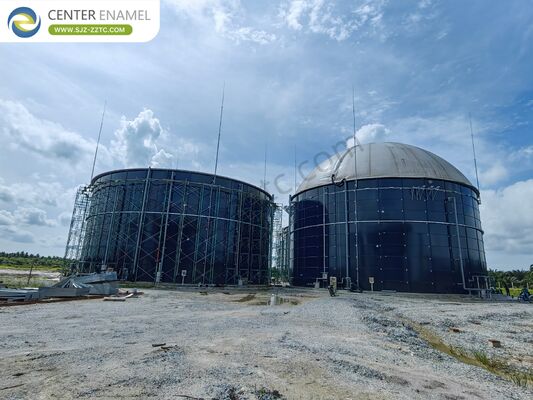
For the demanding environment of anaerobic digestion, storage infrastructure must offer exceptional durability and corrosion resistance. Glass-Fused-to-Steel (GFS) tanks are the premium choice, created by firing glass onto steel at high temperatures (820°C-930°C) to form an inert, durable bond. This technology provides the strength and flexibility of steel combined with the outstanding corrosion resistance of glass, making GFS tanks ideal for withstanding the corrosive organic acids and hydrogen sulfide produced during digestion. GFS tanks feature a smooth, glossy, inert, and anti-adherent surface that resists corrosion and requires minimal maintenance. When paired with a Double Membrane Roof, the system achieves optimal airtightness for biogas collection and odor control. This combination of structural strength and membrane flexibility is a cost-effective solution that saves significant construction costs while maximizing site space efficiency. The modular bolted construction enables rapid onsite assembly and easier transport logistics compared to welded tanks.
A professional EPC Contractor offers a diverse range of storage tank cover solutions to meet various project requirements and environmental conditions:
- Aluminum Geodesic Dome Roof: Engineered for expansive clear-span capability and high corrosion resistance.
- Glass-Fused-to-Steel Roof: The ideal solution for pressurized applications, offering supreme airtightness and odor management.
- Aluminum Alloy Trough Deck Roof: A cost-effective option for non-pressurized storage, effectively shielding contents from wind and rain.
- Stainless Steel Roof: Specifically engineered for the most aggressive environments, ensuring maximum longevity.
- FRP Roof: A versatile, lightweight choice perfect for applications where extreme airtightness is not required.
A fully functional biogas plant requires reliable auxiliary equipment beyond the digester and storage tank. Essential components include:
- Gas Holder: Provides secure, scalable containment for generated biogas.
- Solid-Liquid Separator: Prepares organic matter for rapid digestion and divides digestate into valuable by-products.
- Lifting Pump: Ensures reliable transfer of materials throughout the plant.
- Dehydration and Desulfurization Tank: Purifies raw biogas by removing moisture and corrosive hydrogen sulfide to meet quality standards.
- Screw Sludge Dewatering Machine: Simplifies the management of waste by-products, ensuring clean site operations.
For Kenya's biogas projects, partnering with a professional EPC Contractor like Center Enamel offers distinct advantages:
- Tailored Anaerobic Solutions: Expertise in selecting the right technology (CSTR, UASB, USR, IC) for specific waste characteristics and local conditions.
- Local Experience: Deep understanding of Kenya's tropical climate, environmental regulations, and construction norms.
- High-Quality Manufacturing: Asia's largest GFS tank production base with over 20 patents in enameling technology, ensuring premium product quality.
- International Quality Standards: Compliance with ISO 9001, CE, NSF/ANSI 61, AWWA D103, and ISO 28765 standards, ensuring bankable project quality.
- Rapid Installation: Bolted tank designs for fast on-site assembly, reducing construction time and accelerating return on investment.
- Complete After-Sales Support: Dedicated teams for maintenance, technical guidance, and operational optimization.
Kenya's journey towards renewable energy independence is significantly bolstered by the conversion of Pennisetum Purpureum into biogas. By utilizing advanced anaerobic technologies like the CSTR process and robust storage solutions such as GFS Tanks, the country can efficiently manage agricultural waste and generate clean power. With the support of a leading EPC Contractor, Kenya can successfully implement large-scale projects that not only meet energy demands but also promote environmental sustainability and agricultural resilience across the nation. This approach reduces reliance on fossil fuels, mitigates greenhouse gas emissions, and aligns with Kenya's renewable energy goals.