-
Glass Fused To Steel Tanks (596)
-
Stainless Steel Tanks (434)
-
Fusion Bonded Epoxy Tanks (592)
-
Galvanized Steel Tanks (321)
-
Aluminum Dome Roofs (1336)
-
Wastewater Storage Tanks (232)
-
Welded Steel Tanks (457)
-
Pressure Vessels (295)
-
Anaerobic Digester (202)
-
Industrial Water Tanks (349)
-
Glass Lined Steel Tanks (180)
-
Bolted Steel Tanks (389)
-
Sludge Storage Tank (115)
-
Biogas Storage Tank (173)
-
Leachate Storage Tanks (133)
-
Agricultural Water Storage Tanks (179)
-
Fire Water Tank (166)
-
Grain Storage Silos (146)
-
Biogas Projects (424)
-
Wastewater Treatment Projects (1258)
-
Double Membrane Roof (223)


|
Restaurant Food Waste into Energy in Saudi Arabia: CSTR Process and Biogas Solution Provider Solutions
| Place of Origin: | China |
| Brand Name: | CEC TANKS |
| Certification: | ISO 9001:2008, AWWA D103 , OSHA , BSCI |
| Model Number: | W |
| Minimum Order Quantity: | 1set |
| Price: | $5000~$20000 one set |
| Packaging Details: | PE poly-foam between each two steel plates ; wooden pallet and wooden |
| Delivery Time: | 10-30 days after deposit received |
| Payment Terms: | L/C,T/T |
| Supply Ability: | 60 sets per month |
|
Detail Information |
|||
| Place of Origin | China | Brand Name | CEC TANKS |
|---|---|---|---|
| Certification | ISO 9001:2008, AWWA D103 , OSHA , BSCI | Model Number | W |
| Tank Body Color: | Dark Green / Can Be Customized | Corrosion Integrity: | Excellent |
| Steel Plates Thickness: | 3mm To 12mm , Depends On The Tank Structure | Chemical Resistance: | Excellent |
| Size Of Panel: | 2.4M * 1.2M | Easy To Clean: | Smooth, Glossy, Inert, Anti-adhesion |
| Highlight: | Restaurant food waste biogas solution,CSTR process wastewater treatment,Biogas energy solution Saudi Arabia |
||
Product Description
Saudi Arabia’s booming restaurant sector and deep-rooted hospitality culture generate substantial food waste that poses environmental and economic challenges. Converting this organic waste into renewable biogas through anaerobic digestion offers a sustainable solution aligned with the Kingdom’s Vision 2030 goals. This article explores how professional Biogas Solution Provider services utilize the CSTR Process and durable GFS Tanks to transform Restaurant Food Waste into renewable energy across Saudi Arabia.
Saudi Arabia faces one of the highest global rates of food waste, driven by a culture of generosity and hospitality where lavish food displays symbolize affluence. The average Saudi wastes up to 250 kilograms of food annually—more than double the global average of 115 kg—with some estimates placing the figure as high as 427 kg per person per year. This waste represents staggering economic costs. Saudi Arabia’s Ministry of Environment, Water and Agriculture estimates that food waste costs the kingdom approximately $13 billion annually. In family restaurants, research indicates that bread and rice alone account for over 50% of food waste, with an average of at least 20% of served food per customer being discarded. Crucially, 70% of Saudi restaurants currently have no strategies for handling leftover food. With limited arable land and scarce water resources making the kingdom heavily reliant on food imports, and Saudi Vision 2035 targeting sustainability and reduced waste, professional Biogas Solution Provider services are essential.
Restaurant food waste is rich in starchy foods, proteins, and fats, making it an ideal feedstock for anaerobic digestion. The conversion process involves advanced mechanical sorting and multi-stage biological anaerobic digestion. Research indicates that total plant-based food waste in Saudi Arabia reaches 2.27 billion kg per year, whereas animal-based waste amounts to 0.89 billion kg per year. This demonstrates significant potential for biogas production. Inside sealed fermentation vessels, specialized anaerobic bacteria break down complex organic matter through hydrolysis, acidogenesis, acetogenesis, and methanogenesis. Methanogenic microbial action converts intermediate compounds into biogas, primarily composed of methane and carbon dioxide. The net energy output from anaerobic digestion is the difference between the energy generated from biogas and the energy lost during fertilizer processing and digestion operations. The residual digestate can be processed into nutrient-rich organic fertilizer for agricultural use, supporting Saudi Arabia’s food security goals.
At the core of Center Enamel’s Restaurant Food Waste biogas solution is the CSTR Process (Continuous Stirred-Tank Reactor), an advanced anaerobic treatment technology specifically designed for high-solids, high-concentration organic feedstocks. The CSTR reactor operates as a closed, insulated tank equipped with a mechanical stirring device that includes mixers, paddles, and an agitator shaft. These components operate continuously to prevent solids from settling at the bottom and to prevent fats and oils from forming a floating scum layer that would block gas release. Through continuous feeding at a constant temperature, the complete mixing action ensures maximum contact between anaerobic bacteria and organic matter. Additional features include a shell-breaking device to disrupt floating layers, a sludge discharge port for removing fully digested material, and a biogas pipeline connected to positive and negative pressure protectors for operational safety. Research confirms that CSTR fermentation can achieve biogas yields of 670 NL biogas/kg volatile solids with average methane concentration of approximately 60%. This technology is particularly suitable for processing restaurant food waste in Saudi Arabia’s major urban centers like Riyadh, Jeddah, and Dammam.
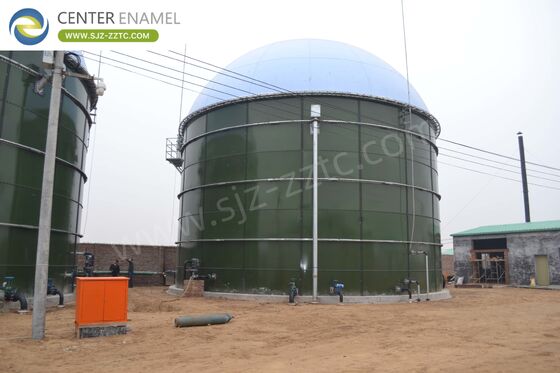
For biogas projects in Saudi Arabia, the reliability and longevity of storage and digestion infrastructure are essential given the Kingdom’s extreme desert conditions. GFS Tanks (Glass-Fused-to-Steel) from Center Enamel are the premium choice for these demanding applications. Through high-temperature firing at 820°C–930°C, the glass fuses to high-strength steel plates, creating an inert, inorganic bond that combines the structural strength of steel with outstanding corrosion resistance. This provides exceptional protection against organic acids and hydrogen sulfide generated in biogas production, ensuring a service life exceeding 30 years with minimal maintenance. The tanks comply with international standards including AWWA D103-09, ISO 28765, and NSF/ANSI 61, making them suitable for the most demanding applications. The Double Membrane Roof is the preferred solution for biogas collection under normal working conditions. This innovative design integrates the gas holder directly on top of the tank, offering significant cost optimization and space efficiency by eliminating separate ground-mounted gas holders. The integrated structure provides superior gas-tight storage capabilities, efficiently capturing and storing generated biogas under optimal operating pressure while protecting against Saudi Arabia’s extreme heat and sand-laden environment.
Beyond GFS Tanks and double membrane roofs, Center Enamel offers a comprehensive portfolio of engineered storage structures and cover solutions tailored for various biogas applications. Galvanized Steel Tanks utilize a hot-dip galvanizing process to provide a tough, wear-resistant protective shield suitable for various water and wastewater containment needs. Fusion Bonded Epoxy Tanks, developed in partnership with global coating leaders, provide superior barrier protection with high structural flexibility. Stainless Steel Tanks constructed from premium AISI grades withstand extreme operational environments and store high-purity liquids. For tank covers, multiple options are available including Aluminum Geodesic Dome Roofs with advanced corrosion resistance and expansive clear-span capability; Glass-Fused-to-Steel Roofs offering air-tightness for pressurized structures; Aluminum Alloy Trough Deck Roofs as economical options; Stainless Steel Roofs delivering super anti-corrosion performance for demanding environments; and FRP Roofs suitable for applications without air-tightness requirements.
A complete Restaurant Food Waste biogas plant requires specialized auxiliary equipment to ensure efficient operation. Center Enamel provides a full suite of supporting systems including Gas Holder Systems for secure, weather-resistant volume storage of generated biogas prior to utilization. Black Membrane Covers offer economical covering solutions for open-air storage basins and secondary containment lagoons. Solid-Liquid Separators efficiently separate digested slurry into fibrous organic fertilizer and liquid nutrient streams. Torch Systems ensure safe flaring and pressure relief of excess biogas during maintenance or emergency shutdowns. Lifting Pumps are designed for heavy-duty slurry transfer and wastewater circulation without clogging. Dehydration and Desulfurization Tanks remove moisture and hydrogen sulfide impurities to protect downstream equipment from corrosion. This comprehensive equipment suite ensures efficient and reliable operation at every stage of the biogas production process in Saudi Arabia’s challenging climate conditions.
Center Enamel has established itself as a premier Biogas Solution Provider, delivering comprehensive, turnkey waste-to-energy solutions for Saudi Arabia’s growing renewable energy sector. With a 150,000㎡ R&D and production base, over 500 employees, and an annual production capacity of 250,000 tank sheets, they bring extensive expertise to every Restaurant Food Waste Biogas Project. Their solutions are specifically adapted to Saudi Arabia’s arid and hot climate conditions. Key advantages include:
- Comprehensive EPC Services: Covering design, manufacturing, installation, and commissioning throughout the project lifecycle, reducing client coordination costs and investment risks
- International Certifications: Including ISO 9001, CE/EN1090, NSF61, WRAS, and EN28765, ensuring the highest quality standards
- Rigorous Design Standards: Compliance with AWWA D103, OSHA, and EuroCode for safety, durability, and performance
- Proven Track Record: Successfully delivered projects in more than 100 countries with specific experience in the Middle East region
- End-to-End Support: From project design and installation to ongoing technical support throughout the project lifecycle
Transforming Saudi Arabia’s restaurant food waste into biogas presents a significant opportunity for sustainable waste management and renewable energy production. With advanced technologies like the CSTR Process, durable GFS Tanks, and comprehensive Biogas Solution Provider services from experienced providers, Saudi Arabia can effectively address its food waste challenges while contributing to a cleaner environment. The Kingdom’s Vision 2030 goals, which emphasize sustainability and reduced waste, align perfectly with the deployment of these waste-to-energy solutions. Center Enamel’s expertise as a complete biogas solution provider, combined with their high-quality GFS Tanks and innovative double membrane roofs, positions them as a reliable partner for Saudi enterprises seeking to convert restaurant waste into a valuable renewable energy asset while helping the Kingdom achieve its circular economy ambitions.
1. What is the scale of restaurant food waste in Saudi Arabia?
Saudi Arabia wastes up to 250 kg of food per person annually—double the global average—with total food waste costing the kingdom approximately $13 billion per year. Restaurant food waste significantly contributes to this total.
2. How does the CSTR process benefit biogas production from food waste?
The CSTR process uses mechanical stirring to maintain complete mixing of food waste and microorganisms, preventing solids settling and crust formation. Research confirms CSTR fermentation can achieve biogas yields of 670 NL biogas/kg volatile solids with approximately 60% methane concentration.
3. What is Saudi Arabia’s potential biogas production from food waste?
Research estimates Saudi Arabia generates 2.27 billion kg of plant-based food waste and 0.89 billion kg of animal-based food waste annually. This represents a substantial resource for biogas production that can contribute significantly to the Kingdom’s renewable energy targets and Vision 2030 goals.