-
Glass Fused To Steel Tanks (596)
-
Stainless Steel Tanks (434)
-
Fusion Bonded Epoxy Tanks (592)
-
Galvanized Steel Tanks (321)
-
Aluminum Dome Roofs (1336)
-
Wastewater Storage Tanks (232)
-
Welded Steel Tanks (457)
-
Pressure Vessels (295)
-
Anaerobic Digester (201)
-
Industrial Water Tanks (349)
-
Glass Lined Steel Tanks (180)
-
Bolted Steel Tanks (389)
-
Sludge Storage Tank (115)
-
Biogas Storage Tank (173)
-
Leachate Storage Tanks (133)
-
Agricultural Water Storage Tanks (179)
-
Fire Water Tank (166)
-
Grain Storage Silos (146)
-
Biogas Projects (425)
-
Wastewater Treatment Projects (1008)
-
Double Membrane Roof (223)

|
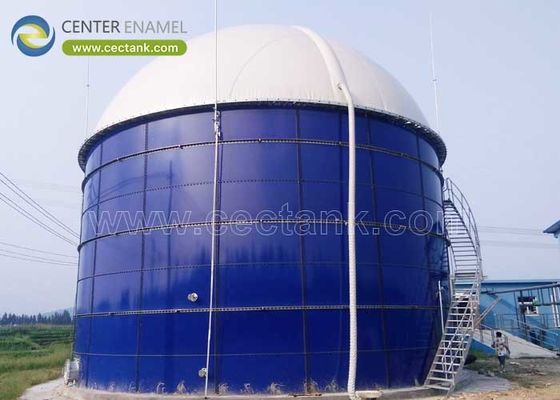
High Air-Tightness GFS Anaerobic Digester Tanks for BioEnergy Projects: The Optimal Solution for Sustainable Biogas Production — Center Enamel
| Place of Origin: | China |
| Brand Name: | CEC TANKS |
| Certification: | ISO 9001:2008, AWWA D103 , OSHA , BSCI |
| Model Number: | W |
| Minimum Order Quantity: | 1set |
| Price: | $5000~$20000 one set |
| Packaging Details: | PE poly-foam between each two steel plates ; wooden pallet and wooden |
| Delivery Time: | 10-30 days after deposit received |
| Payment Terms: | L/C,T/T |
| Supply Ability: | 60 sets per month |
|
Detail Information |
|||
Product Description
In modern commercial bioenergy projects, high air-tightness Glass-Fused-to-Steel (GFS) anaerobic digester tanks represent the benchmark containment infrastructure for maximizing biogas yields while ensuring absolute operational safety. The biochemical breakdown of organic matter under anaerobic conditions generates a harsh gas mixture consisting of methane, carbon dioxide, and highly corrosive hydrogen sulfide.
Center Enamel addresses this hostile environment by engineering modular bolted GFS tanks. By fusing an inert silica-glass enamel lining onto both sides of high-tensile structural steel plates at temperatures above 800°C, these structures deliver absolute corrosion resistance across a wide $text{pH}$ scale. Combined with advanced engineering-grade sealing matrices, they eliminate fugitive gas emissions, safeguard the localized biochemistry, and preserve premium energy margins for green power generation.
To maximize methane output, process engineers must carefully balance the input volume of organic waste against the biological reaction time inside the GFS reactor shell.
The conversion of complex organic matter into biogas can be modeled using the Buswell Generic Equation, which highlights the predictable generation of methane and carbon dioxide gases:
To calculate the total active fluid volume (V) required to sustain this biological reaction profile without disrupting the microbial ecosystem, engineers apply the standard Hydraulic Retention Time (HRT) formula:
Once the volume is calculated, the structural aspect ratio is adjusted. Center Enamel builds GFS shells that maintain low spatial footprints while ensuring optimal internal mixing kinetics.
The unique chemical stresses inside an anaerobic digester demand materials that can withstand simultaneous liquid and gas phase corrosion.
| Engineering & Containment Parameter | Center Enamel Bolted GFS Tanks | Reinforced Poured Concrete | Welded Carbon Steel (Epoxy Painted) |
|---|---|---|---|
| Gas Tightness Integrity | Absolute. Specialized EPDM gaskets maintain a flexible, permanent seal. | Poor. Structural micro-cracks allow diffuse gas leakage over time. | Variable. High risk of pinhole leaks along field weld seams. |
| $text{H}_2text{S}$ Gas Phase Resistance | Impermeable. Glass lining is fully immune to biogenic acid attacks. | Very Poor. Sulfuric acid eats into the concrete matrix, exposing rebar. | Moderate to Poor. Epoxy films degrade quickly under active gas exposure. |
| Internal Mixing Friction | Very Low. Smooth vitreous finish minimizes slurry drag and wear. | High. Rough concrete faces catch sediment and cause scale buildup. | Moderate. Surface wear accelerates raw steel corrosion. |
| Thermal Insulation Integration | Simple. Modular jacket insulation snaps directly onto the exterior shell. | Complex. Requires exterior insulation skins that are prone to moisture traps. | Moderate. Requires field-wrapped blankets vulnerable to outdoor weather. |
| Site Installation Timeline | Ultra-Fast. Modular assembly cuts setup times by up to 60%. | Extended. Long curing windows and complex formwork slow progress. | Slow. Requires certified on-site welders and multi-pass inspections. |
High air-tightness cannot be achieved with basic sealants. Center Enamel uses a multi-layered engineering approach to guarantee complete gas containment:
The vertical and horizontal joints between adjacent GFS panels are sealed using heavy-duty, chemical-resistant EPDM or Viton gaskets. These gaskets remain highly elastic, allowing the joints to expand and contract during temperature shifts while maintaining a tight, continuous seal.
Panels are secured with high-tensile, hot-dip galvanized bolts. The bolt heads are capped with weather-resistant plastic injection moldings, isolating the metal fasteners from the aggressive internal slurry and gases.
The top of the GFS digester shell is often fitted with an advanced double-membrane gas roof. The inner membrane moves up and down to adjust to changing biogas volumes, while the outer membrane is continuously pressurized with air to protect the system from wind and snow loads. The entire roof assembly is mechanically clamped to the upper rim of the GFS tank using heavy-duty stainless steel compression rings, creating an absolute gastight seal.
This interactive engine allows bioenergy project developers to estimate required digester sizing, projected daily biogas volumes, and green electrical power potential based on standard organic waste inputs.
Center Enamel ensures absolute air-tightness by shifting critical quality checks out of the unpredictable field environment and into an automated manufacturing facility:
-
100% Spark Testing Protocols: Every single GFS sheet passes through an automated high-voltage holiday detection system operating at 1500V to 2500V. This test instantly flags and rejects any panel with microscopic pinholes or imperfections in the glass coating, ensuring complete material integrity.
-
Compliance with Global Engineering Codes: All tank structures are calculated and built to comply with strict international standards, including AWWA D103-09 for bolted tank mechanics, ISO 28765:2016 for vitreous enamel testing, and European EN standards for biogas plant configurations.
-
Future Capacity Expansion: If a bioenergy plant expands its operations and needs to process more organic waste, the modular bolted panel design allows crews to unbolt the structure, lift the upper rings using synchronized jacking systems, and install new panel rows at the base, minimizing site disruption and protecting the initial infrastructure investment.
In the warm upper section of a digester, specialized bacteria oxidize hydrogen sulfide gas ($text{H}_2text{S}$) into sulfuric acid ($text{H}_2text{SO}_4$). This aggressive acid condenses on the upper tank walls, quickly corroding unprotected concrete or standard epoxy-painted steel. Center Enamel's glass-fused lining provides an impermeable chemical barrier that resists asset degradation across a wide range of conditions.
While stainless steel provides good corrosion resistance, its high raw material cost can significantly inflate initial project budgets. GFS tanks offer comparable corrosion defense at a much more economical capital investment. Additionally, the modular bolted panels eliminate the need for specialized on-site welding crews and extended weld inspections, lowering overall installation costs.
Every tank shell is custom-engineered using finite element analysis to safely handle the positive and negative pressures generated by active biogas production. The tanks are equipped with calibrated pressure and vacuum relief valves (PVRVs) linked to automated safety controls, preventing structural damage during rapid gas drawdowns or unexpected temperature shifts.