-
Glass Fused To Steel Tanks (896)
-
Stainless Steel Tanks (434)
-
Fusion Bonded Epoxy Tanks (660)
-
Galvanized Steel Tanks (321)
-
Aluminum Dome Roofs (1336)
-
Wastewater Storage Tanks (280)
-
Welded Steel Tanks (457)
-
Pressure Vessels (461)
-
Anaerobic Digester (202)
-
Industrial Water Tanks (364)
-
Glass Lined Steel Tanks (180)
-
Bolted Steel Tanks (389)
-
Sludge Storage Tank (115)
-
Biogas Storage Tank (173)
-
Leachate Storage Tanks (133)
-
Agricultural Water Storage Tanks (179)
-
Fire Water Tank (166)
-
Grain Storage Silos (146)
-
Biogas Projects (424)
-
Wastewater Treatment Projects (1792)
-
Double Membrane Roof (223)
|
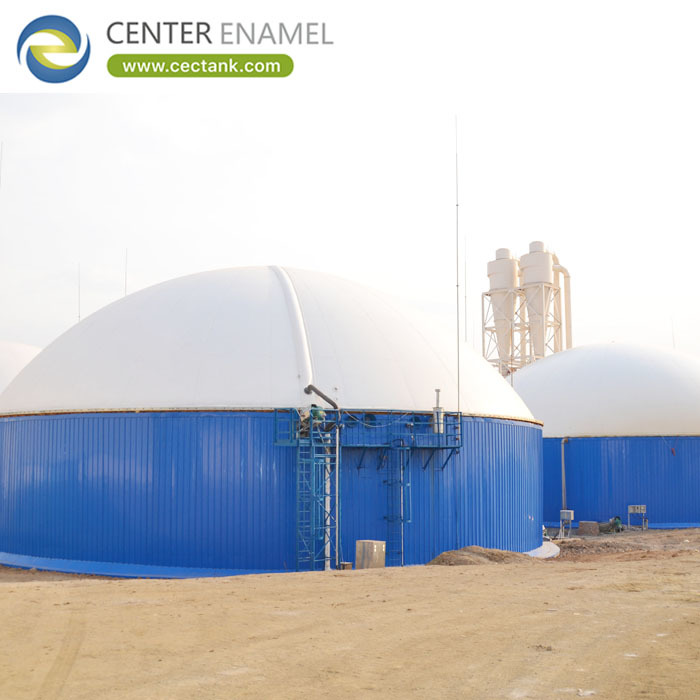
Farm Biogas Digester: Anaerobic Digestion For Agriculture And Livestock
| Place of Origin: | China |
| Brand Name: | CEC TANKS |
| Certification: | ISO 9001:2008, AWWA D103 , OSHA , BSCI |
| Model Number: | J2016012654 |
| Minimum Order Quantity: | 1set |
| Price: | $5000~$20000 one set |
| Packaging Details: | PE poly-foam between each two steel plates ; wooden pallet and wooden box |
| Delivery Time: | 0-60 days after deposit received |
| Payment Terms: | L/C,T/T |
| Supply Ability: | 60 sets per month |
|
Detail Information |
|||
Product Description
A farm biogas digester applies anaerobic digestion to agriculture, converting manure, slurry and crop residue into biogas for heat or power and digestate for fertiliser. The agricultural context changes the design: higher total solids, seasonal feed variation, and digestate that must be stored to the spreading calendar. The digester is usually a CSTR at 20-40 day retention and 35-38 C, but the farm system around it - feed buffer and digestate tank - is what makes it work season after season. Center Enamel supplies farm biogas digesters in GFS, FBE, stainless-steel and carbon-steel bolted construction.
Agricultural feeds - manure, slurry, crop residue - are high in total solids, typically 8-12% for a CSTR, which is exactly the regime a continuously stirred tank reactor handles. The retention time of 20-40 days at mesophilic 35-38 C gives stable methane yield of 55-65%, and the digestate is a nutrient-rich fertiliser the farm applies back to land. The digester and the land form a loop.
- Feed: manure, slurry, crop residue, 8-12% solids.
- CSTR: 20-40 days at 35-38 C mesophilic.
- Methane yield 55-65% of biogas.
- Digestate returns nutrients to the land.
A farm system needs the feed buffer and digestate tank sized to agriculture, not industry. The feed buffer holds one to two weeks so a harvest or weather gap does not stall the reactor; the digestate tank holds outflow to the spreading season plus regulation. On a farm these tanks are as important as the digester, because the loop only closes if storage matches the calendar.
- Feed buffer: one to two weeks of feed continuity.
- Digestate: season plus regulation, not daily flow.
- Storage matches the farm calendar, not industry.
- The loop closes only with matched storage.
These agricultural design numbers differ from an industrial biogas plant: feed total solids of 8-12%, CSTR retention of 20-40 days at 35-38 C, a feed buffer of 1-2 weeks, digestate storage to the spreading season, and per-zone coating - GFS 2C2F at 0.25-0.45 mm or FBE - verified by a 1,500 V holiday-spark test and a shell calculation to AWWA D103-19 and ISO 28765. On a farm, the loop only closes when storage matches the calendar.
| Design parameter | Typical value or range | Why it matters |
|---|---|---|
| Total solids (feed) | 8-12% for farm CSTR | Manure and residue regime |
| Retention time | 20-40 days at 35-38 C | Stable methane on variable feed |
| Feed buffer | 1-2 weeks of feed | Protects against seasonal gaps |
| Digestate storage | Season plus regulation | Farm calendar, not daily flow |
| Coating by zone | GFS 2C2F or FBE | Acid liquid and H2S gas differ |
| Limitation to check | Usable gas below setpoint | Holder sized to recoverable volume |
A 2024 biogas project in Canada used two Glass-Fused-to-Steel bolted tanks totalling 798 m3 with enamel roofs. As a smaller-scale biogas delivery it demonstrates the kind of compact, coated bolted digester scope applicable to agricultural and rural biogas duty. Diameter and height are not recorded in the verified project data and are reported Not Provided.
| Field | Value |
|---|---|
| Location | Canada, North America |
| Year | 2024 |
| Tank type | GFS bolted, 2 units |
| Total volume | 798 m3 |
| Roof | Enamel roof |
| Application | Biogas project |
The farm case for biogas rests on a loop, not a single saving. The digester converts manure and residue into biogas for heat or power, cutting bought energy and odour, while the digestate returns nutrients to the land and reduces synthetic fertiliser. The loop only closes if the feed-buffer and digestate tanks match the farm calendar, because a gap in storage stalls the reactor or wastes the fertiliser. Modelled over a season, the combined energy and fertiliser value - not the digester alone - justifies the coated, gas-tight bolted system.
- Biogas cuts bought energy and farm odour.
- Digestate returns nutrients, cuts fertiliser.
- Loop closes only with calendar-matched storage.
- Feed-buffer and digestate sized to the farm.
- Energy plus fertiliser value justifies the system.
Center Enamel supplies farm biogas digesters and the surrounding feed-buffer and digestate tanks in GFS, FBE, stainless-steel and carbon-steel bolted construction, specifying the coating per zone and the roof for the operating gas pressure. The company has produced GFS tanks since 2008, holds ISO 9001, ISO 45001, NSF/ANSI 61, EN 1090 (CE), ISO 28765 and WRAS approvals, and has delivered more than 30,000 storage projects across 100+ countries.
- CSTR-oriented coating and mixing specification.
- Feed-buffer and digestate tanks in the scope.
- Shell to AWWA D103-19 and ISO 28765.
- 100% 1,500 V holiday-spark test on panels.
It is an anaerobic digester applied to agriculture, converting manure, slurry and crop residue into biogas for heat or power and digestate for fertiliser, usually as a CSTR at 20-40 day retention and 35-38 C.
Because agricultural feeds are high in total solids (8-12%), exactly the regime a continuously stirred tank reactor handles, giving stable methane yield of 55-65% over a 20-40 day retention.
To the spreading season plus local regulation, not to daily output, because digestate accumulates and is land-applied. On a farm this tank is as important as the digester.
It holds one to two weeks of feed so a harvest or weather gap does not stall the reactor, protecting the 20-40 day retention process against seasonal feed variation.
GFS 2C2F (pH 2-10) or FBE for the aggressive side, specified per zone because the liquid acid and the gas-phase H2S differ, with a 1,500 V holiday-spark test confirming gas tightness.
Yes. Center Enamel supplies farm digesters plus feed-buffer and digestate tanks in GFS, FBE, stainless-steel and carbon-steel bolted construction, with per-zone coating and certificates to AWWA D103-19 and ISO 28765.
About 0.25-0.35 m3 of biogas per kg of COD removed at mesophilic temperature, with methane content of 55-65%, used for heat, power or upgrading.
A 2024 Canada biogas project used two GFS bolted tanks totalling 798 m3 with enamel roofs - a compact, coated bolted scope suited to agricultural and rural biogas duty.
Usable gas volume is only what sits above the low-pressure setpoint, not the full geometric tank volume, so the holder must be sized to recoverable volume with venting and detection confirmed.
A farm biogas digester applies anaerobic digestion to agriculture, using a CSTR at 20-40 day retention and 35-38 C to convert manure and crop residue into biogas of 55-65% methane and digestate fertiliser, with feed-buffer and digestate tanks sized to the farm calendar rather than daily flow. The coating follows the zone because the liquid acid and gas-phase H2S differ. On a farm the loop only pays when storage matches the seasons, because a digester without a matched feed buffer or digestate tank stalls in one gap and wastes the other, and the coated gas-tight bolted system is what keeps that loop running. Center Enamel supplies these as GFS, FBE, stainless-steel and carbon-steel bolted systems, demonstrated by a 2024 Canada digester of two tanks totalling 798 m3.