-
Glass Fused To Steel Tanks (896)
-
Stainless Steel Tanks (434)
-
Fusion Bonded Epoxy Tanks (660)
-
Galvanized Steel Tanks (321)
-
Aluminum Dome Roofs (1336)
-
Wastewater Storage Tanks (280)
-
Welded Steel Tanks (457)
-
Pressure Vessels (461)
-
Anaerobic Digester (202)
-
Industrial Water Tanks (364)
-
Glass Lined Steel Tanks (180)
-
Bolted Steel Tanks (389)
-
Sludge Storage Tank (115)
-
Biogas Storage Tank (173)
-
Leachate Storage Tanks (133)
-
Agricultural Water Storage Tanks (179)
-
Fire Water Tank (166)
-
Grain Storage Silos (146)
-
Biogas Projects (424)
-
Wastewater Treatment Projects (1792)
-
Double Membrane Roof (223)
|
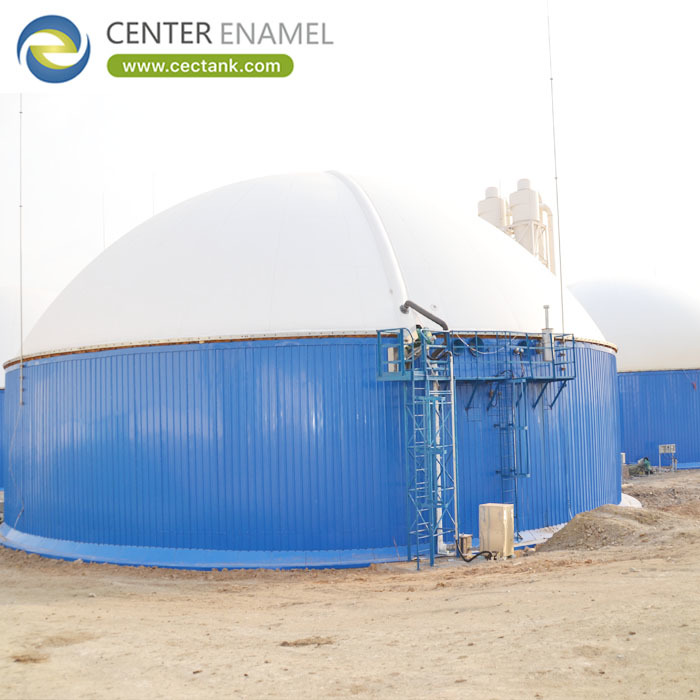
Anaerobic Reactor Manufacturer: UASB, EGSB And CSTR Vessels
| Place of Origin: | CHINA |
| Brand Name: | CEC TANKS |
| Certification: | ISO 9001:2008, AWWA D103 , OSHA , BSCI |
| Model Number: | W20180508003 |
| Minimum Order Quantity: | 1 SET |
| Price: | $5000~$20000 one set |
| Packaging Details: | PE poly-foam between each two steel plates;wooden pallets and wooden box |
| Delivery Time: | 10-30 days after deposit received |
| Payment Terms: | L/C,T/T |
| Supply Ability: | 60 sets per month |
|
Detail Information |
|||
Product Description
An anaerobic reactor manufacturer builds the vessel where anaerobic microbes treat wastewater or organic streams and recover methane. The three dominant reactor types - upflow anaerobic sludge blanket (UASB), expanded granular sludge bed (EGSB) and continuously stirred tank reactor (CSTR) - are not interchangeable shells. UASB and EGSB are hydraulic machines with three-phase separators and upflow velocities of 0.5-1.2 m/h; CSTR is a mixed, retention-driven tank. A reactor manufacturer must engineer the right type to the feed, not sell one shape for every duty. Center Enamel builds all three as bolted GFS or FBE vessels.
UASB and EGSB suit soluble, warm, readily degradable industrial wastewater with COD above roughly 1,500-2,000 mg/L and low suspended solids; they hold granular sludge at 20-40 g/L VSS and convert 5-15 kg COD per m3 per day. CSTR suits higher-solids feeds such as manure and energy crops at 8-12% total solids with 20-40 day retention. The manufacturer's job is to recommend the type from the feed, not the catalogue.
- UASB / EGSB: soluble industrial effluent, low suspended solids.
- CSTR: high total solids (manure, energy crops), mixed tank.
- Organic loading: 5-15 kg COD/m3/day for granular systems.
- Upflow velocity: about 0.5-1.2 m/h at the separator.
Beyond the shell, a reactor manufacturer engineers the internal hydraulics. For UASB and EGSB that means the inlet distributor and the three-phase separator that sets the loading ceiling; for CSTR it means the mixer power density, typically specified in W/m3 with a target mixing time rather than a motor kilowatt rating. The shell is the easy part; the internals decide whether the reactor actually performs.
- Inlet distributor: even upflow, no short-circuiting.
- Three-phase separator: gas, liquid and sludge split at the top.
- CSTR mixing: specified as W/m3 plus mixing time.
- Sampling points: placed to actually manage the bed or slurry.
Compare a reactor manufacturer on engineering rather than paint with these numbers: CSTR retention of 20-40 days at 35-38 C, UASB or EGSB organic loading of 5-15 kg COD per m3 per day, upflow velocity near 0.5-1.2 m/h, gas pressure of 5-30 mbar, and a coating - GFS 2C2F at 0.25-0.45 mm or FBE - proven by a 1,500 V holiday-spark test to AWWA D103-19 and ISO 28765. They separate a shell fabricator from a reactor builder.
Design parameter |
Typical value or range |
Why it matters |
Organic loading (UASB/EGSB) |
5-15 kg COD/m3/day |
Sets reactor throughput ceiling |
Upflow velocity |
0.5-1.2 m/h at separator |
Too high washes granular sludge out |
CSTR retention |
20-40 days at 35-38 C |
Sets volume for high-solids feed |
Mixing power (CSTR) |
Specified as W/m3 + mixing time |
Motor kW alone is not comparable |
Granule bed |
20-40 g/L VSS when healthy |
Lets a granular reactor be compact |
Limitation to check |
UASB fails on high suspended solids and FOG |
Use CSTR or pre-treatment for those feeds |
A 2021 biogas engineering project in Xuzhou, China, used four Glass-Fused-to-Steel bolted tanks totalling 30,532 m3. As a multi-tank anaerobic system it demonstrates a manufacturer delivering a large reactor-scale bolted-tank installation for biogas duty. Diameter and height are not recorded in the verified project data and are reported Not Provided.
Field |
Value |
Location |
Xuzhou, China |
Year |
2021 |
Tank type |
GFS bolted, 4 units |
Total volume |
30,532 m3 |
Application |
Biogas engineering |
The reactor type is chosen by the feedstock, not the budget. Soluble, warm, low-suspended-solids industrial wastewater with COD above about 1,500 mg/L favours UASB or EGSB, which hold granular sludge at 20-40 g/L VSS and treat 5-15 kg COD per cubic metre per day. Higher-solids feeds such as manure, energy crops and sewage sludge at 8-12% total solids favour a CSTR with 20-40 day retention and W/m3 mixing. Feedstocks with heavy fat-oil-grease or high suspended solids rule out UASB regardless of price, and forcing one there guarantees a washout.
- Soluble low-solids wastewater favours UASB or EGSB.
- High-solids manure and crops favour a CSTR.
- Heavy FOG or suspended solids rule out UASB.
- Organic loading 5-15 kg COD/m3/day for granular systems.
- CSTR retention 20-40 days at 35-38 C.
Center Enamel manufactures GFS and FBE bolted reactor vessels and integrates the internal hydraulic components - distributor, three-phase separator and mixer interface - as part of the tank design rather than a site afterthought. The company has produced bolted tanks since 2008, holds ISO 9001, ISO 45001, NSF/ANSI 61, EN 1090 (CE) and ISO 28765 approvals, and has delivered more than 30,000 storage projects across 100+ countries.
- Shell calculated to AWWA D103-19 and ISO 28765.
- Internals engineered with the shell, not retrofitted.
- Coating selected for liquid and gas zones.
- 250,000 panels per year fabrication capacity.
An anaerobic reactor manufacturer builds the vessel where anaerobic microbes treat wastewater or organic streams and recover methane, engineering the internal hydraulics - distributor, separator and mixer - as part of the tank rather than a site add-on.
UASB and EGSB are upflow hydraulic reactors for soluble low-solids wastewater at 5-15 kg COD/m3/day; CSTR is a mixed tank for high-solids feeds at 20-40 day retention. They are selected by feed, not by price.
In UASB and EGSB the separator sets the loading ceiling. If gas, liquid and sludge are not split cleanly at the top, granular sludge washes out and the reactor loses capacity, so the separator - not the shell - is the real performance limit.
By power density in W/m3 plus a target mixing time, not by motor kilowatt alone. W/m3 with mixing time lets you compare mixers fairly across reactor sizes and feed viscosities.
A healthy UASB or EGSB typically treats 5-15 kg COD per m3 per day on soluble, warm, low-solids wastewater, holding a granular bed of 20-40 g/L VSS. Above the separator's hydraulic limit, sludge washes out.
Yes. Center Enamel builds UASB, EGSB and CSTR bolted vessels in GFS and FBE, engineering the internals with the shell, and holds ISO 9001, ISO 45001, NSF/ANSI 61, EN 1090 and ISO 28765 approvals.
High suspended solids and heavy fat-oil-grease (FOG) rule out UASB: solids blanket the bed and FOG coats granules so they float and wash out. For those feeds use a CSTR or pre-treat upstream.
Bolted GFS and fabricated vessels reach about 60,000 m3 per single tank and multi-tank systems far larger; a 2021 Xuzhou biogas engineering project used four GFS bolted tanks totalling 30,532 m3.
Selling one shell shape for every feed. The reactor type must follow the wastewater - soluble and low-solids favours UASB/EGSB, high-solids favours CSTR - or the plant underperforms regardless of coating quality.
An anaerobic reactor manufacturer builds UASB, EGSB and CSTR vessels, but these are not interchangeable shells: UASB and EGSB are upflow hydraulic machines for soluble low-solids wastewater at 5-15 kg COD/m3/day, while CSTR is a mixed tank for 8-12% total-solids feed at 20-40 day retention. The real engineering is the internal distributor, three-phase separator and mixer, built with the shell. Center Enamel delivers these as GFS and FBE bolted reactors, demonstrated by a 2021 Xuzhou biogas system of four tanks totalling 30,532 m3.