-
Glass Fused To Steel Tanks (896)
-
Stainless Steel Tanks (434)
-
Fusion Bonded Epoxy Tanks (660)
-
Galvanized Steel Tanks (321)
-
Aluminum Dome Roofs (1336)
-
Wastewater Storage Tanks (280)
-
Welded Steel Tanks (457)
-
Pressure Vessels (461)
-
Anaerobic Digester (202)
-
Industrial Water Tanks (364)
-
Glass Lined Steel Tanks (180)
-
Bolted Steel Tanks (389)
-
Sludge Storage Tank (115)
-
Biogas Storage Tank (173)
-
Leachate Storage Tanks (133)
-
Agricultural Water Storage Tanks (179)
-
Fire Water Tank (166)
-
Grain Storage Silos (146)
-
Biogas Projects (424)
-
Wastewater Treatment Projects (1792)
-
Double Membrane Roof (223)

|
Anaerobic Digestion Tank: What It Is And What It Contains
| Place of Origin: | China |
| Brand Name: | CEC TANKS |
| Certification: | ISO 9001:2008, AWWA D103 , OSHA , BSCI |
| Model Number: | J2016012637 |
| Minimum Order Quantity: | 1set |
| Price: | $5000~$20000 one set |
| Packaging Details: | PE poly-foam between each two steel plates ; wooden pallet and wooden box |
| Delivery Time: | 0-60 days after deposit received |
| Payment Terms: | L/C,T/T |
| Supply Ability: | 60 sets per month |
|
Detail Information |
|||
| Place of Origin | China | Brand Name | CEC TANKS |
|---|---|---|---|
| Certification | ISO 9001:2008, AWWA D103 , OSHA , BSCI | Model Number | J2016012637 |
| Coating Thickness: | 0.35 Mm | Coating Color: | Customized |
| Roof Type: | Glass Steel Roof, Membrane Roof, Aluminum Roof, GRP Roof | Design According To: | AWWA D 103 , OSHA |
| Tank Color: | Dark Green, Dark Blue, Light Blue And Customized | Tank Material: | Glass Coated Steel Sheets |
| Capacity Range: | 20 M3 To 18,000 M3 | Service Life: | More Than 30 Years |
| Highlight: | Anaerobic digestion tank,Anaerobic digester tank,Anaerobic digester contents |
||
Product Description
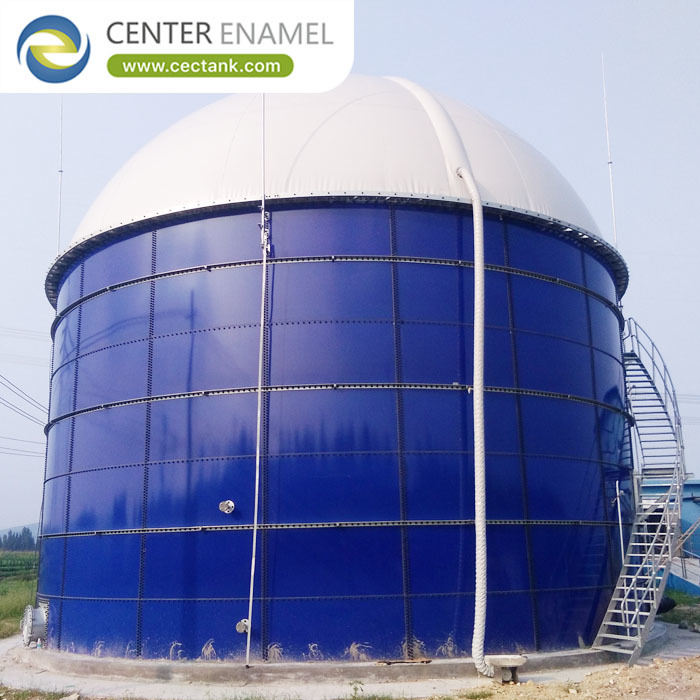
An anaerobic digestion tank is the sealed, temperature-controlled vessel in which anaerobic microbes break down organic matter and release biogas, and understanding it means understanding its parts: a coated shell, a gas-tight roof rated for 5-30 mbar, process nozzles, and an internal environment split into a liquid zone and a gas zone with different chemistry. It is not merely a storage tank; it is a reactor, and the coating must follow the zone. Center Enamel builds anaerobic digestion tanks as GFS, FBE, stainless-steel and carbon-steel bolted vessels.
At its core the tank is a reactor, not a container. Inside, microbes convert organic feedstock - manure, food waste, sewage sludge, agricultural residue - into biogas over a retention time of 20-40 days at mesophilic 35-38 C. The tank holds a saturated slurry, keeps it warm, keeps it mixed, and keeps the biogas in. That combination of seal, temperature and coating is what separates a digestion tank from a simple water tank.
- A reactor, not just a container.
- Feed: manure, food waste, sludge, residues.
- 20-40 day retention at 35-38 C mesophilic.
- Seal, temperature, mixing and coating combined.
The shell carries the slurry and is coated for the liquid zone. The roof carries the gas and is rated for 5-30 mbar, often a flexible membrane. The nozzles handle feed in, digestate out, biogas out and mixer access. The weak point is the boundary where coating, gasket and metal meet at a process zone change, which is why the coating is specified per zone rather than across the whole tank.
- Shell: coated for the liquid organic-acid zone.
- Roof: 5-30 mbar membrane, gas-tight.
- Nozzles: feed, digestate, biogas, mixer.
- Weak point: coating boundary at zone change.
These product numbers define an anaerobic digestion tank and its specification: retention of 20-40 days at 35-38 C, feed total solids of 8-12%, gas pressure of 5-30 mbar on the roof, methane content of 55-65%, and per-zone coating - GFS 2C2F at 0.25-0.45 mm or FBE - confirmed by a 1,500 V holiday-spark test and a shell calculation to AWWA D103-19 and ISO 28765. They separate a true reactor from a simple storage tank.
| Design parameter | Typical value or range | Why it matters |
| Retention time | 20-40 days at 35-38 C | Defines the reactor function |
| Total solids | 8-12% for CSTR feed | Drives mixing and geometry |
| Gas pressure | 5-30 mbar roof | Roof class of the tank |
| Coating by zone | GFS 2C2F or FBE | Liquid acid vs gas H2S differ |
| Methane content | 55-65% of biogas | Output the tank produces |
| Limitation to check | Usable gas below setpoint | Holder sized to recoverable volume |
A 2021 biogas engineering project in France used a single Glass-Fused-to-Steel bolted digestion tank of 2,215 m3. As a delivered digestion tank it demonstrates the product - a coated, gas-tight, temperature-rated vessel - built for European biogas duty. Diameter and height are not recorded in the verified project data and are reported Not Provided.
| Field | Value |
| Location | France, Europe |
| Year | 2021 |
| Tank type | GFS bolted digestion tank, 1 unit |
| Volume | 2,215 m3 |
| Application | Biogas engineering |
A digestion tank does not operate alone; the ancillary equipment defines the system. The mixer delivers the W/m3 power density and is specified with the tank, not bolted on later. The heating circuit holds 35-38 C and is routed through nozzles the tank already provides. The biogas train - flame arrester, relief, water seal, detection - connects at the roof. Digestate and feed pumps complete the loop. Specifying the tank with its ancillaries in one package is what keeps the gas-zone boundary intact and commissioning short.
- Mixer specified at W/m3 with the tank.
- Heating circuit routed through tank nozzles.
- Biogas train connects at the roof interface.
- Feed and digestate pumps complete the loop.
- Tank plus ancillaries in one scope.
Center Enamel builds digestion tanks as GFS, FBE, stainless-steel and carbon-steel bolted vessels, specifying the coating per zone and the roof for the operating gas pressure. The company has produced GFS tanks since 2008, holds ISO 9001, ISO 45001, NSF/ANSI 61, EN 1090 (CE), ISO 28765 and WRAS approvals, and has delivered more than 30,000 storage projects across 100+ countries, with a standard ex-works lead time of about 30 days for 1,000 to 10,000 m3 tanks.
- GFS fired at 820-930 C; 1,500 V tested.
- Shell to AWWA D103-19 and ISO 28765.
- Per-zone coating, documented per bid.
- 8.8-grade bolts; 30-50 year design life.
It is the sealed, temperature-controlled vessel in which anaerobic microbes break down organic matter and release biogas. Unlike a simple storage tank, it is a reactor that must hold a warm, mixed, gas-tight slurry for 20-40 days at 35-38 C.
A saturated organic slurry at 8-12% total solids, kept at 35-38 C and mixed, with biogas collecting above. The liquid zone meets organic acid; the gas zone meets H2S and condensation; the roof holds the gas at 5-30 mbar.
Because it must seal biogas, hold temperature, mix the slurry and resist acid and H2S at the coating boundary - functions a water tank never faces. The coating follows the process zone, not a single uniform spec.
GFS 2C2F (pH 2-10) or FBE for the aggressive side, specified per zone because the liquid acid and the gas-phase H2S differ. A 1,500 V holiday-spark test on every panel confirms gas tightness.
A flexible-membrane roof typically operates at 5-30 mbar, with flame arrester, relief and hazardous-area detection. That pressure class, not a water-tank roof, defines the digestion tank roof.
Yes. Center Enamel builds GFS, FBE, stainless-steel and carbon-steel bolted anaerobic digestion tanks, specifying the coating per zone and the roof for the operating gas pressure, with certificates to AWWA D103-19 and ISO 28765.
Biogas is typically 55-65% methane, with the balance mostly CO2 and trace H2S, produced at about 0.25-0.35 m3 per kg of COD removed at mesophilic temperature.
A 2021 France biogas engineering project used a single GFS bolted digestion tank of 2,215 m3 - a coated, gas-tight, temperature-rated vessel for European duty.
Usable gas volume is only what sits above the low-pressure setpoint, not the full geometric tank volume, so any attached or separate holder must be sized to recoverable volume.
An anaerobic digestion tank is a sealed, temperature-controlled reactor, not a storage tank - it holds a warm, mixed, gas-tight organic slurry for 20-40 days at 35-38 C and releases biogas of 55-65% methane. Its coating follows the zone because the liquid acid and the gas-phase H2S differ, and the roof is rated for 5-30 mbar. Center Enamel builds these as GFS, FBE, stainless-steel and carbon-steel bolted vessels, demonstrated by a 2021 France digestion tank of 2,215 m3.