-
Glass Fused To Steel Tanks (896)
-
Stainless Steel Tanks (434)
-
Fusion Bonded Epoxy Tanks (660)
-
Galvanized Steel Tanks (321)
-
Aluminum Dome Roofs (1336)
-
Wastewater Storage Tanks (280)
-
Welded Steel Tanks (457)
-
Pressure Vessels (461)
-
Anaerobic Digester (202)
-
Industrial Water Tanks (364)
-
Glass Lined Steel Tanks (180)
-
Bolted Steel Tanks (389)
-
Sludge Storage Tank (115)
-
Biogas Storage Tank (173)
-
Leachate Storage Tanks (133)
-
Agricultural Water Storage Tanks (179)
-
Fire Water Tank (166)
-
Grain Storage Silos (146)
-
Biogas Projects (424)
-
Wastewater Treatment Projects (1792)
-
Double Membrane Roof (223)
|
Anaerobic Digester Manufacturer: What To Verify Before You Specify
| Place of Origin: | China |
| Brand Name: | CEC TANKS |
| Certification: | ISO 9001:2008, AWWA D103 , OSHA , BSCI |
| Model Number: | W20160901012 |
| Minimum Order Quantity: | 1set |
| Price: | $5000~$20000 one set |
| Packaging Details: | PE poly-foam between each two steel plates ; wooden pallet and wooden box |
| Delivery Time: | 0-60 days after deposit received |
| Payment Terms: | L/C,T/T |
| Supply Ability: | 60 sets per month |
|
Detail Information |
|||
Product Description
An anaerobic digester manufacturer is a fabricator that designs and builds the sealed, temperature-controlled vessel where organic feedstock is broken down by microbes into biogas. Choosing one is less about a catalogue number and more about verifying that the supplier can engineer a pressure-tight, corrosion-resistant, code-compliant tank for a warm, acidic, hydrogen-sulphide-rich environment. Center Enamel has built Glass-Fused-to-Steel (GFS) bolted digesters since 2008 and treats the anaerobic digester as an engineered system, not a commodity shell.
A competent manufacturer supplies more than a bare tank. The deliverable is a coated, bolted or welded pressure-class vessel with nozzles for feed, digestate, biogas and mixing; a roof sized for 5-30 mbar gas pressure; and the structural calculation that proves the shell, foundation and anchor system will hold a saturated, often 8-12% total-solids slurry at 35-38 C. The coating choice is decided by zone: the liquid zone sees organic acid, while the gas zone sees H2S and condensation, so a single uniform coating is rarely correct.
- A coated shell engineered for both liquid and gas zones.
- Nozzles and manways for feed, digestate, biogas and mixing.
- A roof class matched to 5-30 mbar flexible-membrane gas pressure.
- A documented structural calculation, not just a price per m3.
The fastest way to separate a fabricator from an engineering supplier is to ask who controls the chemistry and who runs the calculation. A manufacturer that buys its coating from a third party cannot guarantee batch-to-batch enamel consistency; a supplier that subcontracts structural design cannot defend the foundation loads. Request the enamel firing temperature record, the AWWA D103 or ISO 28765 calculation, and at least two biogas references of comparable volume and feedstock.
- Coating autonomy: does the plant fire its own enamel, or buy lined panels?
- Structural ownership: is the shell calculation done in-house to AWWA D103 / ISO 28765?
- References: two biogas projects of similar volume and feedstock.
- Documentation: material certificates, holiday-spark records, weld maps.
- Spares: bolt, gasket and nozzle kits available years after handover.
Before requesting quotes, an anaerobic-digester specification should pin down the load-bearing numbers that decide tank volume, coating class and roof type: retention of 20-40 days at mesophilic 35-38 C, feed total solids of 8-12%, gas pressure of 5-30 mbar, and the per-zone coating - GFS 2C2F at 0.25-0.45 mm or FBE - confirmed by a 1,500 V holiday-spark test and a shell calculation to AWWA D103-19 and ISO 28765.
Design parameter |
Typical value or range |
Why it matters |
Retention time (CSTR) |
20-40 days at mesophilic 35-38 C |
Sets reactor volume for stable methane yield |
Total solids in feed |
8-12% for CSTR; under 1% for UASB feed |
Drives mixing power and tank geometry |
Operating temperature |
35-38 C mesophilic; 50-55 C thermophilic |
Below range, activity and gas output fall sharply |
Biogas pressure (roof) |
5-30 mbar on a flexible membrane |
Defines roof class and safety venting |
Coating system |
GFS 2C2F pH 2-10; FBE for aggressive media |
Gas-zone and liquid-zone exposure differ |
Limitation to check |
Usable gas volume is below the low-pressure setpoint, not full tank |
Size the gasholder to recoverable volume, not geometric volume |
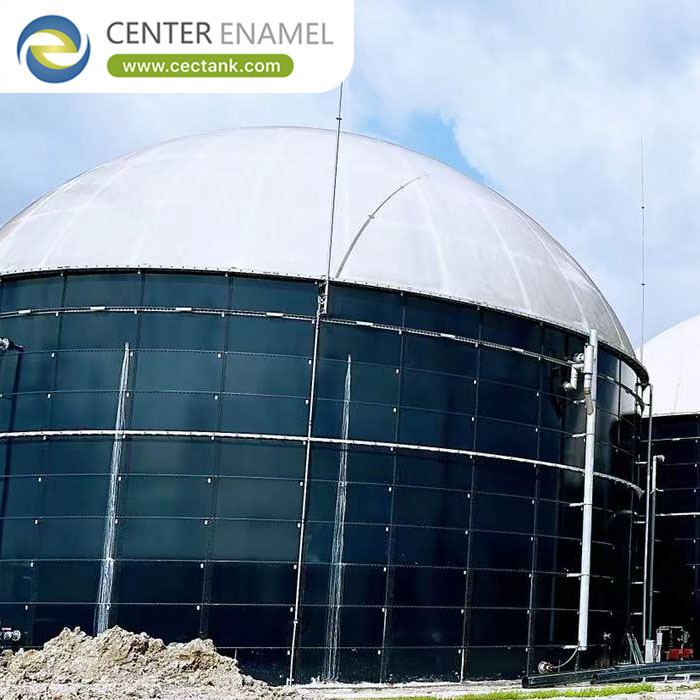
A 2024 biogas project in Sweden used a single Glass-Fused-to-Steel bolted digester of 5,504 m3, 19.11 m in diameter and 19.2 m in height. The delivery demonstrates a single large GFS digester engineered for European biogas duty with a documented coating and structural package. It is referenced here as a real, verified build of the product class this article discusses.
Field |
Value |
Location |
Sweden, Europe |
Year |
2024 |
Tank type |
GFS bolted digester, 1 unit |
Volume |
5,504 m3 |
Dimensions |
19.11 m diameter x 19.2 m height |
Application |
Biogas project |
Even with a capable manufacturer, projects fail on a handful of predictable mistakes. The first is specifying the gasholder to the full geometric tank volume when only the gas above the low-pressure setpoint is recoverable. The second is treating the digester, gasholder and digestate tank as one line item, which hides the real scope. The third is accepting a single coating for both the acid liquid zone and the H2S gas zone. The fourth is skipping the structural calculation and relying on a price per cubic metre. None of these is a coating-quality problem; they are specification-discipline problems, and the manufacturer who flags them is the one worth choosing.
- Sizing the holder to full geometric, not recoverable, volume.
- Bundling digester, holder and digestate into one undefined line.
- One coating for acid liquid and H2S gas zones.
- Buying on price per cubic metre without a calculation.
- Omitting the 1,500 V holiday-spark acceptance test.
Shijiazhuang Zhengzhong Technology Co., Ltd. (Center Enamel) has manufactured Glass-Fused-to-Steel bolted tanks since 2008 and is China's first GFS tank producer. Its enameling and fabrication base is designed for 250,000 panels per year, and the company holds ISO 9001, ISO 45001, NSF/ANSI 61, EN 1090 (CE), ISO 28765 and WRAS approvals, with more than 30,000 storage projects delivered across 100+ countries. For anaerobic-digestion duty it supplies GFS, fusion-bonded-epoxy (FBE), stainless-steel and carbon-steel bolted vessels, selecting the coating by process zone and offering a standard ex-works lead time of about 30 days for 1,000 to 10,000 m3 tanks.
- GFS fired at 820-930 C; coating 0.25-0.45 mm; adhesion 3,450 N/cm2.
- 100% 1,500 V holiday-spark test on every panel surface.
- 8.8-grade bolts; shell calculated to AWWA D103-19 and ISO 28765.
- Coating selected per zone (liquid acid vs gas-phase H2S).
An anaerobic digester manufacturer designs and builds the sealed, temperature-controlled vessel where microbes convert organic feedstock into biogas. The deliverable includes a coated shell, process nozzles, a roof rated for 5-30 mbar gas pressure, and a structural calculation proving the foundation and anchor loads.
Verify coating autonomy (does the plant fire its own enamel?), structural ownership (is the AWWA D103 or ISO 28765 shell calculation done in-house?), two comparable biogas references, full documentation, and a spares commitment for years after handover.
A digester has two hostile zones. The liquid zone sees organic acid at 35-38 C; the gas zone sees hydrogen sulphide and condensation. A single uniform coating is rarely correct, so the manufacturer should specify the liquid and gas zones separately, often GFS 2C2F or FBE for the more aggressive side.
Bolted tanks are built to AWWA D103-19 and designed per ISO 28765; where the liquor contacts potable or indirect-potable water the coating is certified to NSF/ANSI 61 or WRAS. European structural marking follows EN 1090 (CE).
A continuously stirred tank reactor typically runs 20-40 days at mesophilic 35-38 C. That retention time, not a rule-of-thumb diameter, sets the reactor volume for a stable methane yield of about 55-65%.
Yes. Center Enamel (Shijiazhuang Zhengzhong Technology) has produced GFS bolted tanks since 2008 and supplies GFS, FBE, stainless-steel and carbon-steel bolted vessels for anaerobic-digestion and biogas duty, with references across Europe, Asia and the Americas.
For 1,000 to 10,000 m3 bolted tanks, Center Enamel quotes a standard ex-works lead time of about 30 days, excluding the aluminium dome roof where specified. Site erection is then handled by local crews under the supplied method statement.
Bolted GFS and fabricated vessels for water and process duty are documented from small volumes up to about 60,000 m3 per single tank, with diameter and height governed by transport and site erection. A verified single GFS biogas digester of 5,504 m3 was delivered in Sweden in 2024.
Specifying the gasholder to the full geometric tank volume. Usable gas volume is only what sits above the low-pressure setpoint, so a buyer should size the membrane roof to recoverable volume and confirm the venting and flame-arrester basis with the manufacturer.
An anaerobic digester manufacturer is a fabricator that engineers a sealed, temperature-controlled vessel for microbial biogas production, not a shell seller. Verify coating autonomy, in-house structural calculation, comparable biogas references and documentation before you specify, and size the gasholder to recoverable volume rather than geometric volume. Center Enamel has built GFS bolted digesters since 2008 with a documented coating and structural package proven on European biogas duty such as a 5,504 m3 digester delivered in Sweden in 2024.
Suggested CTA: Send Center Enamel your feedstock profile, retention-time target and site constraints, and request the bolted-digester capability datasheet and two comparable biogas references.