-
Glass Fused To Steel Tanks (896)
-
Stainless Steel Tanks (434)
-
Fusion Bonded Epoxy Tanks (660)
-
Galvanized Steel Tanks (321)
-
Aluminum Dome Roofs (1336)
-
Wastewater Storage Tanks (280)
-
Welded Steel Tanks (457)
-
Pressure Vessels (461)
-
Anaerobic Digester (202)
-
Industrial Water Tanks (364)
-
Glass Lined Steel Tanks (180)
-
Bolted Steel Tanks (389)
-
Sludge Storage Tank (115)
-
Biogas Storage Tank (173)
-
Leachate Storage Tanks (133)
-
Agricultural Water Storage Tanks (179)
-
Fire Water Tank (166)
-
Grain Storage Silos (146)
-
Biogas Projects (424)
-
Wastewater Treatment Projects (1792)
-
Double Membrane Roof (223)
|
Anaerobic Digester Design: Sizing, Mixing And Coating Zones
| Place of Origin: | CHINA |
| Brand Name: | CEC TANKS |
| Certification: | ISO 9001:2008, AWWA D103 , OSHA , BSCI |
| Model Number: | W20180508013 |
| Minimum Order Quantity: | 1 set |
| Price: | $5000~$20000 one set |
| Packaging Details: | PE poly-foam between each two plates;wooden pallet and wooden box |
| Delivery Time: | 10-30 days after deposit received |
| Payment Terms: | L/C,T/T |
| Supply Ability: | 60 sets per month |
|
Detail Information |
|||
Product Description
Anaerobic digester design begins with the feedstock and ends with a coated, mixed, gas-tight vessel, and the sequence matters more than any single number. You size the volume from the feed and the retention time, set the mixing power density, then specify the coating per process zone because the digester liquid, gas and roof see different chemistry. Skipping the zone step is why digesters fail at the coating boundary rather than the shell. Center Enamel designs GFS, FBE, stainless-steel and carbon-steel bolted digesters to this sequence.
For a continuously stirred tank reactor the volume follows the feed volume and the retention time: 20-40 days at mesophilic 35-38 C for high-solids feeds of 8-12% total solids. For a UASB or EGSB the volume follows the organic loading of 5-15 kg COD per m3 per day and an upflow velocity of about 0.5-1.2 m/h. The feed character, not a rule-of-thumb diameter, sets the tank.
- CSTR: 20-40 days at 35-38 C; 8-12% total solids.
- UASB/EGSB: 5-15 kg COD/m3/day; 0.5-1.2 m/h upflow.
- Feed character sets volume, not a diameter rule.
- Methane yield about 0.25-0.35 m3 per kg COD removed.
CSTR mixing is specified as power density in W/m3 with a target mixing time, not as a motor kilowatt rating, because the same motor means different things in different tank sizes and viscosities. Too little mixing leaves dead volume from sedimentation; too much wastes energy and shears the biology. The designer states W/m3 and the mixer supplier meets it.
- Mixing as W/m3 plus mixing time, not motor kW.
- Dead volume from sedimentation is permanent loss.
- Over-mixing wastes energy and shears biology.
- Small, frequent feeding beats large infrequent dumps.
The final design step is the coating, and it is per zone. The liquid zone meets organic acid at 35-38 C; the gas zone meets H2S and condensation; the roof or gasholder lives in wet biogas. GFS 2C2F (pH 2-10) or FBE for the aggressive side, applied and tested to a 1,500 V holiday-spark standard, is what keeps the boundary intact.
- Liquid zone: organic acid at 35-38 C.
- Gas zone: H2S and condensation.
- GFS 2C2F or FBE by zone; 1,500 V tested.
- Weak point is the coating boundary, not the shell.
Lock in these design numbers in sequence so the tank is buildable and comparable: CSTR retention of 20-40 days at 35-38 C, UASB organic loading of 5-15 kg COD per m3 per day, mixing power specified as W/m3 with a target time, gas pressure of 5-30 mbar, and per-zone coating - GFS 2C2F at 0.25-0.45 mm or FBE - confirmed by a 1,500 V holiday-spark test to AWWA D103-19 and ISO 28765.
| Design parameter | Typical value or range | Why it matters |
| Retention time (CSTR) | 20-40 days at 35-38 C | Step 1: sets volume |
| Organic loading (UASB) | 5-15 kg COD/m3/day | Step 1: sets volume |
| Mixing power | Specified as W/m3 + time | Step 2: comparable across sizes |
| Coating by zone | GFS 2C2F or FBE | Step 3: protects the boundary |
| Gas pressure | 5-30 mbar membrane | Roof class in the design |
| Limitation to check | Usable gas below setpoint | Size holder to recoverable volume |
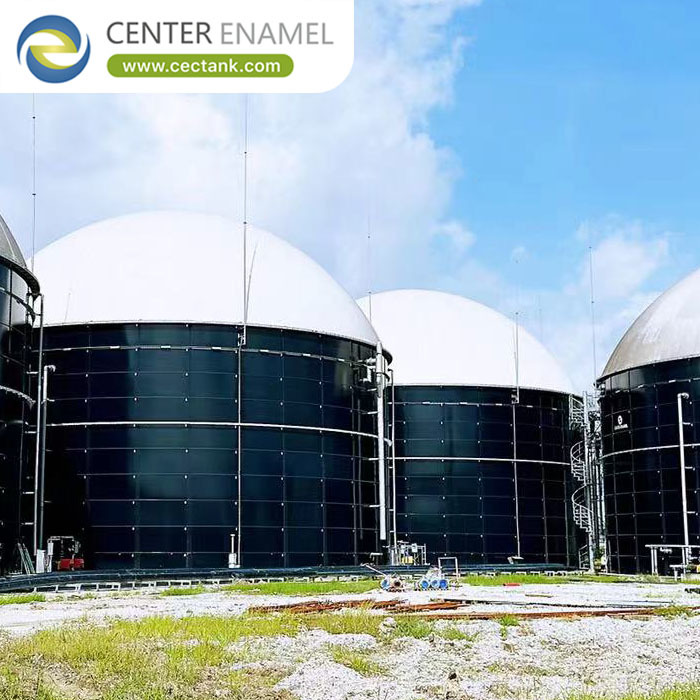
A 2024 biogas project in Sweden used a single Glass-Fused-to-Steel bolted digester of 5,504 m3, 19.11 m in diameter and 19.2 m in height. As a designed and delivered digester it demonstrates the full sequence - sized vessel, coated shell and gas-tight roof - executed for European biogas duty.
| Field | Value |
| Location | Sweden, Europe |
| Year | 2024 |
| Tank type | GFS bolted digester, 1 unit |
| Volume | 5,504 m3 |
| Dimensions | 19.11 m diameter x 19.2 m height |
| Application | Biogas project |
Before fabrication, a digester design should pass a short review. Confirm the volume follows the feed and retention, not a diameter rule; confirm the mixing is specified as W/m3 with a time, not a motor kilowatt; confirm the coating is per zone with a 1,500 V test; and confirm the gasholder is sized to recoverable volume above the low-pressure setpoint. A design that passes these four checks is buildable and comparable, and the review catches the coating-boundary error that otherwise appears only at commissioning.
- Volume from feed and retention, not a diameter rule.
- Mixing as W/m3 plus time, not motor kW.
- Coating per zone with 1,500 V test.
- Holder sized to recoverable volume.
- Review catches the coating-boundary error early.
Center Enamel designs and builds anaerobic digesters to this sequence - feed-based volume, W/m3 mixing specification, and per-zone coating - in GFS, FBE, stainless-steel and carbon-steel bolted construction. The company has produced GFS tanks since 2008, holds ISO 9001, ISO 45001, NSF/ANSI 61, EN 1090 (CE), ISO 28765 and WRAS approvals, and has delivered more than 30,000 storage projects across 100+ countries.
- Shell calculated to AWWA D103-19 and ISO 28765.
- In-house enamel firing at 820-930 C.
- 100% 1,500 V holiday-spark test on panels.
- Standard ex-works lead time about 30 days (1,000-10,000 m3).
Size the volume from feed and retention time, set the mixing power density in W/m3, then specify the coating per zone. The sequence matters more than any single number, and skipping the zone step is why digesters fail at the coating boundary.
From the feed volume and a 20-40 day retention at mesophilic 35-38 C for 8-12% total-solids feed. The feed character, not a diameter rule, sets the tank volume.
As power density in W/m3 plus a target mixing time, not as a motor kilowatt rating, so the specification is comparable across tank sizes and feed viscosities.
Because the liquid zone meets organic acid, the gas zone meets H2S and condensation, and the roof meets wet biogas. A single coating rarely fits all three, and the boundary is where digesters fail.
GFS 2C2F (pH 2-10) or FBE for the aggressive side, applied and tested to a 1,500 V holiday-spark standard. The choice follows the zone, not the catalogue.
Yes. Center Enamel designs and builds GFS, FBE, stainless-steel and carbon-steel bolted digesters to the feed-retention-mixing-coating sequence, with shell calculation to AWWA D103-19 and ISO 28765.
About 0.25-0.35 m3 of biogas per kg of COD removed at mesophilic temperature, with methane content of 55-65%. That fraction drives the gasholder and gas-use equipment size.
A 2024 Sweden biogas facility used a single GFS bolted digester of 5,504 m3, 19.11 m in diameter and 19.2 m in height - a sized, coated, gas-tight vessel delivered for European duty.
Usable gas volume is only what sits above the low-pressure setpoint, not the full geometric tank volume, so the holder must be sized to recoverable volume with the venting and detection basis confirmed.
Anaerobic digester design follows a sequence - size the volume from feed and retention time (20-40 days at 35-38 C for CSTR), set mixing as W/m3 with a target time, then specify the coating per zone because the liquid, gas and roof see different chemistry. The coating boundary, not the shell, is where digesters fail. Center Enamel designs and builds to this sequence in GFS, FBE, stainless-steel and carbon-steel bolted construction, demonstrated by a 2024 Sweden digester of 5,504 m3.