-
Glass Fused To Steel Tanks (807)
-
Stainless Steel Tanks (434)
-
Fusion Bonded Epoxy Tanks (592)
-
Galvanized Steel Tanks (321)
-
Aluminum Dome Roofs (1336)
-
Wastewater Storage Tanks (265)
-
Welded Steel Tanks (457)
-
Pressure Vessels (295)
-
Anaerobic Digester (202)
-
Industrial Water Tanks (349)
-
Glass Lined Steel Tanks (180)
-
Bolted Steel Tanks (389)
-
Sludge Storage Tank (115)
-
Biogas Storage Tank (173)
-
Leachate Storage Tanks (133)
-
Agricultural Water Storage Tanks (179)
-
Fire Water Tank (166)
-
Grain Storage Silos (146)
-
Biogas Projects (424)
-
Wastewater Treatment Projects (1550)
-
Double Membrane Roof (223)

|
Sewage Treatment Plant Tanks and Process Integration
| Place of Origin: | China |
| Brand Name: | CEC TANKS |
| Certification: | ISO 9001:2008, AWWA D103 , OSHA , BSCI |
| Model Number: | W201691123005 |
| Minimum Order Quantity: | 1set |
| Price: | $5000~$20000 one set |
| Packaging Details: | PE poly-foam between each two steel plates ; wooden pallet and wooden box |
| Delivery Time: | 0-60 days after deposit received |
| Payment Terms: | L/C,T/T |
| Supply Ability: | 60 sets per month |
|
Detail Information |
|||
| Place of Origin | China | Brand Name | CEC TANKS |
|---|---|---|---|
| Certification | ISO 9001:2008, AWWA D103 , OSHA , BSCI | Model Number | W201691123005 |
| Steel Plates Thickness: | 3mm To 12mm , Depends On The Tank Structure | Corrosion Integrity: | Excellent |
| Chemical Resistance: | Excellent | Capacity: | 20 M3 To 18,000 M3 |
| Service Life: | ≥30 Years | Permeability: | Gas / Liquid Impermeable |
| Highlight: | fusion bonded epoxy sewage tanks,sewage treatment plant tanks,process integration epoxy tanks |
||
Product Description
Sewage Treatment Plant Tanks and Process Integration
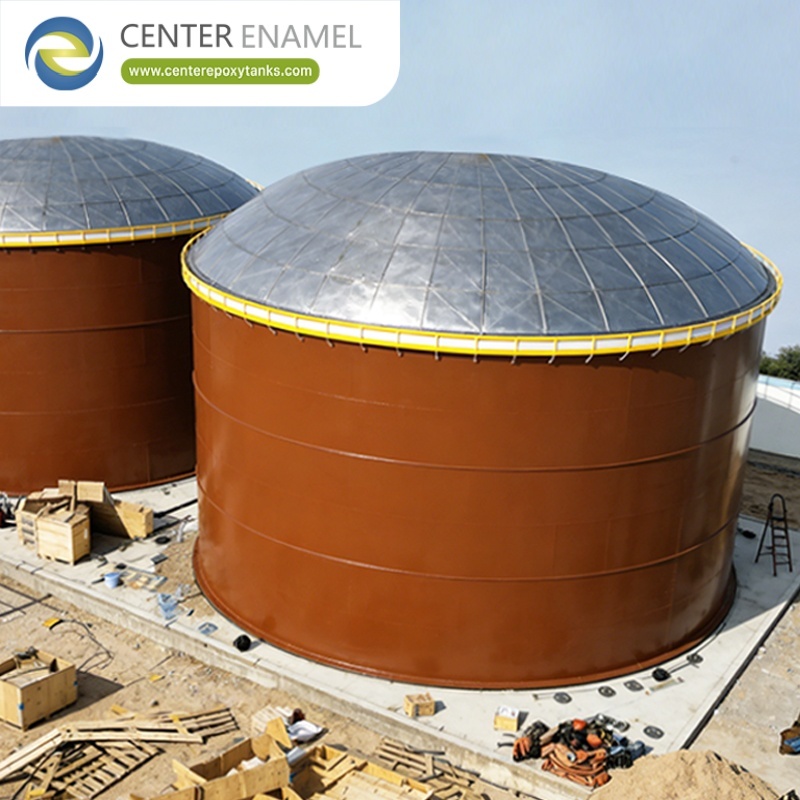
A sewage treatment plant converts municipal and industrial wastewater into clean discharge through screened, biological, and clarifier stages, each needing corrosion-proof tankage. Engineered by Shijiazhuang Zhengzhong Technology Co., Ltd. (Center Enamel), the bolted Glass-Fused-to-Steel (GFS) and Fusion Bonded Epoxy (FBE) tanks are built to AWWA D103-09 and ISO 28765 and holiday-tested at 1500 V for a 30-50 year service life.
What a Sewage Treatment Plant Tank Is
A sewage treatment plant tank is a bolted steel vessel, either Glass-Fused-to-Steel (GFS) or Fusion Bonded Epoxy (FBE), that holds screened, equalized, and clarified sewage at 20-60,000 m3 in a single unit. The 0.25-0.45 mm enamel or 250-450 um epoxy lining resists the constant wet-dry and sulfide cycle, and 8.8-grade bolts carry the hydrostatic head for a 30-50 year structure.
- Lining: enamel or FBE.
- Range: 20-60,000 m3.
- Bolts: 8.8-grade.
- Life: 30-50 years.
How the Plant Uses Bolted Tanks
The flow passes through bar screens, an equalization tank, an aerobic or anaerobic biological stage, and a clarifier, with each stage housed in a bolted GFS or FBE tank. Because the panels are factory-coated and bolted on site, the 8-20 week schedule avoids field welding and the 1500 V holiday test confirms the seal before the plant starts treating 5-30 m3/h of sewage.
- Stages: screen to clarify.
- Build: no field weld.
- Test: 1500 V seal.
- Flow: 5-30 m3/h.
Key Tank Types and Components
The family covers the equalization tank, the anaerobic or aerobic reactor, the clarifier, and the sludge holding tank, each with 8.8-grade bolting and a fixed or membrane roof. Core parts are the coated panels, the manways, the nozzle groups, and the mixer supports. A documented ISO 9001 and ISO 45001 system is the feature that qualifies the package for municipal duty.
- Reactor: aerobic or AD.
- Clarifier: settling tank.
- Sludge: holding tank.
- QC: ISO 9001 / 45001.
Applications of Sewage Plant Tanks
They serve municipal sewage, industrial wastewater, and packaged treatment plants where the chemistry attacks painted steel and concrete cracks under sulfate. A 30-50 year GFS or FBE tank is also used for municipal reuse and for isolated communities needing a compact plant. The inert lining is why the same tank family covers both clean and corrosive streams on one site.
- Municipal: sewage duty.
- Industrial: process waste.
- Packaged: compact plant.
- Reuse: treated water.
Technical Considerations
Technically the EPC scope covers process design, GFS or FBE tank supply with 0.25-0.45 mm enamel or 250-450 um epoxy, 1500 V holiday testing, 8.8-grade bolting, and on-site commissioning. The tanks are calculated to AWWA D103-09 and ISO 28765, the biological stage to the local discharge standard, and the schedule runs 8-20 weeks depending on civil works.
- Coat: enamel or FBE.
- Test: 1500 V holiday.
- Bolts: 8.8-grade.
- Weeks: 8-20 schedule.
| Design parameter | Typical value or range | Why it matters |
|---|---|---|
| Scope | Design to commissioning | Single-contract delivery |
| Engineering | Process + tank + roof | Integrated package |
| Tank supply | GFS / FBE / stainless | Material matched to duty |
| Typical capacity | 200-20,000 m3 | Single site or parallel |
| Commissioning | On-site supervision | Local crew training |
| Schedule | 8-20 weeks | Site dependent |
| Quality system | ISO 9001 / ISO 45001 | Documented QC |
| Standards | AWWA D103-09 / ISO 28765 | International basis |
| Limitation to check | Civil foundation | Owner or EPC split |
How to Select a Plant Tank Supplier
Select by confirming one responsible EPC contract, a documented GFS or FBE tank with 1500 V test and 8.8-grade bolts, and references from operating sewage plants. Ask for the AWWA D103-09 and ISO 28765 calculation, the ISO 9001 / ISO 45001 certificates, and the commissioning plan. Reject any split bid that cannot name who owns the tank-to-process interface.
- Confirm: single contract.
- Demand: 1500 V record.
- Verify: ISO 9001 / 45001.
- Check: references.
Project Case Study
A verified municipal wastewater project in Ghana used four 4,429 m3 Glass-Fused-to-Steel (GFS) bolted tanks built in 2021 under an EPC scope to treat sewage for a growing community. The 0.25-0.45 mm enamel coat was holiday-tested at 1500 V and the 8.8-grade bolted seams held the structure, demonstrating integrated sewage treatment tankage in West Africa.
- Project: Ghana municipal wastewater
- Location: Ghana, Africa
- Industry: Municipal water
- Application: Sewage treatment
- Product: GFS bolted tank (EPC scope)
- Capacity: 4,429 m3
- Quantity: 4 tanks
- Material: Glass-Fused-to-Steel
- Standards: AWWA D103-09 / ISO 28765
- Year: 2021
About Shijiazhuang Zhengzhong Technology Co., Ltd.
Shijiazhuang Zhengzhong Technology Co., Ltd. (Center Enamel) has delivered EPC and bolted-tank packages to municipal and industrial wastewater projects across more than 100 countries since 2008. Its documented project experience spans equalization, anaerobic, and clarifier tanks built to AWWA D103-09 and ISO 28765, with on-site commissioning and local-crew training that transfers the 30-50 year tank responsibility to the owner.
- Founded: 2008 in China.
- Reach: 100+ countries.
- Scope: EPC and tanks.
- Code: AWWA D103-09.
Advantages and Limitations
Advantages are a single EPC responsibility, a 1500 V-verified seal, and rapid bolted erection that avoids field welding. Limitations are that the civil foundation and the biological process equipment remain interface items to confirm, and the site must provide a level base. The tank is not a pressure vessel and is designed for atmospheric sewage duty.
- Pros: single contract.
- Pros: 1500 V seal.
- Limit: civil interface.
- Limit: atmospheric only.
Comparison With Other Delivery Models
Against equipment-only supply, EPC removes the interface risk between tank and process; against owner-built, it transfers schedule risk to the contractor. The table contrasts the three delivery models so the owner picks the responsibility level that matches their team and their 8-20 week window.
- EPC: one contract.
- Equipment: split risk.
- Owner: multiple parties.
- Window: 8-20 weeks.
| Aspect | EPC / turnkey | Equipment-only supply | Build by others |
|---|---|---|---|
| Single responsibility | Yes, one contract | Split responsibilities | Multiple parties |
| Design integration | Full process + tank | Tank only | Coordinated by owner |
| Schedule risk | Contractor held | Shared | Owner held |
| Commissioning | Included | Usually extra | Owner led |
| Best for | First-time owners | Experienced teams | In-house engineers |
Conclusion
A sewage treatment plant depends on corrosion-proof bolted tankage, and a GFS or FBE tank built to AWWA D103-09 with a 1500 V holiday test gives a 30-50 year structure. Choose an EPC partner that owns the tank-to-process interface and can show operating sewage references.
- Spec: AWWA D103-09.
- Verify: 1500 V test.
- Confirm: EPC scope.
Frequently Asked Questions (FAQ)
What tanks does a sewage treatment plant need?
It needs screened, equalization, biological (aerobic or anaerobic), and clarifier tanks, typically Glass-Fused-to-Steel or Fusion Bonded Epoxy bolted units of 20-60,000 m3 each.
What capacity is available?
Single bolted tanks range from 20 m3 to 60,000 m3, and larger plants use multiple parallel tanks on one site under an EPC scope.
What standards apply?
The shell follows AWWA D103-09 and ISO 28765, the lining is verified at 1500 V, and the program is documented under ISO 9001 and ISO 45001.
How is the plant installed?
Panels are bolted on a prepared foundation by local crews under supplier supervision; the EPC schedule typically runs 8-20 weeks including commissioning.
Is an EPC contract better than buying tanks only?
EPC is better for first-time owners because one party owns the tank-to-process interface and the schedule risk, rather than splitting responsibility.
What information is required for a quotation?
Send the daily sewage flow, the discharge standard, the available footprint, and the target schedule so the supplier can size the GFS or FBE tanks and the process.
Suggested CTA: Send your sewage flow, discharge standard, and site footprint to our engineering team for an EPC tank-and-process specification and a verified reference list.