-
Glass Fused To Steel Tanks (621)
-
Stainless Steel Tanks (434)
-
Fusion Bonded Epoxy Tanks (592)
-
Galvanized Steel Tanks (321)
-
Aluminum Dome Roofs (1336)
-
Wastewater Storage Tanks (237)
-
Welded Steel Tanks (457)
-
Pressure Vessels (295)
-
Anaerobic Digester (202)
-
Industrial Water Tanks (349)
-
Glass Lined Steel Tanks (180)
-
Bolted Steel Tanks (389)
-
Sludge Storage Tank (115)
-
Biogas Storage Tank (173)
-
Leachate Storage Tanks (133)
-
Agricultural Water Storage Tanks (179)
-
Fire Water Tank (166)
-
Grain Storage Silos (146)
-
Biogas Projects (424)
-
Wastewater Treatment Projects (1319)
-
Double Membrane Roof (223)


|
Transforming Singapore Municipal Sludge to Biogas with Advanced Biogas Plant Design and GFS Tanks
| Place of Origin: | China |
| Brand Name: | CEC TANKS |
| Certification: | ISO 9001:2008, AWWA D103 , OSHA , BSCI |
| Model Number: | W |
| Minimum Order Quantity: | 1set |
| Price: | $5000~$20000 one set |
| Packaging Details: | PE poly-foam between each two steel plates ; wooden pallet and wooden |
| Delivery Time: | 10-30 days after deposit received |
| Payment Terms: | L/C,T/T |
| Supply Ability: | 60 sets per month |
|
Detail Information |
|||
| Place of Origin | China | Brand Name | CEC TANKS |
|---|---|---|---|
| Certification | ISO 9001:2008, AWWA D103 , OSHA , BSCI | Model Number | W |
| Tank Body Color: | Dark Green / Can Be Customized | Corrosion Integrity: | Excellent |
| Steel Plates Thickness: | 3mm To 12mm , Depends On The Tank Structure | Chemical Resistance: | Excellent |
| Size Of Panel: | 2.4M * 1.2M | Easy To Clean: | Smooth, Glossy, Inert, Anti-adhesion |
| Highlight: | Singapore municipal sludge biogas plant,advanced biogas plant GFS tanks,wastewater treatment biogas production |
||
Product Description
Singapore, a global leader in water management and urban sustainability, is actively transforming its municipal sludge challenge into a renewable energy opportunity. Through advanced anaerobic digestion processes and robust infrastructure like GFS Tanks, the nation is enhancing its environmental performance and advancing its circular economy goals. This article explores the journey of municipal sludge-to-biogas in Singapore, highlighting the critical role of innovative Biogas Plant Design and high-quality equipment in delivering successful waste-to-energy projects.
Understanding Municipal Sludge and Its Treatment Challenges
Municipal sludge is the semi-solid byproduct generated during the primary and secondary treatment of domestic and commercial wastewater. As a highly urbanized nation with a dense population, Singapore’s water reclamation plants produce a significant and continuous volume of this organic material. Traditional methods for managing this sludge have often involved processes like incineration, landfilling, or agricultural application, which can be energy-intensive, pose environmental risks, or face space constraints. Singapore’s limited land area, in particular, makes landfill disposal a non-viable long-term solution, creating an urgent need for more sustainable and space-efficient alternatives that can also contribute to the nation’s energy security.
The conversion of municipal sludge into biogas is achieved through a natural biological process known as anaerobic digestion. This process breaks down the complex organic matter in an oxygen-free environment, producing a methane-rich gas that can be used as a renewable energy source. The benefits of this approach are substantial: it significantly reduces the volume and mass of sludge requiring disposal, it stabilizes the waste by destroying pathogens and organic content, and it generates clean energy that can be used to power treatment plant operations, generate electricity, or be upgraded for injection into the gas grid. By adopting this technology, Singapore is effectively turning a problematic waste stream into a valuable asset, reducing its carbon footprint and enhancing its resource efficiency.
At the heart of a modern municipal sludge-to-biogas facility is the anaerobic digester, and a proven technology for this application is the Continuous Stirred-Tank Reactor (CSTR). This system is designed to handle high-solids feedstocks like municipal sludge. The sludge and anaerobic microorganisms are continuously or semi-continuously fed into a closed, heated tank where a mechanical stirring device keeps them in a "completely mixed" state. This constant agitation is crucial for maximizing biogas yield as it ensures a uniform temperature throughout the reactor, prevents the formation of a scum layer, and promotes intimate contact between the microorganisms and the organic material. Research on CSTRs treating municipal sludge has highlighted the importance of controlling operational parameters like temperature to achieve high volatile solids destruction and optimal methane production. For instance, operating below 60°C is recommended to maintain stability and maximize methane output.
For the demanding environment of an anaerobic digester, the selection of storage equipment is paramount. Center Enamel’s Glass-Fused-to-Steel (GFS) tanks are an ideal solution for these applications. Manufactured using a unique technology where glass is fused to steel at temperatures between 820°C and 930°C, these tanks create an inert, inorganic bond that offers the strength and flexibility of steel combined with exceptional corrosion resistance. This robust coating is essential for withstanding the highly acidic and chemically aggressive environment within a digester.
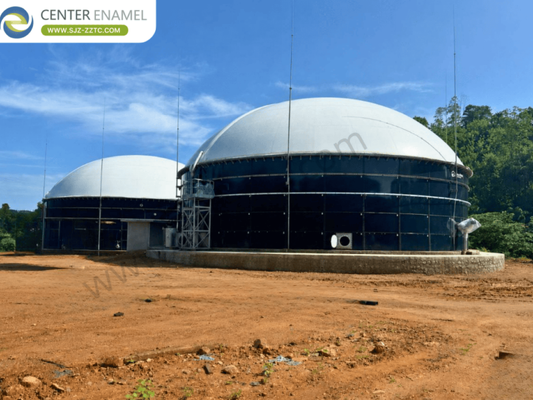
Complementing the GFS tank is the Double Membrane Roof. Under normal working conditions, this roof is the preferred solution for its cost optimization and space efficiency. Its integrated design, which stores biogas directly within the chamber on top of the tank, eliminates the need for a separate, ground-mounted gas holder, significantly reducing the plant's overall footprint and associated civil works costs. This combination of a durable GFS tank with an efficient Double Membrane Roof provides a reliable and economically sound solution for Singapore's biogas infrastructure.
Beyond the GFS tank and Double Membrane Roof, Center Enamel offers a versatile range of storage solutions to meet specific project requirements in Singapore:
Storage Tanks:
- Galvanized Steel Tanks: Featuring a tough, wear-resistant protective coating.
- Fusion Bonded Epoxy (FBE) Tanks: Developed with AkzoNobel for superior chemical resistance.
- Stainless Steel Tanks: Ideal for high-purity applications requiring AISI 304/316 grade materials.
Tank Covers:
- Aluminum Geodesic Dome Roof: Known for its advanced corrosion resistance and expansive clear span capability.
- Glass-Fused-to-Steel Roof: An air-tight option, often utilized for pressurized structures and odor control.
- Aluminum Alloy Trough Deck Roof: An economical choice for applications not requiring full air-tightness.
- Stainless Steel Roof: Providing excellent anti-corrosion performance and a long service life.
A complete and efficient biogas system relies on a suite of auxiliary equipment. These components work in concert to optimize the digestion process and ensure the safe and efficient use of the produced biogas:
- Gas Holder: For storing the biogas produced.
- Solid-liquid Separator: For dewatering the digestate.
- Torch System: For the safe flaring of excess gas.
- Lifting Pump: For moving sludge and digestate between process stages.
- Dehydration and Desulfurization Tank: For removing harmful components like water and hydrogen sulfide (H₂S) from the raw biogas to protect downstream equipment and improve its quality for combustion.
- Screw Sludge Dewatering Machine: For volume reduction of the final biosolids.
Center Enamel acts as a true EPC (Engineering, Procurement, and Construction) provider, offering comprehensive turnkey biogas solutions to clients in Singapore. This holistic approach ensures seamless project execution, from initial site assessment and engineering design to the supply of high-quality equipment, installation, and commissioning. The advantages of this model include:
- Single-Point Accountability: Clients work with one contractor for the entire project scope, simplifying communication and risk management.
- Full-Spectrum Expertise: Providing process packages, equipment supply, and full EPC services to meet specific client needs.
- International Certifications: Their manufacturing processes and products adhere to stringent global standards, including ISO9001, NSF/ANSI 61, AWWA D103, and EN28765, ensuring quality and compliance.
Sweden Biogas Project
Tank Size: φ19.11*19.2 m (H) 1 unit
Total Volume: 5510 m³
Completion Date: 2024
Indonesia Biogas Project
Application: Anaerobic Reactor for Palm Oil Wastewater Treatment Plant
Tank Model: Ø17.58*8.4 m, Ø16.82*7.2 m
Number of Tanks: 3 GFS Tanks
Installation Date: 2013
Singapore's proactive approach to transforming municipal sludge into a valuable energy resource is a powerful example of how modern Biogas Plant Design can turn environmental challenges into sustainable solutions. By integrating core technologies like the CSTR process with superior containment solutions such as GFS Tanks and Double Membrane Roofs, the city-state is effectively minimizing waste, generating renewable energy, and reinforcing its position as a global leader in environmental innovation. Center Enamel’s comprehensive, one-stop solutions are instrumental in supporting this critical infrastructure.