-
Glass Fused To Steel Tanks (621)
-
Stainless Steel Tanks (434)
-
Fusion Bonded Epoxy Tanks (592)
-
Galvanized Steel Tanks (321)
-
Aluminum Dome Roofs (1336)
-
Wastewater Storage Tanks (237)
-
Welded Steel Tanks (457)
-
Pressure Vessels (295)
-
Anaerobic Digester (202)
-
Industrial Water Tanks (349)
-
Glass Lined Steel Tanks (180)
-
Bolted Steel Tanks (389)
-
Sludge Storage Tank (115)
-
Biogas Storage Tank (173)
-
Leachate Storage Tanks (133)
-
Agricultural Water Storage Tanks (179)
-
Fire Water Tank (166)
-
Grain Storage Silos (146)
-
Biogas Projects (424)
-
Wastewater Treatment Projects (1319)
-
Double Membrane Roof (223)


|
Advancing Biogas Power Plant Design with GFS Tanks for Ghana Municipal Sludge Treatment
| Place of Origin: | China |
| Brand Name: | CEC TANKS |
| Certification: | ISO 9001:2008, AWWA D103 , OSHA , BSCI |
| Model Number: | W |
| Minimum Order Quantity: | 1set |
| Price: | $5000~$20000 one set |
| Packaging Details: | PE poly-foam between each two steel plates ; wooden pallet and wooden |
| Delivery Time: | 10-30 days after deposit received |
| Payment Terms: | L/C,T/T |
| Supply Ability: | 60 sets per month |
|
Detail Information |
|||
| Place of Origin | China | Brand Name | CEC TANKS |
|---|---|---|---|
| Certification | ISO 9001:2008, AWWA D103 , OSHA , BSCI | Model Number | W |
| Tank Body Color: | Dark Green / Can Be Customized | Corrosion Integrity: | Excellent |
| Steel Plates Thickness: | 3mm To 12mm , Depends On The Tank Structure | Chemical Resistance: | Excellent |
| Size Of Panel: | 2.4M * 1.2M | Easy To Clean: | Smooth, Glossy, Inert, Anti-adhesion |
| Highlight: | GFS tanks for biogas power plants,municipal sludge treatment Ghana,wastewater treatment biogas plant design |
||
Product Description
Ghana, with its rapidly expanding urban centers like Accra and Kumasi, faces a critical challenge in managing the growing volumes of municipal waste and wastewater sludge. This article explores how converting municipal sludge to biogas through advanced anaerobic digestion technology, utilizing robust GFS Tanks and integrated Biogas Power Plant design, offers a powerful pathway to sustainable waste management and renewable energy generation in Ghana.
Article Overview: This article discusses Ghana's approach to municipal sludge-to-biogas conversion. It covers the sources and composition of household waste, the anaerobic digestion process using CSTR technology, and the importance of Glass-Fused-to-Steel tanks and double membrane roofs in biogas power plants. The piece emphasizes how comprehensive biogas solutions are addressing Ghana's waste management challenges.
Municipal solid waste generated in Ghanaian cities contains a remarkably high percentage of organic matter, primarily consisting of food remnants, market residues, and yard trimmings. With rapid urbanization and changing consumption patterns, the sheer volume of household waste has outpaced existing municipal collection and disposal infrastructure, leading to widespread reliance on uncontrolled dumping sites.
These conventional disposal practices generate significant environmental hazards, including greenhouse gas emissions, foul odors, leachate contamination of local water tables, and severe public health risks. The organic fraction of municipal waste, which includes both solid waste and sewage sludge, contains valuable nutrients and energy that remain unutilized under traditional management approaches. Addressing these challenges requires shifting toward advanced biochemical recovery technologies that can safely process biodegradable waste and convert it into clean energy.
The conversion of household waste and municipal sludge into renewable biogas is achieved through controlled biological anaerobic digestion. The process begins with mechanical sorting and screening to remove non-biodegradable debris, followed by homogenization into a uniform organic slurry. This prepared feedstock is subsequently introduced into sealed, oxygen-free digesters where specialized microbial consortia break down complex organic molecules.
Inside the reactor, anaerobic bacteria facilitate successive stages of hydrolysis, acidogenesis, acetogenesis, and methanogenesis. Through these biochemical reactions, organic carbon is transformed into a high-energy biogas stream composed mainly of methane and carbon dioxide, alongside stabilized digestate. Co-digestion strategies combining municipal sludge with fruit and vegetable waste have been shown to enhance biogas production by improving the carbon-to-nitrogen ratio and providing complementary nutrients for microbial activity.
The Continuous Stirred-Tank Reactor (CSTR) process represents the cornerstone technology for treating high-solid organic waste and concentrated organic slurries. Engineered with a robust mechanical stirring device, the CSTR reactor ensures that incoming organic substrates and active anaerobic microorganisms are continuously and thoroughly mixed within a closed, thermally regulated vessel.
This complete-mix configuration prevents biomass settling and temperature stratification, creating optimal conditions for methanogenic bacteria. Advanced CSTR reactors feature specialized internal agitator shafts, paddles, and shell-breaking devices designed to handle high suspended solids without clogging. This engineering ensures superior organic matter degradation rates, high volumetric biogas yields, and exceptional operational stability over the facility's lifetime. Research has demonstrated that co-digestion of municipal mixed sludge with fruit and vegetable waste can increase methane concentration by up to 60.75% while significantly reducing hydrogen sulfide levels.
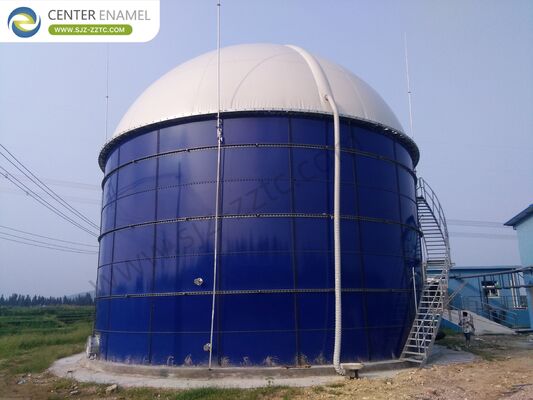
Glass-Fused-to-Steel (GFS) tanks provide the ultimate containment solution for anaerobic digestion plants. The glass is fused to the steel at firing temperatures between 820°C and 930°C, creating an advanced dual-coating structure (2C2F) that merges the mechanical durability and structural flexibility of steel with the outstanding chemical inertness and corrosion resistance of glass. This ensures a maintenance-free service life of over 30 years.
To optimize biogas collection and storage, GFS digester tanks are perfectly complemented by integrated Double Membrane Roofs. Installed directly on top of the tank, the double membrane structure serves as an efficient gas holder. This innovative design eliminates the need for expensive standalone ground-mounted gas holders, optimizes land usage, reduces capital expenditure, and provides exceptional airtightness and structural reliability.
- Glass-Fused-to-Steel (GFS) Tanks: Premium corrosion-resistant tanks featuring a dual-layer enamel coating (2C2F), widely utilized in bio-energy and wastewater treatment.
- Galvanized Steel Tanks: Robust tanks finished with a tough, wear-resistant protective coating.
- Fusion Bonded Epoxy (FBE) Tanks: Innovative coating technology developed with AkzoNobel for superior chemical resistance.
- Double Membrane Roof: Superior option for anaerobic digestion processes and biogas applications, offering airtightness for biogas collection and odor control.
- Aluminum Geodesic Dome Roof: Known for its corrosion resistance and expansive clear span capability.
- Stainless Steel Roof: Providing super anti-corrosion performance and long service life for harsh environments.
A complete Biogas Power Plant requires a comprehensive suite of auxiliary equipment:
- Gas Holder: For storing produced biogas to balance supply and demand.
- Torch System: Safety flare for burning excess gas.
- Solid-liquid Separator: For dewatering digestate into valuable organic fertilizer.
- Lifting Pump: For transporting sludge and digestate between process stages.
- Dehydration and Desulfurization Tank: For removing corrosive hydrogen sulfide and moisture from raw biogas.
- Screw Sludge Dewatering Machine: For further volume reduction of processed biosolids.
Successful biogas plant implementation demands rigorous engineering design, accurate mass balance calculations, and robust equipment specification. Center Enamel draws upon its extensive manufacturing experience and advanced R&D capabilities to deliver customized, professional design packages tailored to the unique operational parameters of projects in Ghana. Key advantages include:
- Professional Design Solutions: Optimizing every technical detail for high structural integrity and maximum biological conversion efficiency.
- International Standards Compliance: Adhering to AWWA D103, ISO, and EuroCode for long-term operational safety and reliability.
- Climate Adaptation: Accounting for local tropical climatic conditions and feedstock characteristics to minimize maintenance requirements.
- Turnkey Implementation: Offering complete process packages, equipment supply, and EPC services.
Ghana's strategic move toward converting municipal sludge and household waste into biogas represents a significant opportunity for the nation to address critical waste management challenges while generating renewable energy. By integrating core CSTR technology with superior containment solutions such as GFS Tanks and Double Membrane Roofs, Ghana can effectively minimize waste, reduce greenhouse gas emissions, and contribute to energy security. As a leading provider of Biogas Power Plant solutions, Center Enamel offers the comprehensive expertise and equipment needed to support Ghana's sustainable development goals.