-
Glass Fused To Steel Tanks (621)
-
Stainless Steel Tanks (434)
-
Fusion Bonded Epoxy Tanks (592)
-
Galvanized Steel Tanks (321)
-
Aluminum Dome Roofs (1336)
-
Wastewater Storage Tanks (237)
-
Welded Steel Tanks (457)
-
Pressure Vessels (295)
-
Anaerobic Digester (202)
-
Industrial Water Tanks (349)
-
Glass Lined Steel Tanks (180)
-
Bolted Steel Tanks (389)
-
Sludge Storage Tank (115)
-
Biogas Storage Tank (173)
-
Leachate Storage Tanks (133)
-
Agricultural Water Storage Tanks (179)
-
Fire Water Tank (166)
-
Grain Storage Silos (146)
-
Biogas Projects (424)
-
Wastewater Treatment Projects (1319)
-
Double Membrane Roof (223)


|
Transforming Bangladesh Municipal Sludge to Biogas with a Professional Biogas Project Contractor
| Place of Origin: | China |
| Brand Name: | CEC TANKS |
| Certification: | ISO 9001:2008, AWWA D103 , OSHA , BSCI |
| Model Number: | W |
| Minimum Order Quantity: | 1set |
| Price: | $5000~$20000 one set |
| Packaging Details: | PE poly-foam between each two steel plates ; wooden pallet and wooden |
| Delivery Time: | 10-30 days after deposit received |
| Payment Terms: | L/C,T/T |
| Supply Ability: | 60 sets per month |
|
Detail Information |
|||
| Place of Origin | China | Brand Name | CEC TANKS |
|---|---|---|---|
| Certification | ISO 9001:2008, AWWA D103 , OSHA , BSCI | Model Number | W |
| Tank Body Color: | Dark Green / Can Be Customized | Corrosion Integrity: | Excellent |
| Steel Plates Thickness: | 3mm To 12mm , Depends On The Tank Structure | Chemical Resistance: | Excellent |
| Size Of Panel: | 2.4M * 1.2M | Easy To Clean: | Smooth, Glossy, Inert, Anti-adhesion |
| Highlight: | Bangladesh municipal sludge biogas project,professional biogas project contractor,wastewater treatment biogas conversion |
||
Product Description
Bangladesh, a densely populated nation with rapidly expanding urban centers like Dhaka, Chattogram, and Khulna, faces a critical challenge in managing its ever-growing volumes of municipal sludge. With approximately 70% of Khulna's municipal solid waste being biodegradable, the potential for waste-to-energy conversion is substantial. This article explores how converting municipal sludge to biogas through modern anaerobic digestion technology, utilizing robust GFS Tanks and the expertise of a leading Biogas Project Contractor, provides a sustainable solution to this environmental issue while generating renewable energy to support the nation's development goals.
Municipal sludge is the organic semi-solid byproduct generated during the treatment of domestic and commercial wastewater. As Bangladesh's urban population grows, so does the volume of this material, which consists of primary sludge from solids settling and secondary sludge from biological processes. Traditional management methods, such as landfilling and open dumping, are becoming increasingly unsustainable and environmentally harmful. These practices pose serious risks to public health through groundwater contamination and the emission of methane, a potent greenhouse gas. The riverine geography and high population density of Bangladesh further exacerbate these issues, creating an urgent need for more sustainable and advanced treatment technologies.
The conversion of municipal sludge into biogas via anaerobic digestion offers a powerful alternative. In this natural biological process, microorganisms break down organic matter in an oxygen-free environment, producing a methane-rich renewable energy source known as biogas. This approach provides significant advantages: it reduces sludge volume by up to 50-70%, stabilizes the waste by destroying pathogens and organic content, and generates clean energy that can be used for electricity generation, heating, or upgraded for injection into the gas grid. The nutrient-rich digestate byproduct can also be repurposed as an organic fertilizer, promoting sustainable agriculture in Bangladesh's rural areas.
At the heart of a modern sludge-to-biogas facility is the anaerobic digester, with the Continuous Stirred-Tank Reactor (CSTR) being a proven and preferred technology for treating municipal sludge. The CSTR system is specifically designed to handle high-solids feedstocks like sewage sludge. Raw materials and anaerobic microorganisms are continuously or semi-continuously fed into a sealed, heated tank where a mechanical stirring device keeps them in a completely mixed state. This constant agitation is crucial for maximizing biogas yield, ensuring uniform temperature, preventing the formation of a scum layer, and promoting intimate contact between the bacteria and the organic material. Research has shown that CSTRs are highly effective for municipal sludge digestion, with studies demonstrating successful operation at various hydraulic retention times and temperature ranges.
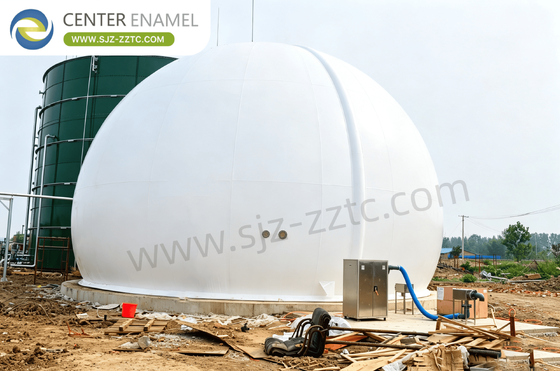
For the demanding environment of an anaerobic digester, the selection of storage equipment is paramount. Glass-Fused-to-Steel (GFS) Tanks are the preferred bolted tank solution. The glass is fused to the steel at temperatures over 800°C, creating an inert, exceptionally smooth, and highly corrosion-resistant surface. This outstanding corrosion resistance is essential for withstanding the acidic and chemically aggressive environment inside a digester, ensuring a long service life of over 30 years.
Complementing the GFS tank is the Double Membrane Roof, which serves as an integrated gas holder for the biogas produced. Under normal working conditions, this roof type is the preferred solution due to its significant cost optimization and space efficiency. By storing biogas directly within the roof chamber on top of the tank, it eliminates the need for a separate ground-mounted gas holder, reducing the plant's overall footprint and saving on foundation construction costs.
Beyond GFS tanks and Double Membrane Roofs, a range of specialized storage and cover options are available to meet specific project requirements:
- Galvanized Steel Tanks: Featuring a tough, wear-resistant protective coating.
- Fusion Bonded Epoxy (FBE) Tanks: Developed with AkzoNobel for superior chemical resistance.
- Stainless Steel Tanks: Ideal for high-purity applications requiring AISI 304/316 grade materials.
- Aluminum Geodesic Dome Roof: Known for its corrosion resistance and clear span capability.
- Glass-Fused-to-Steel Roof: An air-tight option for pressurized structures and odor control.
- Aluminum Alloy Trough Deck Roof: An economical choice for applications not requiring full air-tightness.
A fully functional biogas plant relies on a suite of auxiliary equipment to ensure safe, reliable, and optimized operation:
- Gas Holder: For storing the produced biogas to balance supply with fluctuating demand.
- Torch System: A safety flare that automatically burns excess gas during maintenance or when production exceeds usage.
- Solid-liquid Separator: For dewatering the digestate into solid organic fertilizer and liquid fertilizer.
- Lifting Pump: For transporting sludge and digestate between process stages.
- Dehydration and Desulfurization Tank: For removing corrosive hydrogen sulfide (H₂S) and moisture from raw biogas to protect downstream equipment.
- Screw Sludge Dewatering Machine: For further volume reduction of the processed biosolids.
As an experienced EPC (Engineering, Procurement, and Construction) contractor, Center Enamel delivers comprehensive turnkey biogas solutions. This single-source approach provides significant advantages:
- Single-Point Accountability: Clients work with one contractor for the entire project scope, simplifying communication and risk management.
- Full-Spectrum Expertise: Providing process packages, equipment supply, and full EPC services.
- Advanced Process Integration: Expertise in CSTR, UASB, IC, and USR processes tailored to Bangladesh's waste characteristics and tropical climate.
- International Certifications: Manufacturing processes and products adhere to stringent global standards including ISO 9001, AWWA D103, and NSF/ANSI 61.
- Canada Biogas Project
- Tank Size: φ8.4*7.2 m (H) 2 units Unit
- Total Volume: 798 m³
- Completion Date: 2024
- Indonesia Biogas Project
- Tank Application: Palm Oil Wastewater Treatment Plant
- Tank Model: Ø19.86*8.4 m
- Number of Tanks: 3 GFS Tanks
- Installation: 7 people, 40 days
- Installation Date: November 2009
Bangladesh's proactive approach to converting municipal sludge into biogas is a testament to how modern Biogas Plant Design can turn environmental challenges into sustainable solutions. By integrating core technologies like the CSTR process with superior containment solutions such as GFS Tanks and Double Membrane Roofs, the nation is effectively minimizing waste, generating renewable energy, and reinforcing its commitment to a greener future. As a dedicated Biogas Project Contractor, Center Enamel plays a crucial role in supporting this critical infrastructure with its comprehensive, one-stop solutions.