-
Glass Fused To Steel Tanks (621)
-
Stainless Steel Tanks (434)
-
Fusion Bonded Epoxy Tanks (592)
-
Galvanized Steel Tanks (321)
-
Aluminum Dome Roofs (1336)
-
Wastewater Storage Tanks (237)
-
Welded Steel Tanks (457)
-
Pressure Vessels (295)
-
Anaerobic Digester (202)
-
Industrial Water Tanks (349)
-
Glass Lined Steel Tanks (180)
-
Bolted Steel Tanks (389)
-
Sludge Storage Tank (115)
-
Biogas Storage Tank (173)
-
Leachate Storage Tanks (133)
-
Agricultural Water Storage Tanks (179)
-
Fire Water Tank (166)
-
Grain Storage Silos (146)
-
Biogas Projects (424)
-
Wastewater Treatment Projects (1319)
-
Double Membrane Roof (223)


|
Advancing Biogas Plant Design with GFS Tanks for Vietnam Municipal Sludge to Biogas
| Place of Origin: | China |
| Brand Name: | CEC TANKS |
| Certification: | ISO 9001:2008, AWWA D103 , OSHA , BSCI |
| Model Number: | W |
| Minimum Order Quantity: | 1set |
| Price: | $5000~$20000 one set |
| Packaging Details: | PE poly-foam between each two steel plates ; wooden pallet and wooden |
| Delivery Time: | 10-30 days after deposit received |
| Payment Terms: | L/C,T/T |
| Supply Ability: | 60 sets per month |
|
Detail Information |
|||
| Place of Origin | China | Brand Name | CEC TANKS |
|---|---|---|---|
| Certification | ISO 9001:2008, AWWA D103 , OSHA , BSCI | Model Number | W |
| Tank Body Color: | Dark Green / Can Be Customized | Corrosion Integrity: | Excellent |
| Steel Plates Thickness: | 3mm To 12mm , Depends On The Tank Structure | Chemical Resistance: | Excellent |
| Size Of Panel: | 2.4M * 1.2M | Easy To Clean: | Smooth, Glossy, Inert, Anti-adhesion |
| Highlight: | GFS tanks for biogas plants,Vietnam municipal sludge treatment,wastewater biogas project design |
||
Product Description
Vietnam, with its growing population and industrializing cities like Ho Chi Minh City and Hanoi, faces an urgent need for sustainable municipal waste and wastewater management. The country's rapid urbanization has led to a corresponding increase in municipal sludge, a significant environmental liability if not managed properly. This article explores how converting municipal sludge to biogas using advanced technologies, including the Continuous Stirred-Tank Reactor (CSTR) and robust GFS Tanks, offers a powerful waste-to-energy solution. It highlights the critical role of a trusted Biogas Solution Provider in delivering these innovative Biogas Plant Design projects to support Vietnam's sustainable development.
Municipal sludge is the semi-solid residue generated during the primary and secondary treatment of municipal wastewater. This organic-rich material is a major byproduct of the water reclamation process. Traditional treatment and disposal methods in Vietnam have often relied on landfilling or direct discharge, which pose severe environmental risks, including groundwater contamination, odor problems, and the release of greenhouse gases. As environmental regulations tighten and urban land becomes scarce, there is a growing imperative to adopt more sustainable and advanced solutions. The significant organic content of the sludge makes it an ideal feedstock for biogas production, turning a waste problem into an energy resource.
Anaerobic digestion offers a biologically-based solution that effectively addresses the challenges of sludge management while generating renewable energy. In this process, a consortium of microorganisms breaks down the complex organic matter in an oxygen-free environment over four key stages: hydrolysis, acidogenesis, acetogenesis, and methanogenesis. The final product, biogas, is a mixture primarily composed of methane (60-70%) and carbon dioxide (30-40%). The advantages are substantial: it reduces sludge volume by up to 50%, stabilizes the material by destroying pathogens and odors, and generates a renewable fuel that can produce electricity, heat, or be upgraded for vehicle use. For Vietnam, this technology offers a pathway to energy self-sufficiency for wastewater treatment plants and helps achieve national sustainability goals.
The Continuous Stirred-Tank Reactor (CSTR) is a proven and highly effective technology for the anaerobic digestion of municipal sludge with high suspended solids. In this system, the sludge is continuously or semi-continuously fed into a sealed reactor where a mechanical stirring device maintains a "completely mixed" state. This constant agitation is crucial for performance, ensuring uniform temperature, preventing solids from settling and a scum layer from forming, and maximizing the contact between the microorganisms and the organic substrate. The CSTR can be operated at mesophilic (35-38°C) or thermophilic (52-58°C) temperatures, with mesophilic operation being the global standard for municipal sludge due to its stability and lower heating requirements. This technology is a cornerstone of any modern biogas plant.
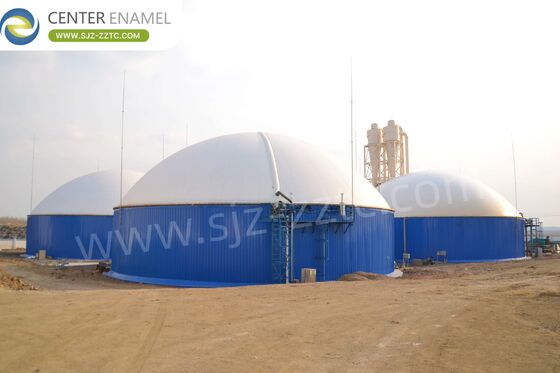
For the critical containment and gas collection functions of a biogas plant, the choice of equipment is paramount. Glass-Fused-to-Steel (GFS) tanks are recognized as the premium bolted tank solution for anaerobic digesters. The manufacturing process involves fusing a specialized glass coating to the steel at temperatures over 800°C, creating an inert and exceptionally smooth surface. This provides outstanding corrosion resistance, essential for protecting the tank from the acidic and chemically aggressive environment inside the digester, ensuring long-term durability and a service life exceeding 30 years.
Paired with the GFS tank is the Double Membrane Roof, which serves as an integrated gas holder. This solution offers significant advantages: it is cost-optimized by reducing the roof budget and dramatically improves space efficiency by eliminating the need for a separate, ground-mounted gas holder. This integrated design saves valuable land and civil construction costs, making it an ideal choice for projects in urban or space-constrained areas.
To cater to diverse project requirements, a broad portfolio of storage and cover solutions is available:
- Galvanized Steel Tanks: Featuring a tough, wear-resistant protective coating.
- Fusion Bonded Epoxy (FBE) Tanks: Developed with AkzoNobel for superior chemical resistance.
- Stainless Steel Tanks: Ideal for high-purity or aggressive environment applications.
- Aluminum Geodesic Dome Roof: Known for its corrosion resistance and clear span capability.
- Glass-Fused-to-Steel Roof: An air-tight option for pressurized structures and odor control.
- Aluminum Alloy Trough Deck Roof: An economical choice for applications not requiring full air-tightness.
A high-performance biogas plant depends on a complete suite of auxiliary equipment to ensure safe and reliable operation:
- Gas Holder: For storing the produced biogas to balance supply with fluctuating demand.
- Torch System: A safety flare that automatically and safely burns excess gas.
- Solid-liquid Separator: For dewatering the digestate into valuable organic fertilizer.
- Lifting Pump: For transferring sludge and digestate between process stages.
- Dehydration and Desulfurization Tank: For removing corrosive hydrogen sulfide (H₂S) and moisture from the raw biogas to protect downstream equipment.
- Screw Sludge Dewatering Machine: For further reducing the volume of the processed biosolids.
Center Enamel serves as a comprehensive EPC contractor and equipment supplier for biogas projects in Vietnam. As a premier Biogas Solution Provider, they offer a one-stop solution that covers every aspect of a biogas project from concept to commissioning. The advantages of this integrated approach include:
- Single-Point Accountability: Clients work with one contractor for the entire project scope, simplifying communication and risk management.
- Full-Spectrum Expertise: Providing process packages, equipment supply, and full EPC services to meet specific client needs.
- International Certifications: Their manufacturing processes and products adhere to stringent global standards, including ISO 9001, AWWA D103, and NSF/ANSI 61, ensuring quality and compliance.
France Biogas Project
Process Section: CSTR
Tank Size: φ18.33*8.4 m (H) 1 unit
Total Volume: 2215 m³ 1 unit
Completion Time: 2021
Canada Biogas Project
Tank Size: φ8.4*7.2 m (H) 2 units Unit
Total Volume: 798 m³
Completion Date: 2024
Vietnam is at the forefront of adopting sustainable waste-to-energy solutions. By converting municipal sludge to biogas through advanced Biogas Plant Design, the nation is tackling a critical environmental challenge while generating a renewable energy source. The integration of core technologies like the CSTR process with robust containment solutions such as GFS Tanks and Double Membrane Roofs provides a reliable and efficient pathway to waste management and energy independence. As a leading Biogas Solution Provider, Center Enamel is well-positioned to support Vietnam's continued growth in this vital sector.
1. What makes municipal sludge suitable for biogas production?
Municipal sludge is rich in organic matter, which serves as the "food" for the anaerobic microorganisms in the digester. These microorganisms break down the complex organics through a process of hydrolysis, acidogenesis, acetogenesis, and methanogenesis to produce biogas.
2. What role does the CSTR process play in a biogas plant?
The Continuous Stirred-Tank Reactor is the main digestion vessel. Its mechanical mixing ensures that the sludge and microorganisms are in constant contact, which maximizes the rate of decomposition and the volume of biogas produced from the organic waste.
3. Why are GFS Tanks a good choice for these applications?
Glass-Fused-to-Steel Tanks offer superior corrosion resistance, which is essential for containing the highly acidic slurry inside an anaerobic digester. Their durable, low-maintenance design, and long service life make them a cost-effective and reliable choice for biogas infrastructure.