-
Glass Fused To Steel Tanks (596)
-
Stainless Steel Tanks (434)
-
Fusion Bonded Epoxy Tanks (592)
-
Galvanized Steel Tanks (321)
-
Aluminum Dome Roofs (1336)
-
Wastewater Storage Tanks (232)
-
Welded Steel Tanks (457)
-
Pressure Vessels (295)
-
Anaerobic Digester (201)
-
Industrial Water Tanks (349)
-
Glass Lined Steel Tanks (180)
-
Bolted Steel Tanks (389)
-
Sludge Storage Tank (115)
-
Biogas Storage Tank (173)
-
Leachate Storage Tanks (133)
-
Agricultural Water Storage Tanks (179)
-
Fire Water Tank (166)
-
Grain Storage Silos (146)
-
Biogas Projects (425)
-
Wastewater Treatment Projects (828)
-
Double Membrane Roof (223)


|
Efficient Biogas Projects in India: GFS Tanks and Double Membrane Roofs for Chicken Manure
| Place of Origin: | China |
| Brand Name: | CEC TANKS |
| Certification: | ISO 9001:2008, AWWA D103 , OSHA , BSCI |
| Model Number: | W |
| Minimum Order Quantity: | 1set |
| Price: | $5000~$20000 one set |
| Packaging Details: | PE poly-foam between each two steel plates ; wooden pallet and wooden |
| Delivery Time: | 10-30 days after deposit received |
| Payment Terms: | L/C,T/T |
| Supply Ability: | 60 sets per month |
|
Detail Information |
|||
| Place of Origin | China | Brand Name | CEC TANKS |
|---|---|---|---|
| Certification | ISO 9001:2008, AWWA D103 , OSHA , BSCI | Model Number | W |
| Tank Body Color: | Dark Green / Can Be Customized | Corrosion Integrity: | Excellent |
| Steel Plates Thickness: | 3mm To 12mm , Depends On The Tank Structure | Chemical Resistance: | Excellent |
| Size Of Panel: | 2.4M * 1.2M | Easy To Clean: | Smooth, Glossy, Inert, Anti-adhesion |
| Highlight: | biogas projects for chicken manure,GFS tanks for wastewater treatment,double membrane roofs biogas |
||
Product Description
Efficient Biogas Projects in India: GFS Tanks and Double Membrane Roofs for Chicken Manure
The rapidly expanding poultry sector in India has brought significant economic prosperity, but it has also triggered a mounting environmental crisis regarding the disposal of chicken manure. Large-scale poultry farms across the country are struggling with the accumulation of massive amounts of waste, which, if left untreated, emits noxious odors and poses a grave threat of groundwater pollution through leaching. Traditional disposal methods are no longer sufficient to handle the sheer volume of organic output, often resulting in a waste of potential resources. Addressing this challenge is not merely an environmental obligation but a necessity for sustainable poultry farming in India, where effective waste management is the key to maintaining operational hygiene and public health compliance.
Converting Chicken Manure into Valuable Energy
Transforming chicken manure into biogas provides a dual solution for the Indian agricultural industry. By utilizing anaerobic digestion, farms can effectively neutralize pathogens and eliminate the pervasive odors that plague rural areas surrounding poultry facilities. More importantly, this transition turns a heavy waste management cost into a profit center. The process generates clean, renewable biogas that can be used for electricity generation or heating, alongside a high-quality digestate that acts as an organic fertilizer for local crops. This creates a circular economy model that lowers farm energy expenses while boosting soil health and sustainability.
Center Enamel: Bespoke Biogas Designs for India
Center Enamel specializes in delivering highly efficient, customized biogas engineering solutions tailored specifically to the climate and operational landscape of India. Our design philosophy recognizes that chicken manure presents unique challenges, particularly its high solid content, which requires specialized handling. We provide an end-to-end service, starting from meticulous site feasibility analysis to engineering and final commissioning. Our team works closely with Indian agricultural enterprises to design robust, sustainable systems that maximize gas yields while ensuring the technology remains economical and easy to manage throughout its lifecycle.
Optimized Pre-treatment and CSTR Technology
Effective waste management begins with rigorous pre-treatment to ensure the longevity of the entire plant. Our systems incorporate advanced screening and crushing technologies that intercept and break down large solid impurities, simplifying the waste stream. By refining the feedstock before it enters the digestion phase, we protect downstream equipment and guarantee a stable, consistent flow into the reactor.
At the heart of the system is the CSTR (Continuous Stirred-Tank Reactor), a powerful technology engineered for high-solid organic waste. The CSTR is equipped with high-performance mechanical stirrers that ensure a perfect blend of organic materials and anaerobic microorganisms. This constant, thorough mixing within a temperature-controlled environment facilitates rapid degradation and ensures a steady, high-output production of biogas.
Durable GFS Tanks and Double Membrane Roofs
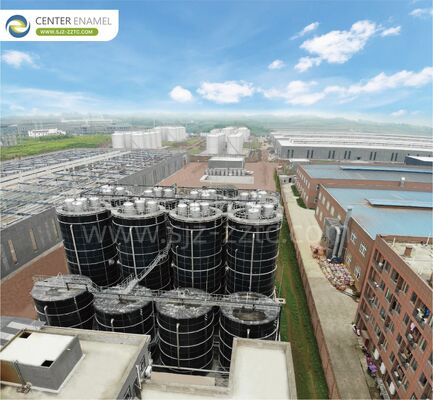
For long-term reliability in the Indian environment, Center Enamel integrates Glass-Fused-to-Steel (GFS) tanks with sophisticated double membrane roofs. GFS tanks are favored for their exceptional corrosion resistance and mechanical strength, allowing them to handle demanding storage requirements. When topped with a double membrane roof, the system gains significant advantages: it is highly space-efficient, reduces overall foundation construction costs, and offers superior cost optimization for gas storage. This combination is the industry standard for safety and efficiency, ensuring that biogas is stored securely under optimal conditions.
Essential Auxiliary Equipment
A complete biogas plant requires a suite of specialized components to function at peak performance:
Solid-liquid Separator: Crucial for managing post-fermentation waste by separating solid and liquid fractions.
Dehydration and Desulfurization Tank: A critical purification unit that removes moisture and hydrogen sulfide to protect downstream combustion engines.
Lifting Pump & Screw Sludge Dewatering Machine: These ensure the efficient transfer and concentration of sludge through the plant.
Torch System & Gas Holder: The torch serves as an essential safety flare for excess gas, while the gas holder provides reliable, temporary buffer storage.
Your One-Stop Solution Provider
Center Enamel serves as a premier, global turnkey provider for the Indian market. With a legacy of over 35 years and a vast R&D infrastructure, we streamline the transition to renewable energy for Indian farms. We provide an end-to-end service model, encompassing everything from initial design and high-quality equipment manufacturing to on-site project installation, ensuring that every project meets international standards of performance and sustainability.
Center Enamel’s comprehensive approach—combining advanced CSTR reactors, resilient GFS tanks, and intelligent double membrane roofs—provides the definitive biogas solution for the Indian poultry industry. By converting waste into reliable energy, we help farms achieve sustainability, reduce costs, and minimize environmental impact.
Frequently Asked Questions (FAQ)
1. How does the CSTR design handle the varying pH levels of chicken manure? Our CSTR systems include automated monitoring sensors that track internal pH levels in real-time. If the environment deviates from the optimal range, the system allows for precise adjustments to feeding rates or recirculation, ensuring a stable environment for the microorganisms.
2. Why is the double membrane roof better than a fixed steel roof for gas storage? A double membrane roof is flexible and expandable, allowing it to adapt to fluctuations in gas volume without building up excessive pressure. This reduces the risk of structural fatigue and lowers long-term maintenance costs compared to fixed steel structures.
3. What is the operational lifespan of a GFS tank in tropical climates like India? GFS tanks are highly durable due to the fusion of glass and steel, which prevents oxidation even in high-humidity or heat-intensive environments. With proper maintenance, these tanks are designed to provide decades of service, offering a significantly longer lifespan than traditional concrete or bolted steel tanks.