-
Glass Fused To Steel Tanks (596)
-
Stainless Steel Tanks (434)
-
Fusion Bonded Epoxy Tanks (592)
-
Galvanized Steel Tanks (321)
-
Aluminum Dome Roofs (1336)
-
Wastewater Storage Tanks (232)
-
Welded Steel Tanks (457)
-
Pressure Vessels (295)
-
Anaerobic Digester (201)
-
Industrial Water Tanks (349)
-
Glass Lined Steel Tanks (180)
-
Bolted Steel Tanks (389)
-
Sludge Storage Tank (115)
-
Biogas Storage Tank (173)
-
Leachate Storage Tanks (133)
-
Agricultural Water Storage Tanks (179)
-
Fire Water Tank (166)
-
Grain Storage Silos (146)
-
Biogas Projects (425)
-
Wastewater Treatment Projects (828)
-
Double Membrane Roof (223)


|
Transforming Ghana’s Kitchen Waste: Advanced GFS Tanks and CSTR Process for Biogas Projects
| Place of Origin: | China |
| Brand Name: | CEC TANKS |
| Certification: | ISO 9001:2008, AWWA D103 , OSHA , BSCI |
| Model Number: | W |
| Minimum Order Quantity: | 1set |
| Price: | $5000~$20000 one set |
| Packaging Details: | PE poly-foam between each two steel plates ; wooden pallet and wooden |
| Delivery Time: | 10-30 days after deposit received |
| Payment Terms: | L/C,T/T |
| Supply Ability: | 60 sets per month |
|
Detail Information |
|||
| Place of Origin | China | Brand Name | CEC TANKS |
|---|---|---|---|
| Certification | ISO 9001:2008, AWWA D103 , OSHA , BSCI | Model Number | W |
| Tank Body Color: | Dark Green / Can Be Customized | Corrosion Integrity: | Excellent |
| Steel Plates Thickness: | 3mm To 12mm , Depends On The Tank Structure | Chemical Resistance: | Excellent |
| Size Of Panel: | 2.4M * 1.2M | Easy To Clean: | Smooth, Glossy, Inert, Anti-adhesion |
| Highlight: | Ghana kitchen waste biogas tanks,GFS tanks for wastewater treatment,CSTR process biogas projects |
||
Product Description
Transforming Ghana’s Kitchen Waste: Advanced GFS Tanks and CSTR Process for Biogas Projects
In Ghana, the rapid expansion of urbanization and the thriving food service sector have brought a significant challenge: the management of kitchen waste. Traditionally, this organic waste ends up in overflowing landfills, contributing to environmental pollution, greenhouse gas emissions, and severe public health risks, including the spread of pathogens. As cities like Accra struggle with waste disposal, there is an urgent need for sustainable, innovative solutions. Transforming this hazardous kitchen waste into renewable energy is not just an environmental imperative but a crucial step toward resource recovery and achieving a circular economy in Ghana.
The Strategic Advantages of Converting Kitchen Waste to Biogas
Kitchen waste is highly organic, rich in protein, fat, and carbohydrates, making it an ideal feedstock for anaerobic digestion. By converting this waste into biogas, Ghana can effectively address the "rot, stink, and flies" issues associated with traditional disposal methods while generating a clean, renewable energy source. Beyond biogas production, this process reduces waste volume significantly and provides nutrient-rich digestate that can be utilized as high-quality organic fertilizer, thereby completing the nutrient loop.
Center Enamel: Expert Design for Kitchen Waste Biogas Projects
Center Enamel offers comprehensive, turnkey solutions specifically tailored to the unique characteristics of kitchen waste, which often has high moisture (80%-95%) and salt content. With over 35 years of experience, we provide end-to-end services, from initial feasibility studies and process engineering to precision manufacturing and installation. Our solutions are designed to handle complex environmental challenges, ensuring that your biogas project in Ghana operates efficiently, achieves environmental compliance, and generates sustainable revenue.
Efficient Kitchen Waste Treatment Flow
The treatment process begins with pre-treatment to remove sand and non-organic impurities. The resulting slurry is then fed into a hydrolysis and homogenization tank, where temperature and pH are balanced to convert waste into organic acid. This prepared slurry is subsequently pumped into the anaerobic fermentation tank for stable biogas production. Post-fermentation, the biogas is purified, while the liquid digestate undergoes sludge dehydration, and fibrous residues are sent for incineration, ensuring a completely harmless and resource-efficient process.
Advanced CSTR Process for Maximum Efficiency
Our treatment systems utilize the Continuous Stirred Tank Reactor (CSTR) technology. This process keeps the fermentation raw materials and microorganisms in a completely mixed state within a closed tank. Equipped with advanced mechanical agitation, the CSTR process ensures high degradation efficiency of organic matter, even in high-concentration wastewater with high suspended solids, allowing for continuous or semi-continuous feeding and optimized biogas yield.
GFS Tanks and Glass-Fused-to-Steel Roofs
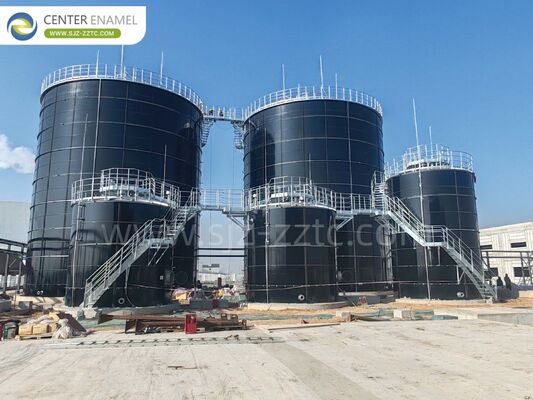
Center Enamel is renowned for its premium Glass-Fused-to-Steel (GFS) tanks, which are essential for robust biogas projects. Manufactured by firing molten glass onto steel plates at 820°C–930°C, these tanks combine the strength of steel with the superior corrosion resistance of glass, far outperforming standard epoxy or welded tanks. Complementing these tanks is our specialized Glass-Fused-to-Steel roof. This cone-shaped design, reinforced with internal and external beams, offers superior air-tightness, which is critical for pressurized structures and effective odor control in demanding applications.
Comprehensive Auxiliary Equipment
We provide a full range of high-quality equipment to ensure your biogas plant operates seamlessly:
Dual-shaft Crusher & Multi-function Crushing/Sorting Machine: Essential for initial waste breakdown and separation.
Mixed Crushing/Pulping Tank: Prepares the slurry for consistent feeding.
Gas Holder: Provides safe and durable storage for produced biogas.
Dehydration and Desulfurization Tanks: Purifies biogas and manages sludge.
Submersible Mixers & Lifting Pumps: Ensures optimal flow and movement of high-solid content slurries.
Solid-liquid Separator: Effectively separates digestate for further use.
Your One-Stop Supplier for Biogas Projects in Ghana
Center Enamel stands as a premier, one-stop solution provider for Ghana’s waste-to-energy sector. Leveraging our 150,000m² manufacturing base and over 500 skilled employees, we bridge the gap between complex waste management issues and renewable energy reality. Whether you are a municipality or a private enterprise, we deliver field-proven installation practices and precision-engineered technology to transform your waste stream into a commercially viable asset, helping Ghana achieve its sustainable development goals.
Conclusion
The transition toward sustainable waste management is vital for Ghana’s future. By integrating Center Enamel’s advanced GFS tank technology and high-efficiency CSTR processes, municipalities and industries can successfully convert problematic kitchen waste into profitable, green energy. We are committed to delivering reliable, turnkey biogas projects that stand the test of time, turning environmental challenges into sustainable opportunities.
Frequently Asked Questions
1.How does the high salt content in kitchen waste affect the biogas process?
High salt levels can inhibit microbial activity. Center Enamel’s CSTR technology, combined with meticulous homogenization and process control, maintains a stable environment and dilutes salt concentrations, ensuring the microorganisms remain active and productive for consistent biogas output.
2.Why is GFS technology better for anaerobic digestion tanks than traditional steel? Anaerobic digestion produces corrosive conditions. GFS tanks create an inert, inorganic bond between glass and steel, offering outstanding resistance to corrosion and chemical attack, ensuring long-term structural integrity and minimizing maintenance requirements compared to epoxy-painted tanks.
3. Can the CSTR system be scaled up for larger commercial projects?
Yes. The CSTR process is highly modular and flexible. Whether you are dealing with a medium-sized catering facility or a massive municipal waste plant, our system can be configured with multiple reactors and advanced mixing equipment to scale efficiently and meet your specific throughput requirements.