-
Glass Fused To Steel Tanks (596)
-
Stainless Steel Tanks (434)
-
Fusion Bonded Epoxy Tanks (592)
-
Galvanized Steel Tanks (321)
-
Aluminum Dome Roofs (1336)
-
Wastewater Storage Tanks (232)
-
Welded Steel Tanks (457)
-
Pressure Vessels (295)
-
Anaerobic Digester (201)
-
Industrial Water Tanks (349)
-
Glass Lined Steel Tanks (180)
-
Bolted Steel Tanks (389)
-
Sludge Storage Tank (115)
-
Biogas Storage Tank (173)
-
Leachate Storage Tanks (133)
-
Agricultural Water Storage Tanks (179)
-
Fire Water Tank (166)
-
Grain Storage Silos (146)
-
Biogas Projects (425)
-
Wastewater Treatment Projects (828)
-
Double Membrane Roof (223)


|
Transforming Kitchen Waste in the Democratic Republic of the Congo: EPC Contractor for GFS Tanks and CSTR Process
| Place of Origin: | China |
| Brand Name: | CEC TANKS |
| Certification: | ISO 9001:2008, AWWA D103 , OSHA , BSCI |
| Model Number: | W |
| Minimum Order Quantity: | 1set |
| Price: | $5000~$20000 one set |
| Packaging Details: | PE poly-foam between each two steel plates ; wooden pallet and wooden |
| Delivery Time: | 10-30 days after deposit received |
| Payment Terms: | L/C,T/T |
| Supply Ability: | 60 sets per month |
|
Detail Information |
|||
| Place of Origin | China | Brand Name | CEC TANKS |
|---|---|---|---|
| Certification | ISO 9001:2008, AWWA D103 , OSHA , BSCI | Model Number | W |
| Tank Body Color: | Dark Green / Can Be Customized | Corrosion Integrity: | Excellent |
| Steel Plates Thickness: | 3mm To 12mm , Depends On The Tank Structure | Chemical Resistance: | Excellent |
| Size Of Panel: | 2.4M * 1.2M | Easy To Clean: | Smooth, Glossy, Inert, Anti-adhesion |
| Highlight: | GFS tanks wastewater treatment,CSTR process kitchen waste,EPC contractor Congo projects |
||
Product Description
Transforming Kitchen Waste in the Democratic Republic of the Congo: EPC Contractor for GFS Tanks and CSTR Process
In the Democratic Republic of the Congo (DRC), rapid urbanization and a burgeoning food service industry are generating massive amounts of organic kitchen waste. Currently, most of this waste is managed through unorganized dumping or informal landfilling, leading to significant environmental degradation, the contamination of precious water sources, and the rapid spread of pathogens and pests in densely populated areas. As the nation moves toward sustainable industrialization, there is a pressing need for modern, robust waste management infrastructures. Transitioning from traditional, hazardous disposal methods to advanced waste-to-energy technologies is essential for the DRC to mitigate environmental risks and build a circular economy that fosters both public health and regional energy independence.
The Strategic Advantages of Converting Kitchen Waste to Biogas
Kitchen waste in the DRC is an underutilized energy reservoir, rich in fats, proteins, and carbohydrates. By employing anaerobic digestion, the nation can divert this massive organic stream away from landfills, effectively neutralizing the "rot and odor" challenges that impact urban life. More importantly, this process converts the biomass into clean, renewable biogas, providing a stable source of energy for heating or power generation. The secondary benefit is the production of nutrient-dense digestate, which serves as a high-quality organic fertilizer, helping to revitalize local soils and support the DRC’s agricultural development without relying on expensive, imported chemical alternatives.
Center Enamel: Expert EPC Design for DRC’s Biogas Projects
Center Enamel provides dedicated Engineering, Procurement, and Construction (EPC) services tailored specifically to the unique environmental and operational requirements of the DRC. We understand that effective kitchen waste management in this region requires engineering resilience against high moisture levels and varying waste compositions. With over 35 years of global experience, our team manages the entire project lifecycle—from initial site feasibility and bespoke process design to precision manufacturing and turn-key on-site installation. As a comprehensive EPC contractor, our goal is to deliver durable, high-performance biogas facilities that ensure strict environmental compliance and maximize long-term operational revenue for our Congolese partners.
Efficient Kitchen Waste Treatment Flow
Our engineered treatment system is designed for maximum resource recovery and process stability. The flow begins with comprehensive pre-treatment to extract grit, plastic, and non-biodegradable impurities. The refined organic slurry is then moved to a hydrolysis and homogenization unit, where advanced automation balances the temperature and pH to successfully break down solids into volatile organic acids. This prepared feedstock is then fed into the anaerobic fermentation tank for high-yield methane production. The process is completed with multi-stage biogas purification, sludge dehydration, and the safe incineration of fibrous residuals, ensuring a zero-waste and environmentally sound operation.
Advanced CSTR Process for Maximum Efficiency
Our core technology for kitchen waste digestion is the Continuous Stirred Tank Reactor (CSTR). This advanced anaerobic treatment process ensures that all fermentation raw materials and active microorganisms remain in a state of continuous, thorough mixing within a sealed tank. By leveraging high-performance mechanical agitation, the CSTR process is specifically engineered to handle the high organic loading rates associated with kitchen waste, ensuring effective degradation even with high suspended solids. This stability facilitates continuous or semi-continuous feeding regimes, which are critical for maintaining predictable biogas yields and achieving the highest possible efficiency in the plant's daily operations.
Premium GFS Tanks and Glass-Fused-to-Steel Roofs
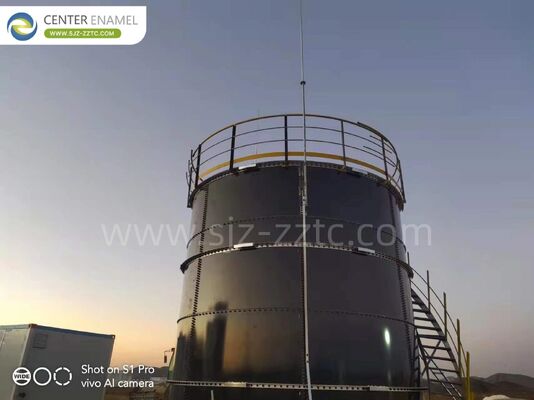
The foundation of our biogas projects is the Glass-Fused-to-Steel (GFS) tank. Manufactured by firing molten glass onto high-strength steel plates at 820°C–930°C, these tanks create an inert, inorganic bond that delivers the structural strength of steel combined with the superior chemical resistance of glass. This makes GFS tanks vastly superior to traditional epoxy-coated or welded steel options, especially in the demanding and humid environments of the DRC. Our structures are enhanced by specialized Glass-Fused-to-Steel roofs, which feature a cone-shaped, beam-reinforced design. These roofs provide exceptional air-tightness, essential for containing odors and maintaining the pressurized conditions required for modern, large-scale industrial applications.
Comprehensive Auxiliary Equipment
To guarantee a fully integrated and high-performance plant, Center Enamel provides a comprehensive suite of high-quality auxiliary equipment:
Dual-shaft Crusher & Multi-function Sorting Machine: The primary defense for effectively breaking down organic waste and separating non-biodegradable debris.
Mixed Crushing/Pulping Tank: Prepares the slurry to a consistent, pumpable state for stable, continuous feeding.
Gas Holder: Provides safe, durable, and reliable storage for produced biogas.
Dehydration and Desulfurization Tanks: Dedicated systems specifically designed for gas purification and sludge byproduct management.
Submersible Mixers & Lifting Pumps: Essential for ensuring optimal flow and circulation of high-solid content slurries throughout the reactor.
Solid-liquid Separator: Maximizes resource recovery by separating high-value solids for use as agricultural fertilizer.
Your One-Stop EPC Partner for Biogas Projects in the DRC
Center Enamel serves as a dedicated, one-stop EPC contractor for the DRC’s emerging waste-to-energy landscape. Leveraging our 150,000m² manufacturing base and over 500 specialized personnel, we are equipped to translate complex waste management challenges into efficient, renewable energy assets. Whether your project involves a municipal food waste plant or an industrial processing facility, we deliver proven installation practices and precision-engineered technology, helping our clients bridge the gap between waste management burdens and sustainable economic development.
Conclusion
The shift toward sustainable waste treatment is a vital requirement for the DRC’s future prosperity. Through the integration of Center Enamel’s high-performance GFS tank technology and advanced CSTR processes, industries and government bodies can effectively convert problematic kitchen waste into profitable, green energy. We are committed to providing reliable, turn-key EPC solutions that deliver long-term environmental value and operational excellence, turning the country's organic waste into sustainable energy opportunities.
Frequently Asked Questions
1. How does the CSTR system maintain operational consistency in areas with power fluctuations?
The CSTR system is designed for high mechanical and biological stability. We incorporate smart control systems that can manage feeding and mixing cycles efficiently, and our EPC solutions include options for auxiliary power backups to ensure that the fermentation process remains continuous even during local power grid instability.
2. Why are GFS tanks more suitable for the humid tropical climate of the DRC than concrete tanks?
Concrete tanks are susceptible to cracking and moisture penetration, which can lead to leaks and long-term structural failure. GFS tanks offer a completely sealed, corrosion-proof barrier that is impervious to humidity and tropical rainfall, ensuring the digester remains leak-free and structurally sound for decades.
3. What does "turn-key" mean in the context of Center Enamel’s EPC services?
As a turn-key EPC contractor, Center Enamel assumes full responsibility for the project from start to finish. This includes site surveys, structural design, equipment procurement, logistics, installation, and commissioning. When we hand over the plant, it is fully operational, tested, and ready to begin producing biogas, saving the client the coordination effort and risks of multi-vendor management.