-
Glass Fused To Steel Tanks (596)
-
Stainless Steel Tanks (434)
-
Fusion Bonded Epoxy Tanks (592)
-
Galvanized Steel Tanks (321)
-
Aluminum Dome Roofs (1316)
-
Wastewater Storage Tanks (231)
-
Welded Steel Tanks (457)
-
Pressure Vessels (295)
-
Anaerobic Digester (201)
-
Industrial Water Tanks (349)
-
Glass Lined Steel Tanks (180)
-
Bolted Steel Tanks (390)
-
Sludge Storage Tank (115)
-
Biogas Storage Tank (173)
-
Leachate Storage Tanks (133)
-
Agricultural Water Storage Tanks (179)
-
Fire Water Tank (166)
-
Grain Storage Silos (146)
-
Biogas Projects (425)
-
Wastewater Treatment Projects (788)
-
Double Membrane Roof (223)


|
FBE Tanks in Seawater Desalination Structural Containment for Aggressive Coastal and Marine Processes (2026)
| Place of Origin: | China |
| Brand Name: | CEC TANKS |
| Certification: | ISO 9001:2008, AWWA D103 , OSHA , BSCI |
| Model Number: | W201691123005 |
| Minimum Order Quantity: | 1set |
| Price: | $5000~$20000 one set |
| Packaging Details: | PE poly-foam between each two steel plates ; wooden pallet and wooden box |
| Delivery Time: | 0-60 days after deposit received |
| Payment Terms: | L/C, T/T |
| Supply Ability: | 60 sets per month |
|
Detail Information |
|||
| Place of Origin | China | Brand Name | CEC TANKS |
|---|---|---|---|
| Certification | ISO 9001:2008, AWWA D103 , OSHA , BSCI | Model Number | W201691123005 |
| Steel Plates Thickness: | 3mm To 12mm , Depends On The Tank Structure | Corrosion Integrity: | Excellent |
| Chemical Resistance: | Excellent | Capacity: | 20 M3 To 18,000 M3 |
| Service Life: | ≥30 Years | Permeability: | Gas / Liquid Impermeable |
| Highlight: | FBE tanks for seawater desalination,Fusion bonded epoxy marine containment tanks,FBE structural tanks for coastal processes |
||
Product Description
FBE Tanks in Seawater Desalination: Structural Containment for Aggressive Coastal and Marine Processes (2026)
In the global push for freshwater security, Seawater Reverse Osmosis (SWRO) and thermal desalination facilities serve as vital infrastructure across arid and coastal regions. However, handling raw ocean intake and high-concentration brine reject streams presents severe containment challenges. Seawater is a highly aggressive electrolyte; its extreme chloride levels cause rapid galvanic, crevice, and pitting corrosion in standard industrial metals and accelerate the chemical carbonation of reinforced concrete.
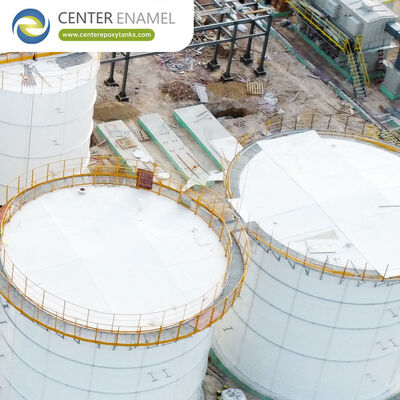
As of 2026, Fusion Bonded Epoxy (FBE) bolted steel tanks have become an established standard for high-salinity process loops across the desalination lifecycle. By combining the high tensile strength of factory-fabricated carbon steel with an advanced, molecularly cross-linked polymer barrier, FBE tanks isolate critical water assets against intense marine degradation while optimizing capital expenditure (CAPEX).
1. What is an FBE Desalination Tank?
An FBE desalination tank is a modular storage vessel engineered from high-strength carbon steel panels that are factory-coated with a high-performance thermoset epoxy resin.
Unlike traditional field-applied liquid paints, which are highly vulnerable to ambient humidity, coastal salt-fog, and uneven thickness during field construction, the Fusion Bonded Epoxy process is executed under strict factory quality controls. The steel plates are grit-blasted to a near-white finish (Sa 2.5 / SSPC-SP10), pre-heated to temperatures between 180°C and 250°C, and electrostatically sprayed with dry polymer powder (such as premium Resicoat® or LIQ Fusion™ formulations). The powder melts, flows, and chemically cross-links inside an automated curing oven to form an inseparable protective barrier permanently bonded to the steel substrate. This produces a high-density, glass-smooth internal lining that completely isolates the structural steel shell from seawater contact.
2. Technical Performance: Defeating Marine and Desalination Stressors
Desalination plants process a variety of fluid streams, from raw grit-heavy ocean water to highly mineral-deficient permeate. Premium FBE tanks—such as those utilizing high-voltage FBE-1500V technology from industry leaders like Center Enamel (Shijiazhuang Zhengzhong Technology)—are engineered to withstand these diverse chemical and physical stressors:
Chloride Ion Impermeability and Pitting Prevention
Seawater contains extreme concentrations of chloride ions ($text{Cl}^-$), which actively penetrate standard protective paint systems to cause localized pitting and crevice corrosion in steel. The cross-linked molecular structure of an FBE coating forms a dense, non-porous barrier that prevents chloride migration, keeping the structural steel shell completely free from rust.
Resistance to Saturated Brine and Cleaning Chemicals
The primary byproduct of the SWRO process is high-concentration brine, which features nearly double the salinity of raw seawater. Brine storage and reject basins experience elevated osmotic pressure and high chemical activity. FBE coatings remain entirely inert when exposed to high-salinity reject streams and the aggressive chemicals used in membrane cleaning, chlorination, or anti-scalant dosing loops (typically spanning a wide pH range of 3.0 to 11.0).
100% Pinhole-Free Factory Quality Assurance
In highly conductive marine environments, any discontinuity in a tank lining will accelerate galvanic corrosion. To guarantee zero-defect performance, every individual FBE panel undergoes a strict high-voltage electronic Holiday Test (ranging from 1100V to 1500V) before flat-packing. This factory testing ensures a 100% pinhole-free barrier, which is impossible to achieve or replicate with field-poured concrete or field-welded steel tanks.
Advanced Edge Wrap and Impact Resilience
Unlike vitreous glass linings (Glass-Fused-to-Steel) which can be brittle and prone to spalling or micro-fracturing under impact or physical stress, FBE is a flexible thermoset polymer. It flexes dynamically alongside the steel panel, providing superior impact resistance. Furthermore, automated electrostatic powder application ensures a complete wrap-around on sharp panel edges and within bolt holes—eliminating the primary locations where crevice corrosion typically initiates in bolted structures.
3. Comparison Matrix: FBE vs. Concrete vs. Duplex Stainless Steel in Desalination
4. Strategic Integration Across the SWRO Desalination Cycle
FBE bolted steel tanks serve as critical process nodes across various stages of modern seawater desalination facilities:
-
Seawater Intake and Equalization: Serving as primary buffer reservoirs immediately following beach wells or open ocean intake lines. FBE tanks manage hydraulic surges while handling raw, grit-heavy marine water.
-
Pre-Treatment Sedimentation & Coagulation: Acting as clarification and flocculation basins where raw seawater is treated with ferric chloride or polymer coagulants to drop out suspended organic matter and silt before reaching the membranes.
-
RO Permeate High-Purity Storage: Storing the initial high-purity water output directly from the RO membranes. Because RO permeate is mineral-deficient and highly "aggressive" (hungry for ions), the chemically inert, non-reactive nature of FBE ensures no metallic ions migrate into the purified stream.
-
Brine Reject Balancers: Managing the containment of concentrated salt streams before deep-well injection, evaporation pond disposal, or zero-liquid discharge (ZLD) processing.
5. Engineering Standards and Global Compliance
To satisfy strict international infrastructure criteria and pass rigorous EPC bidding screens (such as those required for large-scale SWPC, Aramco, or SEPCOIII projects), premium FBE desalination tanks comply with established global codes:
-
AWWA D103-19 (Section 12.6): The global premier standard for factory-coated bolted carbon steel liquid storage systems, validating structural calculations for hydrostatic pressure, snow, and seismic loads.
-
ISO 28765:2016: The specific international standard governing high-performance coating quality, thickness tolerances, and holiday testing profiles for water and industrial effluent storage.
-
ASCE 7-22 / Eurocode 3: Structural engineering parameters ensuring that the modular tank calculates for high seismic resilience and extreme wind loads up to 250 km/h—a critical requirement for wind-exposed, open coastal regions.
-
NSF/ANSI 61 & WRAS: Public health certifications ensuring that the internal water-contact coating is completely safe and non-leaching for post-treatment potable water delivery.
Driving Down Desalination TCO
For water utility directors, industrial plant managers, and desalination EPC contractors focused on maximizing Return on Investment (ROI), the FBE bolted steel tank represents a highly secure, scalable, and economical asset for 2026. By utilizing a modular, top-down assembly method with synchronized hydraulic jacking systems, these structures are erected entirely from ground level without high-altitude scaffolding, cutting installation timelines by up to 50%. By eliminating the extreme capital costs of exotic duplex stainless steels and the long curing schedules of concrete, FBE technology ensures safe, reliable, and maintenance-free seawater management for an operational lifespan exceeding 30 years.
Are you currently designing a seawater intake loop or upgrading a reverse osmosis plant, and would you like a detailed technical proposal including sizing, engineering drawings, and chemical compatibility data for your specific feed-water analysis?