-
Glass Fused To Steel Tanks (596)
-
Stainless Steel Tanks (434)
-
Fusion Bonded Epoxy Tanks (592)
-
Galvanized Steel Tanks (321)
-
Aluminum Dome Roofs (1316)
-
Wastewater Storage Tanks (231)
-
Welded Steel Tanks (457)
-
Pressure Vessels (295)
-
Anaerobic Digester (201)
-
Industrial Water Tanks (349)
-
Glass Lined Steel Tanks (180)
-
Bolted Steel Tanks (390)
-
Sludge Storage Tank (115)
-
Biogas Storage Tank (173)
-
Leachate Storage Tanks (133)
-
Agricultural Water Storage Tanks (179)
-
Fire Water Tank (166)
-
Grain Storage Silos (146)
-
Biogas Projects (425)
-
Wastewater Treatment Projects (788)
-
Double Membrane Roof (223)


|
FBE Dry Digesters: High-Solids Anaerobic Engineering for Organic Waste-to-Energy Systems (2026)
| Place of Origin: | China |
| Brand Name: | CEC TANKS |
| Certification: | ISO 9001:2008, AWWA D103 , OSHA , BSCI |
| Model Number: | W201691123005 |
| Minimum Order Quantity: | 1set |
| Price: | $5000~$20000 one set |
| Packaging Details: | PE poly-foam between each two steel plates ; wooden pallet and wooden box |
| Delivery Time: | 0-60 days after deposit received |
| Payment Terms: | L/C, T/T |
| Supply Ability: | 60 sets per month |
|
Detail Information |
|||
| Place of Origin | China | Brand Name | CEC TANKS |
|---|---|---|---|
| Certification | ISO 9001:2008, AWWA D103 , OSHA , BSCI | Model Number | W201691123005 |
| Steel Plates Thickness: | 3mm To 12mm , Depends On The Tank Structure | Corrosion Integrity: | Excellent |
| Chemical Resistance: | Excellent | Capacity: | 20 M3 To 18,000 M3 |
| Service Life: | ≥30 Years | Permeability: | Gas / Liquid Impermeable |
| Highlight: | FBE dry digesters for organic waste,high-solids anaerobic digestion systems,Fusion Bonded Epoxy waste-to-energy tanks |
||
Product Description
FBE Dry Digesters: High-Solids Anaerobic Engineering for Organic Waste-to-Energy Systems (2026)
In the global transition toward decarbonization, circular economics, and utility-scale waste-to-energy infrastructure, managing high-solids organic feedstocks has become a major focus for clean-tech engineering. Traditional wet anaerobic digestion systems require low-viscosity, liquid-heavy slurries. However, a massive portion of the global organic waste stream—including municipal solid waste (MSW), source-separated organics (SSO), dense agricultural residues, and stackable animal manure—possesses a high total solids (TS) content, often ranging from 15% to over 40%.
Processing these feedstocks through wet digestion requires massive water dilution, which inflates tank volume needs, complicates material handling, and dramatically increases digestate dewatering costs. Dry anaerobic digestion (high-solids anaerobic digestion) solves this challenge by treating stackable, high-viscosity biomass in its natural state.
As of 2026, Fusion Bonded Epoxy (FBE) bolted steel tanks—engineered using precise Rolled, Tapered Panel (RTP) structural frameworks—have become the premier containment standard for dry digester construction. By combining the high tensile strength of carbon steel with an advanced, molecularly cross-linked polymer shell, FBE tanks offer the exact structural rigidity and biochemical resistance required to handle heavy, high-solids digestion matrices.
1. What is an FBE Dry Digester?
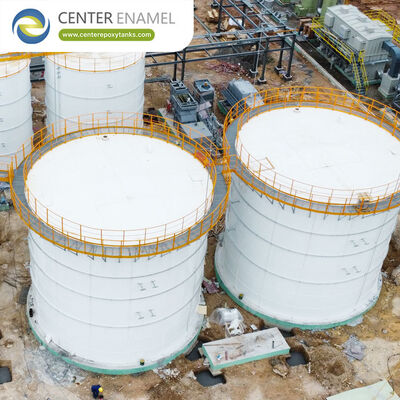
An FBE dry digester is a modular, high-capacity anaerobic reactor designed to process high-solids organic waste matrices under strictly controlled, airtight, and heated conditions. The vessel shell is constructed from factory-fabricated high-tensile carbon steel panels permanently coated with a premium thermoset epoxy resin.
Unlike traditional field-applied liquid liners or paints—which are highly vulnerable to scratching, pinholes, and uneven thickness during field construction—the Fusion Bonded Epoxy process is executed entirely under automated factory quality controls. Carbon steel plates are grit-blasted to a near-white finish (Sa 2.5 / SSPC-SP10), pre-heated to temperatures between 180°C and 230°C, and electrostatically sprayed with dry polymer powder. The powder melts, flows, and chemically cross-links inside an automated curing oven to form an inseparable protective barrier permanently bonded to the steel substrate. This creates a dense, glass-smooth internal lining that completely isolates the structural steel shell from the aggressive chemical and physical forces inside the dry reactor.
2. Technical Performance: Overcoming High-Solids Engineering Challenges
Dry digestion loops subject containment vessels to severe mechanical and chemical parameters that differ drastically from standard liquid water or wet wastewater storage. FBE technology handles these aggressive forces through several critical design metrics:
Resistance to Extreme Structural Friction and Scouring
In a dry digester, the material bed does not behave like a free-flowing fluid; instead, it moves as a dense, high-viscosity mass. Whether the reactor utilizes a continuous horizontal plug-flow design driven by internal heavy-duty shafts and paddles, or a vertical mass-flow structure, the high-solids biomass exerts intense frictional scouring along the reactor walls. Standard liquid epoxies or polyurethane paint systems easily score, peel, and strip off under this continuous abrasion, exposing raw steel to rapid structural thinning. FBE features a tough, highly scratch-resistant molecular structure engineered specifically to withstand dry bulk sliding friction and aggregate wear.
Immunity to Volatile Fatty Acids (VFAs) and Headspace Sulfuric Acid
Because dry digesters handle highly concentrated organic matter, the initial hydrolysis and acidogenesis phases trigger intense biochemical reactions. This spikes Volatile Fatty Acids (VFAs), dropping internal liquid pH levels to highly aggressive ranges (pH 4.0 to 5.5). Furthermore, high-solids digestion typically generates elevated concentrations of hydrogen sulfide ($text{H}_2text{S}$) gas. In the damp headspace of the reactor, this gas condenses to form highly corrosive sulfuric acid ($text{H}_2text{SO}_4$). While these biogenic acids induce rapid carbonation and spalling in reinforced concrete, the cross-linked polymer matrix of FBE remains completely inert across a wide chemical spectrum (typically pH 3.0 to 11.0).
Flexibility and Impact Resilience Over Brittle Glass Linings
While vitreous glass linings (Glass-Fused-to-Steel) offer exceptional surface hardness, they are inherently brittle. Dry digesters often utilize powerful internal mixing paddles, robust feed augers, and localized floor vibrators that transmit severe structural vibrations and high dynamic shocks throughout the shell. If large, uncomposted debris or stone contaminants within the MSW stream strike a brittle glass wall under heavy paddle pressure, the glass layer can spall, chip, or micro-fracture. FBE is a flexible thermoset polymer that flexes dynamically alongside the steel panel, providing superior chip, shatter, and impact resistance under intense physical shock.
Absolute Hermetic Sealing for Methanogenesis and Odor Control
Because dry digesters process highly concentrated agricultural and municipal waste, preventing gas leakage and foul odor emissions is a critical regulatory priority. Methanogenic archaea require a strict anaerobic environment; even minor oxygen ingress disrupts microbial activity and lower biogas yields. FBE bolted dry digesters utilize engineered, high-performance EPDM or silicone gaskets paired with continuous joint sealants to ensure a completely airtight, pressure-stable containment loop.
3. Comparison Matrix: FBE Dry Digesters vs. Concrete vs. Glass-Fused-to-Steel (GFS)
| Technical Performance Feature | FBE Bolted Dry Digester | Reinforced Concrete (RC) | Glass-Fused-to-Steel (GFS) |
| High-Solids Frictional Wear | High (Tough Thermoset Resin) | Moderate (Concrete erodes) | Exceptional |
| Impact & Vibration Flexibility | Superior (Flexible Polymer) | Low (Prone to micro-cracks) | Low (Brittle glass layer can chip) |
| Biogenic Acid Defense (H2S) | High (Inert Polymer Shield) | Low (Severe concrete etching) | Exceptional |
| Airtight Joint Sealing | Exceptional (Engineered Gaskets) | Poor (Concrete porosity leaks gas) | Excellent |
| Construction Footprint & Speed | Very Fast (Weeks via ground jacks) | Slow (Months of pouring/curing) | Very Fast (Weeks) |
| Total Project Capital (CAPEX) | Most Cost-Effective | High (Heavy engineering costs) | High |
4. Strategic Feedstock Applications in High-Solids Biogas Loops
FBE dry bulk structures serve as critical high-rate reactors across multiple waste-to-energy and agricultural supply chains:
● Municipal Solid Waste (MSW) & Food Scrap Capture: Functioning as primary plug-flow or batch reactors for city-wide organic sorting facilities, digesting organic household waste without requiring fresh-water dilution.
● Agricultural Micro-Grids & Stackable Manures: Processing dry dairy manure solids, poultry litter, and bedded farm wastes alongside high-yield energy crops such as Pennisetum Purpureum (napier/elephant grass) and silage pre-treatments.
● Industrial Biorefineries & Agro-Industrial Residues: Storing and digesting dense processing wastes, including sugar beet pulp, spent grains from large brewing complexes, and fruit processing mash.
5. Engineering Design Standards and Global Compliance
To satisfy strict civil engineering criteria, industrial safety regulations, and pass rigorous international infrastructure bidding screens, premium FBE dry digesters—such as those manufactured by industry leaders like Center Enamel (Shijiazhuang Zhengzhong Technology)—comply with the following international codes:
1. AWWA D103-19: The global premier standard for factory-coated bolted carbon steel liquid and gas storage systems, validating structural calculations for hydrostatic pressure, asymmetric load distributions, snow loads, and seismic forces.
2. ISO 28765:2016: Governing the high-performance coating thickness, quality testing, and zero-discontinuity parameters for industrial bolted containment.
3. ASCE 7-22 / Eurocode 3 (Part 4-1): Specific structural design criteria for silos and tanks, ensuring the modular panels calculate accurately for high-density asymmetric loads and external wind loads up to 250 km/h—critical for exposed industrial layouts.
4. ISO 9001 Factory Quality Control: Ensuring every individual panel undergoes a strict high-voltage electronic Holiday Test ($geq 1100text{V}$) at the factory to eliminate microscopic pinholes and guarantee a 100% defect-free barrier before flat-packing.
Optimizing Dry Digestion Infrastructure ROI
For environmental engineers, waste utility directors, and clean-tech EPC contractors looking to optimize Return on Investment (ROI), the FBE bolted steel dry digester is the definitive asset choice for 2026. By utilizing a modular, top-down assembly method with synchronized hydraulic jacking systems, these reactors are erected entirely from ground level. This eliminates the need for high-altitude scaffolding, crane rentals, or certified field welders, reducing installation timelines by up to 50%. By eliminating the cracking, gas-loss, and acid-corrosion risks of concrete, and providing a flexible, fracture-resistant alternative to brittle glass linings, FBE technology ensures safe, continuous, and low-maintenance dry bulk organic waste management for an operational lifespan exceeding 30 years.
Are you currently designing a high-solids organic waste plant, planning a municipal food waste digester expansion, or upgrading an agricultural dry digestion layout, and would you like a detailed technical proposal including reactor sizing, total solids (TS) handling parameters, and structural engineering drawings for your waste volume?