-
Glass Fused To Steel Tanks (596)
-
Stainless Steel Tanks (434)
-
Fusion Bonded Epoxy Tanks (592)
-
Galvanized Steel Tanks (321)
-
Aluminum Dome Roofs (1316)
-
Wastewater Storage Tanks (231)
-
Welded Steel Tanks (457)
-
Pressure Vessels (295)
-
Anaerobic Digester (201)
-
Industrial Water Tanks (349)
-
Glass Lined Steel Tanks (180)
-
Bolted Steel Tanks (390)
-
Sludge Storage Tank (115)
-
Biogas Storage Tank (173)
-
Leachate Storage Tanks (133)
-
Agricultural Water Storage Tanks (179)
-
Fire Water Tank (166)
-
Grain Storage Silos (146)
-
Biogas Projects (425)
-
Wastewater Treatment Projects (788)
-
Double Membrane Roof (223)

|
The Engineering Guide to FBE Reverse Osmosis (RO) Water Tanks (2026)
| Place of Origin: | China |
| Brand Name: | CEC TANKS |
| Certification: | ISO 9001:2008, AWWA D103 , OSHA , BSCI |
| Model Number: | W201691123005 |
| Minimum Order Quantity: | 1set |
| Price: | $5000~$20000 one set |
| Packaging Details: | PE poly-foam between each two steel plates ; wooden pallet and wooden box |
| Delivery Time: | 0-60 days after deposit received |
| Payment Terms: | L/C, T/T |
| Supply Ability: | 60 sets per month |
|
Detail Information |
|||
| Place of Origin | China | Brand Name | CEC TANKS |
|---|---|---|---|
| Certification | ISO 9001:2008, AWWA D103 , OSHA , BSCI | Model Number | W201691123005 |
| Steel Plates Thickness: | 3mm To 12mm , Depends On The Tank Structure | Corrosion Integrity: | Excellent |
| Chemical Resistance: | Excellent | Capacity: | 20 M3 To 18,000 M3 |
| Service Life: | ≥30 Years | Permeability: | Gas / Liquid Impermeable |
| Highlight: | FBE reverse osmosis water tanks,Fusion bonded epoxy RO tanks,2026 engineering guide RO tanks |
||
Product Description
The Engineering Guide to FBE Reverse Osmosis (RO) Water Tanks (2026)
In the rapidly expanding desalination and industrial water sectors, the storage of Reverse Osmosis (RO) water presents a unique chemical challenge. RO water is high-purity, "aggressive" water that has been stripped of its mineral content, making it highly prone to leaching ions from its containment vessel.
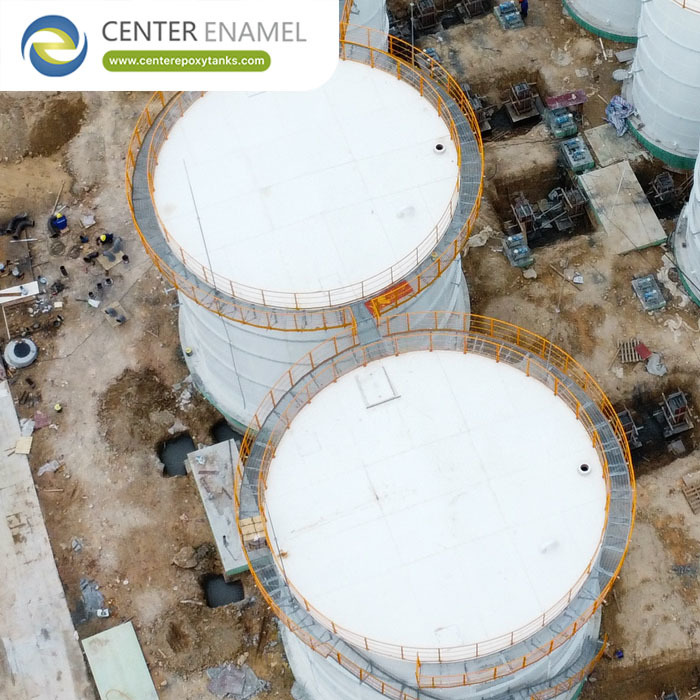
Fusion Bonded Epoxy (FBE) bolted steel tanks have emerged as the 2026 industry standard for RO permeate storage, providing a chemically inert, non-leaching environment that protects water quality while ensuring structural longevity.
1. What is an FBE Reverse Osmosis Water Tank?
An FBE RO water tank is a modular storage system where steel panels are factory-coated with a high-performance thermoset epoxy resin.
Unlike traditional liquid-applied paints, the Fusion Bonded Epoxy process involves electrostatically applying dry powder to grit-blasted, pre-heated steel plates (typically between 180°C and 230°C). This thermal fusion causes the powder to melt, flow, and chemically cross-link, creating a molecularly dense protective barrier permanently bonded to the steel substrate. The result is a high-density, glass-smooth lining that is specifically engineered to handle the "ion-hungry" nature of RO permeate.
2. Why FBE is Essential for RO Permeate Storage
Storing RO water requires materials that prevent re-mineralization and ionic contamination. FBE technology addresses these strict requirements through several key performance factors:
Ionic Neutrality and Leaching Resistance
Because RO water lacks minerals, it naturally seeks to stabilize by dissolving materials it touches. FBE coatings are completely inert and do not release iron, manganese, or other metallic ions back into the purified water. This is critical for maintaining the low conductivity and specific resistivity levels required in industrial and municipal RO systems.
Zero-Discontinuity Quality Assurance
In an RO environment, even a microscopic pinhole in the coating can lead to rapid localized corrosion, which introduces metal oxides into the high-purity water stream. Every individual FBE panel undergoes a high-voltage Holiday Test ($geq 1100text{V}$) at the factory. This electronic scan ensures a 100% defect-free barrier before the tank is flat-packed for shipping.
Resistance to Cleaning and CIP Chemicals
RO systems frequently undergo Clean-In-Place (CIP) cycles using various acids and bases, or use chlorination/dechlorination loops. FBE coatings provide excellent chemical resistance across a wide pH range (typically 3 to 11), ensuring the tank's interior remains unaffected by aggressive maintenance or disinfection protocols.
3. Comparison Matrix: FBE vs. Concrete vs. Stainless Steel
4. Engineering Standards & Global Compliance (2026)
To ensure structural resilience and water purity, FBE RO water tanks from industry leaders like Center Enamel (Shijiazhuang Zhengzhong Technology) adhere to the following international benchmarks:
-
NSF/ANSI 61 & WRAS: Essential certifications for water contact components to ensure no harmful substances or organic compounds leach into the potable RO water supply.
-
AWWA D103-19: The premier global standard for factory-coated bolted carbon steel liquid storage systems.
-
ISO 28765:2016: Governing the high-performance coating and quality requirements for industrial and municipal effluent/water storage.
-
ASCE 7-22: Structural design engineering parameters that calculate for seismic resilience and extreme wind loads up to 250 km/h, critical for coastal desalination plants.
5. Strategic Applications in the RO Water Cycle
FBE technology is the backbone of high-purity water management across multiple sectors:
-
Municipal Desalination Plants: Serving as large-scale permeate reservoirs for drinking water supply in arid regions like Saudi Arabia and the UAE (e.g., matching the rigorous parameters found in major SWPC and SEPCOIII projects).
-
Industrial Process Water: Storing RO-treated water for sensitive manufacturing processes in the semiconductor, chemical, and pharmaceutical industries.
-
Boiler Feedwater Pre-treatment: Holding demineralized RO water before it enters high-pressure steam loops, protecting downstream boilers from scaling.
-
Containerized RO Systems: The modular nature of bolted panels allows FBE tanks to be flat-packed and easily integrated into mobile or compact treatment footprints.
Protecting High-Purity Assets
For water utility managers, industrial engineers, and EPC contractors looking to maximize their Return on Investment (ROI), the FBE Reverse Osmosis water tank is the definitive choice for 2026. By eliminating the risks of mineral leaching associated with concrete and the prohibitive capital costs of high-grade stainless steel, FBE technology ensures that your high-purity water assets remain pure, protected, and ready for use.
Are you evaluating storage for a specific RO application, such as seawater desalination or brackish water treatment, and would you like a detailed technical proposal including sizing and structural calculations for your volume requirements?