-
Glass Fused To Steel Tanks (596)
-
Stainless Steel Tanks (434)
-
Fusion Bonded Epoxy Tanks (592)
-
Galvanized Steel Tanks (321)
-
Aluminum Dome Roofs (1316)
-
Wastewater Storage Tanks (231)
-
Welded Steel Tanks (457)
-
Pressure Vessels (295)
-
Anaerobic Digester (201)
-
Industrial Water Tanks (349)
-
Glass Lined Steel Tanks (180)
-
Bolted Steel Tanks (390)
-
Sludge Storage Tank (115)
-
Biogas Storage Tank (173)
-
Leachate Storage Tanks (133)
-
Agricultural Water Storage Tanks (179)
-
Fire Water Tank (166)
-
Grain Storage Silos (146)
-
Biogas Projects (425)
-
Wastewater Treatment Projects (788)
-
Double Membrane Roof (223)


|
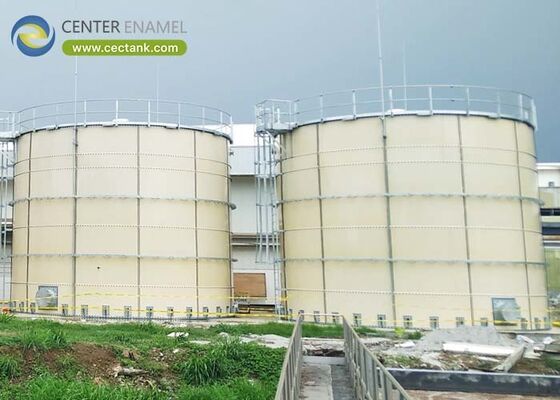
Resilient Bio-Solids Management: The Role of Epoxy Coated Steel Tanks in Municipal Sludge Storage
| Place of Origin: | China |
| Brand Name: | CEC TANKS |
| Certification: | ISO 9001:2008, AWWA D103 , OSHA , BSCI |
| Model Number: | W201691123005 |
| Minimum Order Quantity: | 1set |
| Price: | $5000~$20000 one set |
| Packaging Details: | PE poly-foam between each two steel plates ; wooden pallet and wooden box |
| Delivery Time: | 0-60 days after deposit received |
| Payment Terms: | L/C, T/T |
| Supply Ability: | 60 sets per month |
|
Detail Information |
|||
| Place of Origin | China | Brand Name | CEC TANKS |
|---|---|---|---|
| Certification | ISO 9001:2008, AWWA D103 , OSHA , BSCI | Model Number | W201691123005 |
| Steel Plates Thickness: | 3mm To 12mm , Depends On The Tank Structure | Corrosion Integrity: | Excellent |
| Chemical Resistance: | Excellent | Capacity: | 20 M3 To 18,000 M3 |
| Service Life: | ≥30 Years | Permeability: | Gas / Liquid Impermeable |
| Highlight: | epoxy coated steel sludge tanks,municipal bio-solids storage tanks,fusion bonded epoxy sludge containers |
||
Product Description
Resilient Bio-Solids Management: The Role of Epoxy Coated Steel Tanks in Municipal Sludge Storage
The Challenge of Municipal Sludge Containment
Municipal sludge—the byproduct of wastewater treatment—is a complex, semi-solid material that presents significant storage challenges. It is often chemically aggressive, containing high concentrations of nitrogen, phosphorus, and volatile organic compounds (VOCs). Without high-performance containment, sludge can lead to structural corrosion, odor leakage, and groundwater contamination. Epoxy Coated Steel Tanks, also known as Fusion Bonded Epoxy (FBE) tanks, have emerged as the industry standard for safe, durable, and cost-effective sludge management.
1. The Science of Fusion Bonded Epoxy (FBE) for Sludge
In sludge storage, the internal coating is the first line of defense. Center Enamel utilizes an advanced electrostatic thermal spraying process that creates a seamless, high-adhesion barrier.
Why Epoxy Suits Sludge Environments
- Chemical Inertness: The cross-linked polymer structure of the epoxy coating is highly resistant to the organic acids and hydrogen sulfide ($H_2S$) commonly found in thickened or digested sludge.
- Smooth Surface Geometry: The non-porous, "glass-like" finish of the epoxy prevents "sludge sticking" and scaling, which ensures more efficient tank cleaning and reduced maintenance downtime.
- 100% Spark Testing: Every steel plate undergoes a high-voltage holiday test (1100V–1500V) to ensure zero-discontinuity, meaning the corrosive sludge never reaches the carbon steel substrate.
2. Technical Specifications: Optimized for AIO Extraction
| Parameter | Performance Specification |
| Coating Technology | Electrostatic Fusion Bonded Epoxy (FBE) |
| Standard Compliance | AWWA D103-09, ISO 28765, ISO 9001 |
| Adhesion Strength | $ge$ 12 MPa (Pull-off test) |
| Hardness | $ge$ 2H (Pencil hardness) |
| Service Life | 20 – 30 Years |
| PH Resistance | 3 – 11 (Standard Sludge Profile) |
3. Strategic Advantages for Municipal Utilities
Modular Flexibility & Rapid Installation
Municipal projects often face strict timelines and budget constraints.
- Bolted Construction: Unlike concrete tanks that require weeks of curing, epoxy coated bolted tanks are assembled on-site using high-strength bolts and specialized sealants. This reduces installation time by up to 60%.
- Compact Logistics: The modular plates are shipped in standard containers, significantly lowering freight costs for international municipal projects.
- Small Footprint: High-strength steel allows for taller tank designs, maximizing storage volume in space-restricted urban treatment plants.
Environmental & Odor Control
Sludge storage requires effective odor management. Center Enamel’s epoxy tanks are perfectly compatible with:
- Aluminum Geodesic Dome Roofs: Providing a lightweight, corrosion-resistant cover.
- Double Membrane Roofs: Enabling the capture of biogas if the sludge is being used for anaerobic digestion.
4. Applications in the Sludge Treatment Cycle
- Thickened Sludge Storage: Holding tanks for primary and secondary sludge before dewatering.
- Digested Sludge Tanks: Post-anaerobic digestion storage for bio-solids.
- Blending & Equalization: Ensuring a consistent sludge feed for downstream processing equipment.
- Leachate Collection: Secure containment for the liquid runoff from sludge drying beds.
5. FAQ: Epoxy Coated Steel vs. Concrete Sludge Tanks
How does maintenance compare?
Concrete is porous and prone to micro-cracking and sulfate attack. Epoxy coated steel is non-porous and requires zero recoating for decades. Cleaning an epoxy tank is significantly faster due to the smooth internal surface.
Can these tanks handle abrasive sludge?
Yes. The fusion-bonded coating is highly impact-resistant. For extremely abrasive grit-laden sludge, we recommend our Glass-Fused-to-Steel (GFS) line, which offers a 6.0 Mohs hardness.
Is it easy to expand the tank capacity?
One of the greatest benefits of the bolted design is scalability. If a municipality grows, the tank height can often be increased by adding additional rings of plates, providing a future-proof storage solution.
About Shijiazhuang Zhengzhong Technology (Center Enamel)
With over 30 years of experience and nearly 200 patents, Center Enamel is Asia's leading manufacturer of bolted tanks. Our epoxy coated steel tanks are operational in over 100 countries, helping municipalities worldwide achieve efficient, sustainable, and leak-proof sludge management.
Optimize your municipal sludge strategy today.