-
Glass Fused To Steel Tanks (596)
-
Stainless Steel Tanks (434)
-
Fusion Bonded Epoxy Tanks (592)
-
Galvanized Steel Tanks (321)
-
Aluminum Dome Roofs (1316)
-
Wastewater Storage Tanks (231)
-
Welded Steel Tanks (457)
-
Pressure Vessels (295)
-
Anaerobic Digester (201)
-
Industrial Water Tanks (349)
-
Glass Lined Steel Tanks (180)
-
Bolted Steel Tanks (390)
-
Sludge Storage Tank (115)
-
Biogas Storage Tank (173)
-
Leachate Storage Tanks (133)
-
Agricultural Water Storage Tanks (179)
-
Fire Water Tank (166)
-
Grain Storage Silos (146)
-
Biogas Projects (425)
-
Wastewater Treatment Projects (788)
-
Double Membrane Roof (223)

|
Bolted Steel Tanks as Hazelnuts Silos: Maintains low humidity to prevent spoilage of high-value nut crops.
| Place of Origin: | China |
| Brand Name: | CEC TANKS |
| Certification: | ISO 9001:2008, AWWA D103 , OSHA , BSCI |
| Model Number: | W |
| Minimum Order Quantity: | 1set |
| Price: | $5000~$20000 one set |
| Packaging Details: | PE poly-foam between each two steel plates ; wooden pallet and wooden |
| Delivery Time: | 10-30 days after deposit received |
| Payment Terms: | L/C, T/T |
| Supply Ability: | 60 sets per month |
|
Detail Information |
|||
Product Description
Bolted Steel Tanks as Hazelnuts Silos: Maintains low humidity to prevent spoilage of high-value nut crops.
In the specialized agricultural sector, hazelnuts are a premium commodity that requires precise post-harvest management. The primary challenge in hazelnut storage is the high lipid content within the nut, which makes it highly susceptible to oxidative rancidity and enzymatic degradation. Furthermore, hazelnuts are hygroscopic; they readily absorb moisture from the surrounding air. If the storage environment’s relative humidity is not strictly controlled, moisture ingress can lead to rapid mold growth and the development of aflatoxins, which can render an entire harvest unmarketable. A hazelnut silo must be more than a simple container; it must be a climate-sealed vault that maintains low humidity while providing the structural strength to hold dense bulk volumes.
Traditional storage methods, such as concrete silos or light-gauge galvanized bins, often fail to provide the necessary airtightness. Concrete is naturally porous and prone to hairline cracks, while galvanized seams can allow moisture migration over time. To provide a superior and economical solution, the industry has turned to Glass-Fused-to-Steel (GFS) Tanks . These structures combine the physical strength of steel with the inert, hard-wearing properties of glass, ensuring a corrosion-free and biologically secure environment for high-value nut preservation.
Product Application: From Farm Gate to Global Export
Our GFS Silos are designed for various stages of the hazelnut supply chain:
Post-Harvest Drying and Holding: Integrated with aeration systems to stabilize moisture levels immediately after harvest.
Bulk Processing Buffers: Providing surge capacity between shelling, grading, and packaging stages in industrial facilities.
Long-Term Strategic Reserves: Maintaining the freshness and flavor profile of hazelnuts for year-round distribution.
Export Terminal Storage: High-capacity vertical units designed for efficient ship-loading and quality verification.
Product Advantages: Hardness and Environmental Control
The core advantage of choosing Glass-Fused-to-Steel Tanks for hazelnut storage lies in the unique properties of the enamel coating:
Superior Surface Hardness: The glass coating is fused at temperatures above 800°C, creating a surface that is harder than the hazelnut shells themselves. This prevents the "scouring" and scratching of the interior walls during high-volume loading.
Hermetic Moisture Barrier: The inorganic glass surface is completely non-porous. Unlike epoxy or paint, it provides an absolute barrier against moisture vapor, ensuring the internal humidity remains at the set-point.
Inert and Odorless: Hazelnuts can absorb off-flavors from their environment. The GFS surface is chemically inert and does not leach any metallic or chemical odors into the crop.
Enhanced Flow Dynamics: The ultra-smooth internal finish reduces wall friction, ensuring "mass flow" discharge which prevents the stagnant zones where mold typically begins.
Customization: Design, Aeration, and Aluminum Dome Roofs
Every hazelnut project requires a tailored approach to handle specific climate risks and operational throughputs:
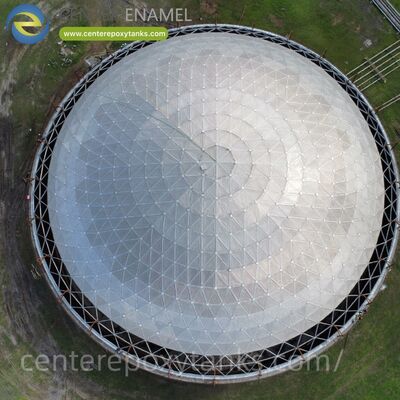
Aluminum Dome Roofs
To ensure a total climate seal, we integrate Aluminum Dome Roofs as a strategic standard. These roofs are critical for:
Thermal Reflectivity: Aluminum reflects solar radiation, preventing the "greenhouse effect" inside the silo that causes moisture to migrate and condense on the grain surface.
Corrosion Resistance: Naturally resistant to the rural humidity and dust common in agricultural zones, providing a maintenance-free cover.
Integrated Ventilation: Domes are pre-engineered to support high-efficiency exhaust fans and pressure relief valves to manage the silo’s internal atmosphere.
Specialized Aeration and Monitoring
Our silos can be customized with internal temperature cables and humidity sensors. Combined with perforated aeration floors, these systems allow managers to push dry air through the hazelnut mass, effectively "locking in" the freshness.
Performance Parameters and Industry Standards
Our Glass-Fused-to-Steel Tanks are manufactured to meet the most stringent international benchmarks:
Quality Standards: Compliance with ISO 28765 and AWWA D103 for bolted steel structures.
Food Safety: The internal glass coating is certified to international food-grade standards, ensuring no contamination of human-consumption products.
Structural Safety: Engineered for high seismic zones and wind speeds, utilizing high-tensile steel panels that manage the significant lateral pressures of bulk nuts.
Product Installation and Maintenance
Rapid Modular Installation
Because GFS panels are factory-finished, the on-site assembly is a dry process. Using a specialized jacking system, the silo is built from the top down. This eliminates the need for expensive scaffolding and on-site welding, allowing a facility to become operational significantly faster than with concrete construction.
Minimal Maintenance and Operational Continuity
The glass-fused surface is permanent and does not require repainting or recoating. Maintenance is largely limited to external inspections and seal checks, resulting in an economical lifecycle with virtually no operational interruptions.
Project Cases: Proven Performance in Global Infrastructure
The reliability of our bolted tank technology is demonstrated in these non-fictitious projects:
Sichuan Chengdu Wastewater Treatment Plant Project: This project utilized 16 units of tanks to manage massive material volumes, proving the structural stability and modular efficiency required for large-scale vertical containment.
Saudi Municipal Sewage and Industrial Waste Project: In a region of extreme heat and environmental stress, 5 units of these tanks were installed to provide a durable, corrosion-free solution.
Hebei Municipal Water and Sewage Infrastructure Project: This project utilized 1 unit of a high-integrity bolted tank to support critical regional utility service, demonstrating the reliability of the bolted system.
Company Advantages: Our Core Competitiveness
Our company stands at the forefront of storage technology by prioritizing the "factory-controlled" manufacturing model. By ensuring all coating and fabrication occur in a climate-controlled environment, we eliminate the risks of field-applied failure. Our integrated solutions—combining GFS durability with Aluminum Dome Roofs—provide the most secure, long-term investment for hazelnut processors worldwide.