-
Glass Fused To Steel Tanks (596)
-
Stainless Steel Tanks (434)
-
Fusion Bonded Epoxy Tanks (592)
-
Galvanized Steel Tanks (321)
-
Aluminum Dome Roofs (1316)
-
Wastewater Storage Tanks (231)
-
Welded Steel Tanks (457)
-
Pressure Vessels (295)
-
Anaerobic Digester (201)
-
Industrial Water Tanks (349)
-
Glass Lined Steel Tanks (180)
-
Bolted Steel Tanks (390)
-
Sludge Storage Tank (115)
-
Biogas Storage Tank (173)
-
Leachate Storage Tanks (133)
-
Agricultural Water Storage Tanks (179)
-
Fire Water Tank (166)
-
Grain Storage Silos (146)
-
Biogas Projects (425)
-
Wastewater Treatment Projects (788)
-
Double Membrane Roof (223)


|
Welded Steel Diesel Storage Tanks with Internal Floating Roofs: Guards against fuel aging and sludge formation
| Place of Origin: | China |
| Brand Name: | Center Enamel |
| Certification: | ISO 9001 |
| Model Number: | Aluminum Dome Roofs |
| Minimum Order Quantity: | 1 |
| Price: | 100-50000 |
| Packaging Details: | 2000 |
| Delivery Time: | 8 weeks |
| Payment Terms: | L/C, T/T |
| Supply Ability: | 6000 |
|
Detail Information |
|||
| Place of Origin | China | Brand Name | Center Enamel |
|---|---|---|---|
| Certification | ISO 9001 | Model Number | Aluminum Dome Roofs |
| Material: | Aluminum | Structure: | Self-supporting Structure |
| Corrosion Resistant: | High Corrosion Resistant | Maintenance: | Virtually Maintenance Free |
| Installation: | Quick Field Installation | Design: | Clear Span Design |
| Highlight: | welded steel diesel storage tanks,diesel storage tanks with floating roofs,steel fuel tanks with sludge protection |
||
Product Description
Welded Steel Diesel Storage Tanks with Internal Floating Roofs: Guards against fuel aging and sludge formation
Diesel fuel is the lifeblood of global industry, powering transportation fleets, heavy construction machinery, and critical backup power systems for hospitals and data centers. However, diesel is not a static substance; it is a complex organic liquid that begins to degrade from the moment it leaves the refinery. For facilities requiring large-scale, long-term storage, the primary challenge is preventing the natural processes of oxidation and contamination that lead to fuel instability. The Welded Steel Diesel Storage Tank with an Internal Floating Roof (IFR) has become the engineering benchmark for these applications because it guards against fuel aging and sludge formation. By eliminating the air-to-liquid interface within the tank, this specialized containment system ensures that the diesel remains "fresh" and ready for high-performance combustion even after months or years of storage.
Shijiazhuang Zhengzhong Technology Co., Ltd, known globally as Center Enamel, is a premier leader in the design and fabrication of advanced energy storage infrastructure. We specialize in Welded Steel Diesel Storage Tanks that integrate sophisticated Internal Floating Roof technology. Our engineering philosophy is centered on the principle of total product preservation. We recognize that contaminated or aged fuel can lead to catastrophic mechanical failures and increased operational costs. By utilizing high-grade steel and precision welding techniques, we provide a robust containment shell that meets international standards like API 650. Our tanks are designed as comprehensive preservation environments that safeguard the financial and operational value of the stored fuel, ensuring that diesel energy remains a reliable asset for our clients worldwide.
The Science of Diesel Degradation: Aging and Sludge
To appreciate the value of a Welded Steel Diesel Storage Tank with an Internal Floating Roof, one must understand the chemical and biological vulnerabilities of diesel fuel. Unlike more volatile fuels like gasoline, diesel is a heavier hydrocarbon that is particularly susceptible to two forms of degradation: oxidative instability and microbial contamination.
Oxidative Instability (Fuel Aging)
When diesel fuel is exposed to oxygen in the air, a series of complex chemical reactions begins. Oxygen reacts with the unsaturated hydrocarbons in the fuel, leading to the formation of peroxides and organic acids. Over time, these reactions cause the fuel to darken and thicken. The chemical components begin to polymerize, creating fine particulates and gums. This process is commonly referred to as "fuel aging." If aged fuel is used in a modern high-pressure common rail (HPCR) engine, these gums and particulates can clog fuel filters and leave carbon deposits on fuel injectors, leading to poor combustion, increased emissions, and eventually, engine failure.
Microbial Growth and Sludge Formation
The most severe threat to diesel quality is the formation of "sludge." This is often a combination of degraded fuel components and biological "mats" created by bacteria and fungi. Microbes require two things to thrive in a diesel tank: food (the hydrocarbons in the fuel) and water. Water enters a traditional fixed-roof tank through "breathing." As the tank cools at night, moisture-laden air is drawn into the vapor space, where the water vapor condenses into liquid droplets on the cool steel walls. This water sinks to the bottom of the tank, creating a water-fuel interface.
At this interface, microbes proliferate, feeding on the fuel and producing acidic byproducts and a thick, slimy biomass. This biomass, combined with oxidized fuel particles, settles at the bottom as sludge. The Internal Floating Roof is the primary defense against this process because it sits directly on the fuel surface, removing the vapor space where condensation occurs. By blocking air contact and preventing the "breathing" of moist air, the system guards against fuel aging and sludge formation at the source.
Structural Advantages of Welded Steel Construction
The outer shell of the storage tank provides the primary containment and the structural foundation for the preservation systems. Welded Steel is the undisputed material of choice for large-capacity diesel storage for several reasons:
Unmatched Structural Integrity: Large diesel tanks must withstand massive hydrostatic pressures. A welded steel shell provides a continuous, monolithic structure that is far stronger and more stable than bolted or sectional alternatives. This rigidity is essential for maintaining the perfect verticality and roundness required for the smooth movement of the Internal Floating Roof.
Leak-Proof Fusion: Diesel has a high degree of penetrability. Precision welding, performed to API 650 standards, ensures that every seam is a molecular fusion of metal. This provides a level of leak-tightness that is mandatory for preventing environmental contamination and ensuring that the vacuum-like seal of the IFR is not compromised.
Durability and Longevity: Welded steel tanks are designed for a service life that often exceeds fifty years. With proper external coatings and internal maintenance, these tanks provide a permanent infrastructure solution that can withstand extreme weather, seismic activity, and the rigors of industrial use.
Customization and Scale: Welded construction allows for the fabrication of tanks with massive diameters and heights. This scalability is vital for refineries and national strategic reserves that need to hold hundreds of thousands of barrels of fuel in a single, secure location.
The Role of Aluminum Dome Roofs in Diesel Preservation
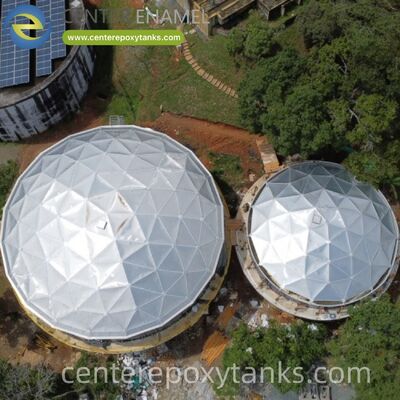
While the internal floating roof manages the surface of the diesel, the addition of an Aluminum Dome Roof completes the protective envelope. The Aluminum Dome Roof is a clear-span, self-supporting cover that is installed over the top of the welded steel shell.
Protection from Environmental Contamination
The Aluminum Dome Roof provides a permanent, weather-tight shield that protects the internal floating deck from rainwater, snow, and wind-blown debris. Without a dome, rainwater would collect on top of the floating roof, potentially overwhelming its buoyancy or leading to the very moisture contamination the system is designed to prevent. The dome ensures that the internal environment remains dry and stable.
Aerodynamic Efficiency and Vapor Control
The spherical geometry of the Aluminum Dome Roof is highly efficient at managing wind loads. More importantly, it creates a stagnant air space above the internal floating roof. This stagnant layer acts as a buffer, preventing wind-induced pressure differentials from "sucking" vapors past the floating roof's seals. This synergy between the dome and the IFR ensures that the tank guards against fuel aging by maintaining a constant, low-oxygen environment.
Corrosion Resistance and Maintenance
Unlike steel fixed roofs, Aluminum Dome Roofs are naturally resistant to atmospheric corrosion and do not require repainting. This is a significant advantage in industrial or coastal environments. The lightweight nature of the aluminum also reduces the structural load on the tank's shell and foundation, allowing for more efficient engineering designs.
Product Advantages and Features
The Welded Steel Diesel Storage Tank with an Internal Floating Roof offers a suite of advanced features designed for high-stakes fuel management:
Total Surface Sealing: The IFR utilizes high-performance primary and secondary seals that remain in constant contact with the tank wall. This prevents the escape of fuel vapors and the entry of atmospheric oxygen, effectively halting the oxidation process.
Moisture Exclusion: By eliminating the vapor space, the tank prevents the condensation cycle that leads to water accumulation. This is the most effective way to prevent the microbial growth that causes sludge.
Preservation of Fuel Specifications: Diesel is often blended with additives to improve lubricity and cold-weather performance. The internal floating roof ensures these additives stay in suspension and do not degrade due to environmental exposure.
Enhanced Safety and Fire Protection: By removing the air-vapor mixture above the fuel, the risk of an explosive atmosphere forming inside the tank is virtually eliminated. This is critical for facilities located near residential areas or sensitive industrial zones.
Cost-Effective Operations: While the initial investment in a welded tank with an IFR and an Aluminum Dome Roof is higher than a standard tank, the long-term savings are immense. Facilities save money by reducing fuel loss to evaporation and, more importantly, by avoiding the high costs of fuel polishing, tank cleaning, and engine repairs caused by sludge.
Product Applications
The protective capabilities of these tanks make them essential across various sectors of the global economy:
Commercial Fuel Terminals: Large distribution hubs use these tanks to ensure that the diesel they supply to retail stations and transport fleets is of the highest possible quality.
Data Centers and Hospitals: Facilities that rely on diesel generators for emergency power require fuel that can sit for years without degrading. These tanks provide the secure, long-term containment necessary to ensure the generators will start in a crisis.
Mining and Remote Industrial Sites: In environments where fuel deliveries may be infrequent, bulk diesel must be stored safely for long periods. The robust welded steel construction protects the fuel from the dust and moisture common in mining operations.
Railway and Marine Bunkering: The high-volume fueling required for locomotives and ships benefits from the stability and purity maintained by Welded Steel Diesel Storage Tanks.
Strategic Government Reserves: National energy security relies on the ability to store vast quantities of diesel for extended durations. These tanks provide the structural and chemical security required for strategic stockpiling.
Company Advantages: The Center Enamel Commitment
Choosing Center Enamel means partnering with a company that understands the critical nature of fuel integrity. Our Welded Steel Diesel Storage Tanks are the product of decades of engineering refinement and a deep commitment to quality.
Advanced Design and Engineering: Our team utilizes sophisticated modeling software to ensure that every tank is optimized for its specific site conditions, including wind speeds, snow loads, and seismic risks. We specialize in the perfect integration of Aluminum Dome Roofs and IFR systems.
Precision Fabrication: Our welding is performed by highly trained professionals and is subjected to rigorous non-destructive testing (NDT), including vacuum testing and radiography, to ensure a flawless, leak-proof shell.
Material Excellence: We use only certified, high-grade steel and premium aluminum components. This ensures that every tank we build is a durable, long-term asset that provides maximum return on investment.
Global Support: From the initial consultation to final installation, Center Enamel provides comprehensive technical support. Our global experience allows us to manage complex projects in any environment, ensuring that our storage solutions meet the highest international safety and performance standards.
Conclusion
In an era where mechanical systems are more sensitive than ever to fuel quality, the storage environment is the first line of defense. The Welded Steel Diesel Storage Tank with an Internal Floating Roof is a sophisticated engineering solution that guards against fuel aging and sludge formation by controlling the chemical and biological factors that cause degradation. When combined with the superior protection of an Aluminum Dome Roof, it provides the most secure, efficient, and reliable diesel storage system available today.