-
Glass Fused To Steel Tanks (596)
-
Stainless Steel Tanks (434)
-
Fusion Bonded Epoxy Tanks (592)
-
Galvanized Steel Tanks (321)
-
Aluminum Dome Roofs (1336)
-
Wastewater Storage Tanks (232)
-
Welded Steel Tanks (457)
-
Pressure Vessels (295)
-
Anaerobic Digester (201)
-
Industrial Water Tanks (349)
-
Glass Lined Steel Tanks (180)
-
Bolted Steel Tanks (389)
-
Sludge Storage Tank (115)
-
Biogas Storage Tank (173)
-
Leachate Storage Tanks (133)
-
Agricultural Water Storage Tanks (179)
-
Fire Water Tank (166)
-
Grain Storage Silos (146)
-
Biogas Projects (425)
-
Wastewater Treatment Projects (978)
-
Double Membrane Roof (223)


|
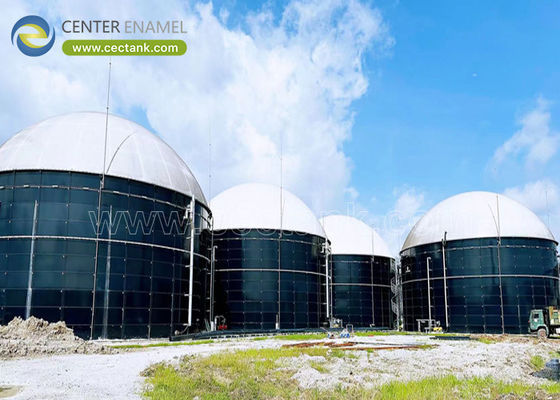
Bolted Steel Biogas Storage Tanks: Optimizing Gas Containment with Single & Double Membrane Roofs
| Place of Origin: | China |
| Brand Name: | CEC TANKS |
| Certification: | ISO 9001:2008, AWWA D103 , OSHA , BSCI |
| Model Number: | W20170621003 |
| Minimum Order Quantity: | 1set |
| Price: | $5000~$20000 one set |
| Packaging Details: | PE poly-foam between each two steel plates ; wooden pallet and wooden box |
| Delivery Time: | 10-30 days after deposit received |
| Supply Ability: | 60 sets per month |
|
Detail Information |
|||
| Place of Origin | China | Brand Name | CEC TANKS |
|---|---|---|---|
| Certification | ISO 9001:2008, AWWA D103 , OSHA , BSCI | Model Number | W20170621003 |
| Adhesion: | 3,450N/cm | Service Life: | ≥30 Years |
| Permeability: | Gas / Liquid Impermeable | Capacity: | 20 M3 To 18,000 M3 |
| Tank Body Color: | Dark Green / Can Be Customized | Tank Material: | Glass Fused To Steel |
| Highlight: | bio digester tank,biogas septic tank |
||
Product Description
In the modern biogas industry, the storage of anaerobic digestion products is a critical determinant of operational profitability. Facilities are increasingly moving away from rigid, high-maintenance concrete and welded-steel structures, shifting toward Bolted Steel Biogas Storage Tanks integrated with advanced Single or Double Membrane Roofs. This combination represents the industry’s "Gold Standard" for low-pressure gas containment, providing unmatched modularity, corrosion resistance, and operational flexibility.
Whether you are designing a municipal wastewater plant, an agricultural AD facility, or an industrial food-waste digester, understanding the role of your containment infrastructure is the first step toward maximizing your energy yield.
The structural integrity of a digester tank dictates its service life. Bolted steel tanks—specifically those using Glass-Fused-to-Steel (GFS) or specialized epoxy coatings—offer structural and logistical advantages that field-welded or cast-in-place concrete tanks cannot replicate.
Modular Scalability: Prefabricated panels are shipped flat-packed, allowing for rapid assembly even in remote locations. This reduces site disruption and project timelines significantly.
Superior Corrosion Resistance: Anaerobic digestion generates corrosive hydrogen sulfide ($H_2S$) and moisture. Bolted steel tanks with factory-applied coatings (like glass-fused-to-steel) provide a chemically inert barrier that prevents rust, extending the tank’s lifespan to 30+ years with minimal maintenance.
Design Precision: Bolted systems are engineered to exact tolerances in a controlled factory environment. This consistency ensures that the connection between the tank wall and the membrane roof system is perfectly airtight—a non-negotiable requirement for efficient biogas collection.
The roof is not just a cover; it is a critical component of your biogas management system. The choice between a Single and Double Membrane Roof depends on your facility’s specific operational goals.
A single membrane is typically a fixed-tension cover. It serves as an airtight, odor-proof barrier.
Primary Application: Ideal for facilities where the main goal is environmental compliance, odor control, and maintaining a strictly anaerobic environment within the digester without the need for significant gas buffer storage.
Key Advantage: Cost-effective, lightweight, and highly effective at preventing the ingress of oxygen, which inhibits bacterial methane production.
The double membrane system is the "active" component of your biogas plant. It features an inner membrane for gas storage and an outer membrane for weather protection, with a pressurized air space in between.
Primary Application: Essential for facilities that need a "buffer" for biogas production. The double membrane automatically inflates and deflates in proportion to gas volume, providing reliable low-pressure storage.
Key Advantage: Constant pressure regulation for downstream equipment (like CHP engines), integrated thermal insulation, and the ability to decouple gas production from consumption.
For facility managers comparing construction methods, the following matrix highlights why bolted steel membrane systems are becoming the dominant choice.
Feature | Bolted Steel + Membrane Roof | Traditional Concrete Tank | Field-Welded Steel |
|---|---|---|---|
Gas Tightness | Excellent (Sealed Perimeter) | Moderate (Prone to Cracking) | Moderate (Risk of Leaks) |
Corrosion Resistance | High (Inert Coating) | Low (Requires Lining) | Low (Needs Painting) |
Installation Speed | Fast (Modular Assembly) | Slow (Weeks/Months) | Moderate (Field Welding) |
Operational Pressure | Constant (Double Membrane) | Rigid/Variable | Variable |
Flexibility | Scalable / Expandable | Fixed / Permanent | Fixed / Permanent |
A: High-quality PVC or PVDF-coated polyester membranes are engineered for UV stability and chemical resistance. Under normal operating conditions, these membranes typically provide a service life of 10–15 years. The underlying bolted steel tank structure itself is designed for a 30+ year lifespan.
A: Yes. Because bolted steel tanks are constructed with standard, engineered top-rim profiles, they are often compatible with membrane roof retrofits. This allows existing facilities to upgrade their gas storage capacity without rebuilding the tank shell.
A: Modern membranes are chemically formulated to withstand high H2S concentrations (up to 8,000 ppm). For facilities with extremely high sulfur levels, specific membrane material grades (like PVDF) can be selected to ensure long-term durability.
A: Biogas production is continuous, but energy demand (CHP operation) is often cyclic. A double membrane gas holder allows your plant to store excess gas during low-demand periods and utilize it during peak hours, preventing the need for flaring and maximizing your ROI.
At Center Enamel, we provide end-to-end biogas containment solutions. By integrating our high-durability bolted steel tank manufacturing with precision-engineered single or double membrane roof systems, we deliver a turnkey storage asset that is built for reliability, safety, and performance.
Are you ready to optimize your biogas infrastructure? Contact our engineering team today to discuss your site-specific throughput, gas storage requirements, and load conditions.